multiplicação de monomios e polinomios

Read · 1 min

Quick Recap

Before we begin there's a couple things we need to recap.

First, is multiplying monomials. When we multiply two monomials together, we multiply their coefficients, and then their variables. (8x)(9x2)=8⋅9⋅x⋅x2=72⋅x1+2=72x3\begin{align} (8x)(9x^2)&=8\cdot9\cdot x\cdot x^2\\ &=72\cdot x^{1+2}\\ &=72x^3 \end{align} (3x)(4y)=3⋅4⋅x⋅y=12xy\begin{align} (3x)(4y)&=3\cdot4\cdot x\cdot y\\ &=12xy \end{align} (2a2b)(6a3c)=2⋅6⋅a2⋅a3⋅b⋅c=12⋅a2+3⋅b⋅c=12a5bc\begin{align} (2a^2b)(6a^3c)&=2\cdot6\cdot a^2\cdot a^3\cdot b\cdot c\\ &=12\cdot a^{2+3}\cdot b\cdot c\\ &=12a^5bc \end{align}

Second is the distributive property. When a term is multiplied outside parentheses, we multiply it to every term inside the parentheses. 3(x+4)=3⋅x+3⋅4=3x+12\begin{align} 3(x+4)&=3\cdot x+3\cdot 4\\ &=3x+12 \end{align}

Multiplying a Polynomial by a Monomial

Now on to our topic. Multiplying a polynomial by a monomial is just using the distributive property to turn the problem into a bunch of monomials being multiplied.

Suppose we multiply a monomial, xx, and a polynomial, x2+1x^2+1. x(x2+1)x(x^2+1) The monomial, xx, gets distributed and multiplied to each term in the polynomial. Thus, we get two sets of monomials being multiplied: x⋅x2x\cdot x^2 and x⋅1x\cdot 1. x(x2+1)=x⋅x2+x⋅1=x3+x\begin{align} x(x^2+1)&=x\cdot x^2+x\cdot 1\\ &=x^3+x \end{align}

When solving these kinds of problems, things can get jumbled and messy real fast. One simple thing to do is to put each distribution inside its own set of parentheses, so nothing gets mixed up. 2abc(3a2+4b2+5c2)=2abc⋅3a2+2abc⋅4b2+2abc⋅5c2=(2⋅3⋅a⋅a2⋅b⋅c)+(2⋅4⋅a⋅b⋅b2⋅c)+(2⋅5⋅a⋅b⋅c⋅c2)=6a3bc+8ab3c+10abc3\begin{align} &2abc(3a^2+4b^2+5c^2)\\ &=2abc\cdot 3a^2+2abc\cdot 4b^2+2abc\cdot 5c^2\\ &=(2\cdot3\cdot a\cdot a^2\cdot b\cdot c)+(2\cdot4\cdot a\cdot b\cdot b^2\cdot c)+(2\cdot5\cdot a\cdot b\cdot c\cdot c^2)\\ &=6a^3bc+8ab^3c+10abc^3 \end{align}

Interactive · 2 questions

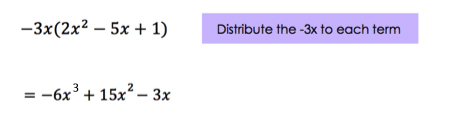
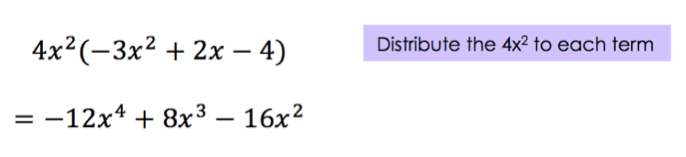
Multiplying polynomials by monomials requires that we exploit the distributive property.

Recall that, with the distributive property, we drag the term on the outside of the parentheses through each term inside in order to multiply them.

Let's look at an example:

3(2x^3 + 4x^2 - x + 1)

Image source: by Hannah Bonville

3(2x^3 + 4x^2 - x + 1) = 6x^3 + 12x^2 -3x -3

Image source: by Anusha Rahman

Use the distributive property to simplify this expression: −2(x2+3x−9)-2\left(x^2+3x-9\right) What is the result?

Choose one answer

Video

(Video) Multiplying a Polynomial by a Monomial

by thenewboston

This video by thenewboston covers distribution of a monomial over a polynomial.

Summary\large{\text{Summary}}

To multiply a polynomial by a monomial, we need to use the distributive property. We take the monomial out front and multiply to every term in the polynomial.

Let's look at an example. Suppose we have: −2a2(9−a−4a2)-2a^2(9-a-4a^2) We want to multiply the monomial, −2a2-2a^2, to every term in the polynomial, 99, −a-a, and −4a2-4a^2. −2a2(9−a−4a2)=−2a2⋅9+−2a2⋅−a+−2a2⋅−4a2=−18a2+2a3+8a4\begin{align} &{\color{#8925AE}{-2a^2}}(9-a-4a^2)\\ &={\color{#8925AE}{-2a^2}}\cdot9+{\color{#8925AE}{-2a^2}}\cdot -a+{\color{#8925AE}{-2a^2}}\cdot-4a^2\\ &=-18a^2+2a^3+8a^4 \end{align}

Let's do some more examples.

Example 1

2x2(x3−2x2+8x−5)=2x2⋅x3−2x2⋅2x2+2x2⋅8x−2x2⋅5=2x5−4x4+16x3−10x2\begin{align} &{\color{#29A603}{2x^2}}(x^3-2x^2+8x-5)\\ &={\color{#29A603}{2x^2}}\cdot x^3-{\color{#29A603}{2x^2}}\cdot2x^2+{\color{#29A603}{2x^2}}\cdot8x-{\color{#29A603}{2x^2}}\cdot5\\ &=2x^5-4x^4+16x^3-10x^2 \end{align}

Example 2

(6x−5x2+8)(−3x)=(−3x⋅6x)−(−3x⋅5x2)+(−3x⋅8)=−18x2−(−15x3)+(−24x)=−18x2+15x3−24x\begin{align} &(6x-5x^2+8)({\color{#8925AE}{-3x}})\\ &=({\color{#8925AE}{-3x}}\cdot6x)-({\color{#8925AE}{-3x}}\cdot5x^2)+({\color{#8925AE}{-3x}}\cdot8)\\ &=-18x^2-(-15x^3)+(-24x)\\ &=-18x^2+15x^3-24x \end{align}

Example 3

−3ab2(a3b2−2a2b)=(−3ab2⋅a3b2)−(−3ab2⋅2a2b)=−3a4b4−(−6a3b3)=−3a4b4+6a3b3\begin{align} &{\color{green}{-3ab^2}}(a^3b^2-2a^2b)\\ &=({\color{green}{-3ab^2}}\cdot a^3b^2)-({\color{green}{-3ab^2}}\cdot2a^2b)\\ &=-3a^4b^4-(-6a^3b^3)\\ &=-3a^4b^4+6a^3b^3\\ \end{align}

Type a concept, like “slope” or “photosynthesis”.

↑ ↓ to choose · Enter to openSearch explanations and problems