
Illustrated · 1 min
By Gabi Slizewska

+1 contributors
Contributors

The Polar Biomes:
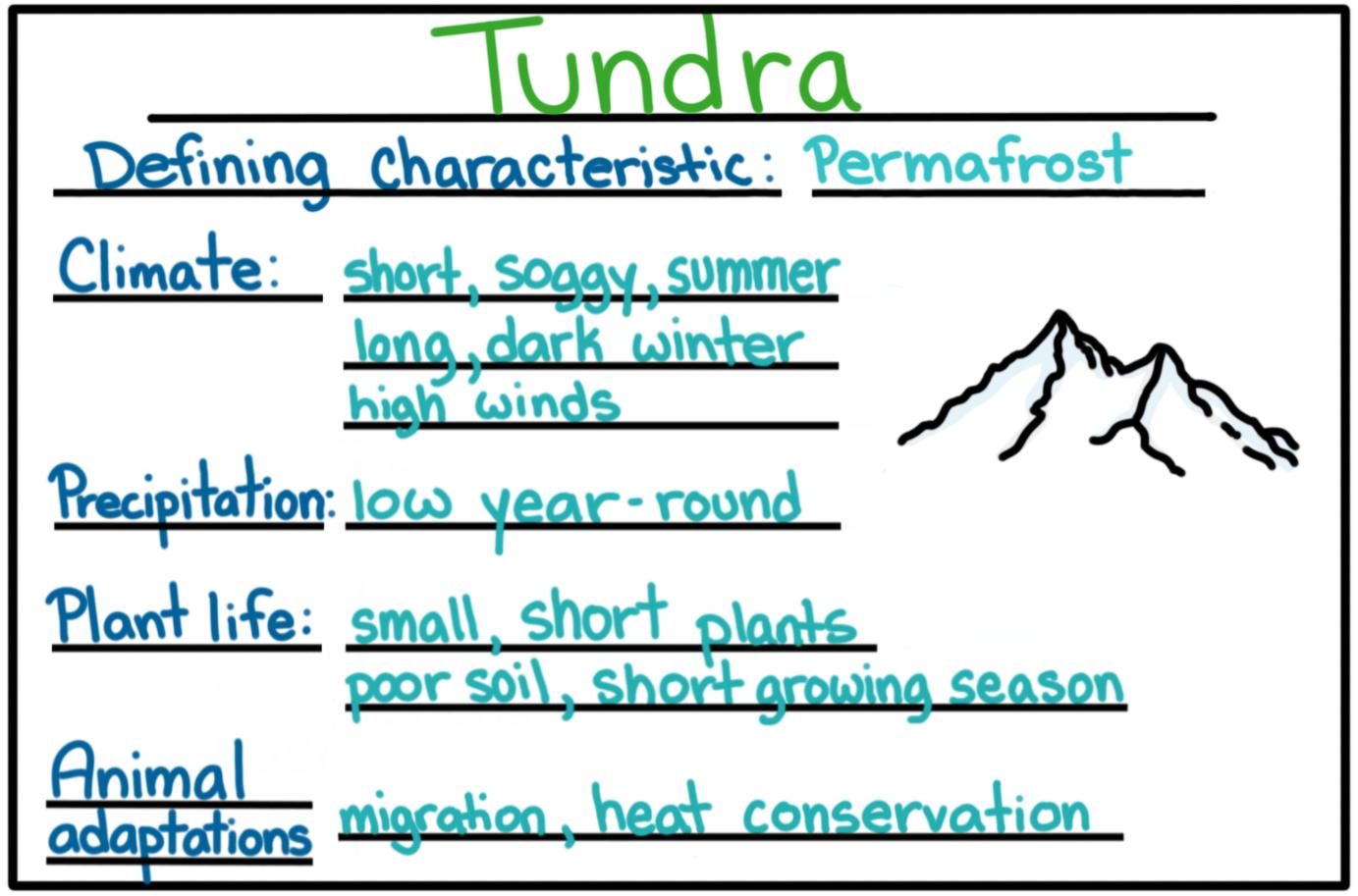


Image source: By Gabi Slizewska
Illustrated · 1 min
Image source: By Gabi Slizewska
Illustrated · 2 min
The tundra and taiga are the two main polar biomes.
The tundra biome is known for its permanent permafrost; it's the only biome that has it. This biome has the coldest temperature and the fewest organisms. During the summer months, a few centimeters of the permafrost in the ground thaws and becomes soggy. During the winter months, the entire ground is frozen.

Image source: By NASA [Public domain], via Wikimedia Commons
The plants here are small and stunted because of the constant frost. They have little room for their roots to grow. In addition, there are high winds, very short growing seasons, dark winters, and very little precipitation—not exactly the ideal conditions for life. Mosses and other similar plants are the most common in this area due to the harsh conditions.
Animals do live in the tundra, but they often migrate for the winter months because the environment is too harsh. The few that stay year-round have some really cool adaptations like natural antifreeze.
You can find tundras in the polar regions (near the North Pole and South Pole).

Image source: By Terpsichores CC BY-SA 3.0, via Wikimedia Commons
When you think of a tundra, you might envision ice caps and ice sheets, but there are actually a few different types you may see.
The two main types of tundras are arctic and alpine.
The arctic tundra occurs at any elevation, but the alpine tundra is only seen on top of mountains.
The taiga, (also known as coniferous forest or boreal forest), is made up of tightly packed coniferous trees. Conifers are plants that spread their seeds by using cones, like pine cones.

Image source: By Andrey "Efenstor" Pivovarov CC0, via Wikimedia Commons
The weather in the taiga is horribly cold, similar to the tundra. It also has very long winters and very, very short, mild summers. It doesn't get a ton of rain, but it typically gets more than the tundra. The soil is still pretty poor though.
The main type of life here is conifers. Conifers are good at surviving in this biome because their cone shape lets the snow fall off of them, their dark color helps them absorb heat energy, and their needles help prevent water loss.
More animals live in the taiga than the tundra, but they have similar adaptations. Many animals have extra fat storage for insulation and small limbs so that they can keep heat in their core. A large number of animals living in the taiga biome migrate south for the winter.
This biome is mostly unpopulated by humans because of its harsh conditions. The biggest human disturbance is caused by deforestation. The taiga has very short growing seasons, so it takes a lot longer for cut down trees to be replaced by new ones.

Image source: By Mark Baldwin-Smith CC BY-SA 3.0, via Wikimedia Commons
Illustrated · 2 min
The tundra biome is the driest and the coldest of all the biomes. It receives less than ten inches of rain per year. Summers are extremely short; they're only about six to ten weeks. Because the tundra is so far north during the summer, it sees the sun for 24 hours a day. Due to the short summers, the tundra has a very short growing season.
Certain plants can survive in the harsh conditions of the tundra. Lichens, mosses, shrubs, grasses, and flowers have adapted to the cold temperatures and high winds by grouping and having tough root systems. Many tall plants cannot survive in this biome due to the strong winds.
Trees cannot survive in the tundra due to a thick layer of polar ice called permafrost. Permafrost is about a foot beneath the surface of the ground. The water in the ground never thaws, so roots cannot reach into it.
There are two types of tundra: arctic tundra and alpine tundra. You can find them in both arctic and antarctic regions.
The arctic tundra can be found at various elevations while the alpine tundra exists only on mountains.

Image source: By Hannes Grobe, AWI CC BY-SA 2.5, via Wikimedia Commons
The taiga or boreal forest is a biome that resides in the northern hemisphere, right below the tundra. The taiga biome is mostly found in Canada, Russia, and the Nordic countries.
The taiga is very cold, but the ground thaws for a short period to allow larger plants, like trees, to grow. In fact, one kind of tree dominates the taiga landscape. Coniferous trees cover the taiga. Conifers like pine and spruce trees have special features that allow them to photosynthesize in cold weather.
The taiga is the world's largest biome, covering 29% of the land's surface. It has a summer ranging between one and three months, and it experiences large variations in temperature, going down to 58°F in the winter and up to 72°F in the summer.
The taiga has long, cold winters and short, mild summers with moderate precipitation. It has nutrient-poor soils due to the low temperature halting decomposition.

Image source: By peupleloup CC BY-SA 2.0, via Wikimedia Commons
Video
by MooMoo Math and Science

In this short video, you will get to see the taiga biome (also called the coniferous forest or boreal forest) and learn about some of its unique characteristics.
by MooMoo Math and Science

When you hear the word "tundra", you probably think of polar bears and sea ice, but there are some other cool features about this biome as well. In this video, you will learn about characteristics of the tundra biome and see some examples of the animals that live there.

