Revisão

Before this, knowFundamentos e exemplos

Interactive · 2 questions

Polynomial Long Division

Image by fxxu via Pixabay (License)

Polynomial long division isn't too different from integer long division. And like integer long division, it can be a pain. Therefore, it's best to use this new tool when you can't factor the polynomial.

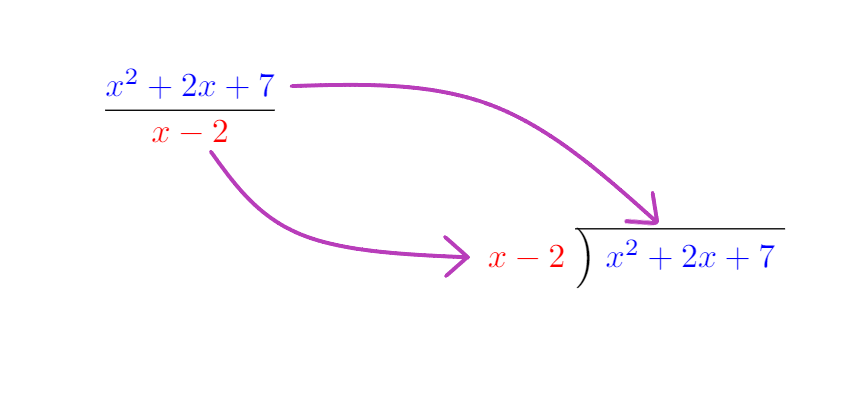
To start, we turn the rational expression into long division form.

Standard Practices

Before we start, there's two standard practices you should do. You can get by without them but they make the division problem easier and more structured. Make sure to apply these to the divisor and dividend if necessary.

  1. Put the polynomials in standard form.
  2. Add zero coefficients.

Standard form is when the highest exponent term comes first and lowest exponent term (usually the constant) comes last.

For example, x2+x+1x^2+x+1 is in standard form because the highest power, the 22 in x2x^2, comes first. Followed by the second highest power, xx, and the third highest power, the constant.

Is our numerator, 12x3+6+4x4+2x12x^3+6+4x^4+2x, in standard form? If no, what is its standard form?

Choose one answer

Interactive · 2 questions

Polynomial Long Division

Polynomial division helps break down expressions into factors, consistent with the total number of roots.

Let's say that we are trying to divide x2+2x−7x^2+2x-7 by x−2x-2:

Showing two ways of writing (x^2+2x+7)/(x-2)

Image source: by Vinitha Ranganeni

Step 1: Divide the first term of the numerator by the first term in the denominator and make that the first term in the answer.

Step 2: Multiply the denominator by the answer you got and put the product below the numerator

Step 3: Subtract the product from the numerator to create a new polynomial

Repeat Steps 1-3 with the new polynomial until you get a remainder or 0. If there is a remainder, it will have a lower degree than the divisor does.

Here we see that we have a quotient of x−4x-4 and a remainder of 11. We can rewrite the fraction x2+2x−7x−2\frac{x^2+2x-7}{x-2} as x+4+1x−2x+4+\frac{1}{x-2}. This is similar to rewriting an improper fraction as a mixed number, except we have polynomials (with variables) instead of integers.

Also, notice if we multiply x−2x-2 by x+4+1x−2x+4+\frac{1}{x-2} we'll get x2+2x−7x^2+2x-7. This is a good way to check if our answer is correct.

What is the remainder when x2−3x−10x^2-3x-10 is divided by x+2x+2?

Choose one answer

Video · + 1 min read

(Video) How to Do Long Division with Polynomials

by Nancy Pi

In this video by Nancy Pi she explains how to use long division with polynomials.

Summary\large{\text{Summary}}

The example she starts with is: x2+3x+5x+1\frac{x^2+3x+5}{x+1}

The first step is to rewrite this in long division form.

Next, we look for the highest power of xx in the outside term, and in the inside term. In this case, we have the xx in (x+1)(x+1), and x2x^2 in (x2+3x+5)(x^2+3x+5). We now consider how many times xx goes into x2x^2." In other words, we want to know what x2x\frac{x^2}x is. The answer is xx. So we put this up top. Now, we multiply the top xx through the x+1x+1, and subtract the product.

We repeat the above process with this new line we got. How many times does xx go into 2x2x? The answer is 22 times.

This is as far as we can go. But we have a remainder of 33. So, we place this over the divisor and add it onto our answer. x2+3x+5x+1=x+2+3x+1\frac{x^2+3x+5}{x+1}=\boxed{x+2+\frac{3}{x+1}}

The second example is: 6x3+10x2+82x2+1\frac{6x^3+10x^2+8}{2x^2+1}

Notice both the numerator and denominator are missing an xx term. We can still use long division but it's good practice to leave in a placeholder for this missing xx term. We go through the same steps as above to solve this. Here's what you should get: We can't divide any further. So we have our answer and the remainder as: 3x+5+−3x+32x2+1\boxed{3x+5+\frac{-3x+3}{2x^2+1}}

Video

(Video) Long Division of Polynomials

by PatrickJMT

In this video, Patrick looks at a more challenging example of long division with polynomials.

Summary\large{\text{Summary}}

Before you begin, notice that there isn't an x3x^3 term inside the dividend. Thus, we should put a placeholder term there to make it easier for us to calculate.

Start by focusing on the highest power things in the divisor and dividend. Here, x2x^2 goes into x4x^4 a total of x2x^2-times (i.e. x4x2=x2\frac{x^4}{x^2}=x^2). This is the first part of our quotient.

Now multiply x2x^2 through x2−2x+5x^2-2x+5 and subtract from the dividend.

Do this process again with x2x^2 and 2x32x^3.

Finally, do this once more with x2x^2 and −2x2-2x^2. We can't divide anymore. So this last line becomes our remainder. Place it in a fraction above the divisor and add it to our quotient. =x2+2x−2+−13x+6x2−2x+5\boxed{=x^2+2x-2+\frac{-13x+6}{x^2-2x+5}}

Video

(Video) Dividing Polynomials

by yaymath

Here's a video by yaymath showing you how to divide polynomials with long division.

Summary\large{\text{Summary}}

The steps are:

  1. Set the problem up like normal long division. If there are terms missing from the dividend, write them in as 00. For example, 3x2−63x^2-6 is missing its xx term. So you would write it as 3x2+0x−63x^2+0x-6.
  2. Find how many times the first term of the divisor goes into the first term of the dividend.
  3. Multiply the divisor by this and subtract it from the dividend.
  4. Bring down any remaining terms from the dividend.
  5. Repeat steps 2, 3, and 4 until you found the solution.

Test Yourself: Solve 3x2+25x−18÷x+93x^2+25x-18\div x+9

Choose one answer

Illustrated · 1 min

Polynomial Long Division

Polynomial long division is a method for dividing one polynomial by another. It works a lot like regular long division with numbers, but instead of digits, you are working with variables like xx.

When you divide polynomials, your goal is to figure out:

  • How many times the divisor fits into the dividend
  • What is left over (the remainder)

You will end up with three parts:

  • The dividend: the expression you are dividing
  • The divisor: the expression you are diving by
  • The quotient: the answer
Polynomial Long Division
[Example problem of 2x^2+5x+3 / x+1\
1. Divide
2. Multiply
3. Subtract

Image source: by Anusha Rahman

The Process

Here's the general method you will follow:

  1. Divide the leading terms: Look at the first term of each polynomial. Divide them to get the first term of your answer.

  2. Multiply: Multiply your answer by the entire divisor.

  3. Subtract: Subtract the result from the original polynomial. Be careful with the signs here!

  4. Bring down the next term: Move the next term from the dividend down into your working area.

  5. Repeat: Keep going through the same steps until: a) you run out of terms, or b) the power of what's left is smaller than the divisor

####Important Rules

  • Always arrange the terms in order, from the highest power to the lowest power
  • If a term is missing, use a placeholder with zero (like 0x20x^2)
  • Line up like terms when subtracting
  • Watch your negative terms, as they are a common source of mistakes

Remainder

Sometimes the division doesn't come out evenly. That's ok! When that happens, you'll have a remainder.

Quotient=RemainderDivisor\text{Quotient} = \frac{\text{Remainder}}{\text{Divisor}}

Instead of writing RR, like we do in algebra, we will keep everything in exact form.

Polynomial long division works because it breaks a big problem into smaller, manageable steps. Each step removes the highest power term, making the expression simpler each time.

Once you've mastered long division, we have a shortcut called synthetic division!

Type a concept, like “slope” or “photosynthesis”.

↑ ↓ to choose · Enter to openSearch explanations and problems