Regra da expansão

Before this, knowRegra do produto

Interactive · 1 question

Power Rule for Exponents

How do you raise a power to a power?

Power Rule for Exponents: (x^a)^b=x^(ab). Example: (2^2)^3 = 2^(2 times 3) = 2^6=64

Image by Caroline Kulczycky

In this formula, aa, bb, and xx are all real numbers. We plug in values for each number and simplify. This is an example of using the order of operations. We simplify the power first. Once the power is simplified, we calculate the exponent.

Let's do one more example.

Simplify (56)12.(5^6)^{\frac{1}{2}}.

Choose one answer

Check what you really know

If you can solve a contest problem with this idea, you know it well. If not, you know exactly what to review. These are real problems from the AMC 8, AMC 10, AMC 12 and AIME, the national math competitions for middle and high school students, each with a worked solution on LIVE by Po-Shen Loh.

Video · + 1 min read

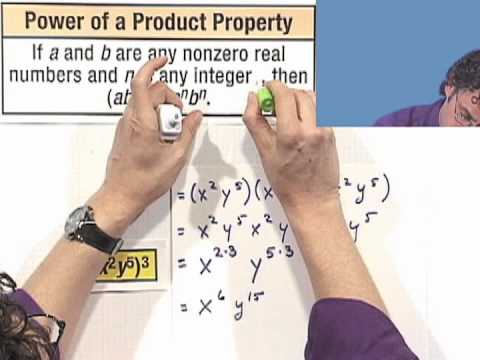
(Videos) Power of a Power and Power of a Product

by ThinkwellVids

Here's some more videos by ThinkwellVids showing you how to take a power of a power and how you take a product to a power.

Summary\large{\text{Summary}}

When taking a power of a power all you do is multiply the exponents. So: (am)n=am⋅n(a^m)^n=a^{m\cdot n}

When taking a product to a power you distribute the power to all the terms inside, taking the product of each of them. In other words: (ma⋅nb)c=ma⋅c⋅nb⋅c(m^a\cdot n^b)^c=m^{a\cdot c}\cdot n^{b\cdot c}

This closely resembles the distributive property we use without exponents.

Let's look at an example. Suppose we want to simplify: (x4)3(x^4)^3 The power rule tells us to multiply the exponents. =x4×3=x12\begin{align} &=x^{4\times3}\\ &=x^{12} \end{align}

When raising a group to a product, we want to distribute the exponent to all the terms inside. Suppose we want to simplify: (x2y5)3(x^2y^5)^3 We multiply the exponents for xx and also for yy. It doesn't matter that we have two separate variables. That happens all the time. You just have to group the right power with the right variable base. =x2×3y5×3=x6y15\begin{align} &=x^{2\times3}y^{5\times3}\\ &=x^6y^{15} \end{align}

Test Yourself: Simplify the expression (4x−2y7)−2(4x^{-2}y^7)^{-2}.

Choose one answer

Video

(Video) Basic Exponent Properties

by PatrickJMT

Patrick JMT has a good video explaining the basic properties of exponents.

Summary\large{\text{Summary}}

Recall that an exponent is just a shorthand way of referring to repeated multiplication. 53=5⋅5⋅5=1255^3=5\cdot5\cdot5=125 Power Rule

The power rule says that if we have an exponent raised to another exponent, you can just multiply the exponents together.

(am)n=am⋅n\boxed{\left(a^m\right)^n=a^{m\cdot n}}

For example, suppose we wanted to simplify (34)2\left(3^4\right)^2. Our rule tells us:

(34)2=34⋅2=38\left(3^4\right)^2=3^{4\cdot2}=3^8

And to prove this we can write out the multiplication.

(34)2=34⋅34=(3⋅3⋅3⋅3)⋅(3⋅3⋅3⋅3)=3⋅3⋅3⋅3⋅3⋅3⋅3⋅3=38\begin{align} \left(3^4\right)^2&= 3^4\cdot3^4 \\ &=(3\cdot3\cdot3\cdot3)\cdot(3\cdot3\cdot3\cdot3)\\ &=3\cdot3\cdot3\cdot3\cdot3\cdot3\cdot3\cdot3\\ &=3^8 \end{align}

This rule is not to be confused with the product rule. In that rule we add exponents together rather than multiply them.

Type a concept, like “slope” or “photosynthesis”.

↑ ↓ to choose · Enter to openSearch explanations and problems