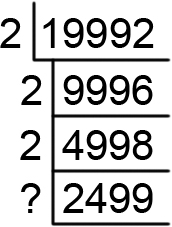
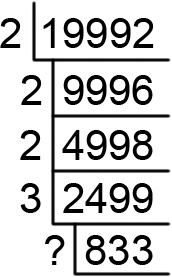
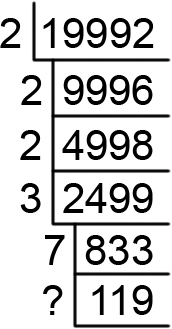
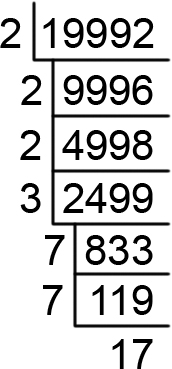
Fatores primos: a partir dos numeros inteiros

Before this, knowTeorema da Aritimetica: fatoração de primos

Interactive · 1 question

Find Prime Factors by Upside-Down Division

We have a new way to find the prime factorization of a number! This is another method that can be used to find the factors of a number. In this method, you will divide a number evenly by the smallest prime number you can.

It is called the upside down division because the division symbol is flipped upside down. This method is in lieu of using a factor tree.

Let’s take a look at an example with 4040. We'll try to find the prime factors of 4040.

The first prime is 22, and divides 4040 evenly. This can be seen with a divisibility trick. Most importantly is that 4040 is even. All even numbers are multiples of 22.

We can write 22 on the left side of the number and divide 4040 by 22, writing the result below.

Image of upside down division of 40 / 2

Image Source: Eunji Kwon

We continue by finding the smallest prime number that is a factor of 2020.

The smallest prime number is 22 again, so we write 22 on the left side again, and write 20÷2=1020 \div 2 = 10 below.

Image of upside down division of 40 / 2 / 2

Image Source: Eunji Kwon

We see that 2020 is a composite number, so we're not done yet. We continue this process until the number on the bottom is a prime number.

Image of upside down division of 40 / 2 / 2 / 2

Image Source: Eunji Kwon

Here is our final result. Now, we take all the numbers on the outside left and the number on the bottom, and this is our prime factorization. 40=2×2×2×540 = 2 \times 2 \times 2 \times 5 We also have the option to present the final factorization as a product of exponential numbers having a prime number base in the exponential notation. 40=23×540 = 2^3 \times 5 We are now going to take a look at some of the types of problems you might encounter about finding prime factors by upside down division. Before you start these problems, make sure to go over the basics of finding prime factors by upside down division.

One more note: you can always check a prime factorization. Multiply all the numbers you have in your factorization. Your answer should be the number you started with.

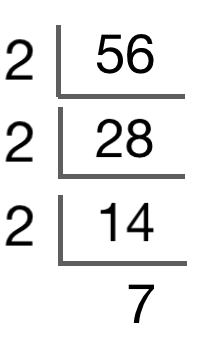
Example \\ What is the prime factorization of 5656?

Choose one answer

Interactive · 9 questions

Interactive Problem

Before you begin, make sure you know how to do upside-down prime factorization.

Here's a graphic to remind you of how to use this method:

Finding Factors of 60 using Upside Down Division. Start with 60. Divide the original number, 60, by its smallest prime factor (60/2=30). Then continue this process...30/2=15, 15/3=5. Stop when the number on the bottom is prime (5, a prime, is the number on the bottom, so we stop here). Prime factorization is the product of all the primes that appear in the upside down division. Thus, 60=2*2*3*5 = 2^2*3*5

Image by Caroline Kulczycky

Now, let's begin.

Which number should we choose for our prime factorization?

Choose one answer

Video

(Video) Prime Factorization

by mathman1024

This video by mathman1024 teaches prime factorization through the upside down division method.

Summary\large{\text{Summary}}

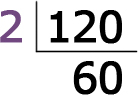
He uses an example with 120120. The first prime is 22. Does 22 go into 120120 evenly? Yes it does! We write 22 on the left side of the number and then divide 120120 by it, writing the result below.

120 has a prime factor of 2. Dividing by that we get 60.

Image Source: Alex Federspiel

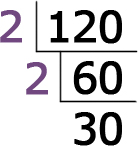
We continue by finding the smallest prime that goes into 6060.

60 has a prime factor of 2. Dividing that by we get 30.

Image Source: Alex Federspiel

We continue this process until the bottom number is prime.

15 has a prime factor of 3, which gives us the final answer of 5.

Image Source: Alex Federspiel

The final result is 55. We can take all the numbers and write out our prime factorization. 120=2⋅2⋅2⋅3⋅5120=23⋅3⋅5\begin{align}120&=2 \cdot 2 \cdot 2 \cdot 3 \cdot 5\\ 120&= 2^3 \cdot 3 \cdot 5 \end{align}

These two ways of writing 120120 are equivalent. It just so happens the second way uses exponents. Either way we've found the set of prime factors of 120120. It's just the numbers being multiplied together!

Type a concept, like “slope” or “photosynthesis”.

↑ ↓ to choose · Enter to openSearch explanations and problems