Dois eventos dependentes

Interactive · 4 questions

Dependent events

In contrast to independent events, when events are dependent, the outcome of one has an effect on the outcome of the other.

Sometimes, the probabilities of dependent events are called conditional probabilities. To solve these problems, you'll be calculating the probability of one event given that the other has already happened.

The fancy math way to write this is:
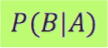
P(B|A)

Here, P(B∣A)P(B|A) represents the probability of event BB given event A.A. Let's look at an example.

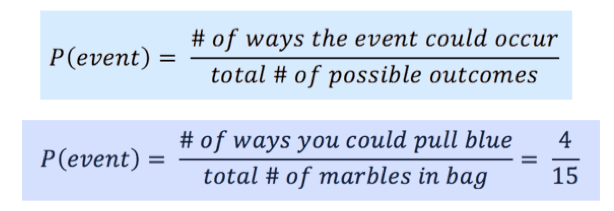
We have a bag of 5 red, 6 green, and 4 blue marbles. Without looking, you draw a marble and DO NOT put it back in the bag.

If we don't put the marbles back into the bag, there's one less marble left when we draw the next one. This means that the probability of the second drawing is affected by (i.e., dependent on) the first one.

Let's say I want to determine the following conditional probability.

What is P(red | blue)?

How many marbles did we start with in our bag?

Choose one answer

Video

(Video) Probability of Dependent Events

by MathHelp.com

MathHelp.com has a great video on how to find the probability of two dependent events.

A common type of dependent probability is choosing without replacement. The key for doing these problems is making sure you take away from the right value in the formula for the probability of the event. The denominator is always the total number of things you are choosing from, so if you take one thing away and do not replace it, then the next thing you choose will be coming from a smaller total, so the denominator is smaller.

If you are choosing with replacement, on the other hand, then the denominator does not change.

Interactive · 1 question

Dependent Events and Conditional Probability

Recall that for two independent events AA and B,B, the probability of event AA does not affect the probability of event BB and vice versa.

For two dependent events, the probability of one event is affect by the other event. Two events are dependent if the outcome or occurrence of the first event affects the outcome or occurrence of the second event, so that the probability is changed.

**What are some examples? **

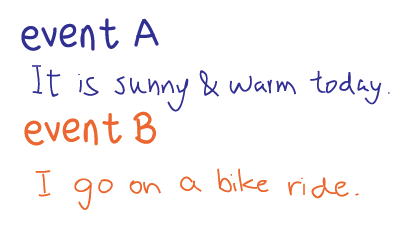
Event A: It is sunny and warm today; Event B: I go on a bike ride.

In this case, whether event BB happens is dependent on event A.A. If it is sunny and warm today, I will go on a bike ride. A lot of events in life and like this, whether one thing happens relies on the occurrence of another event.

Here is another example.

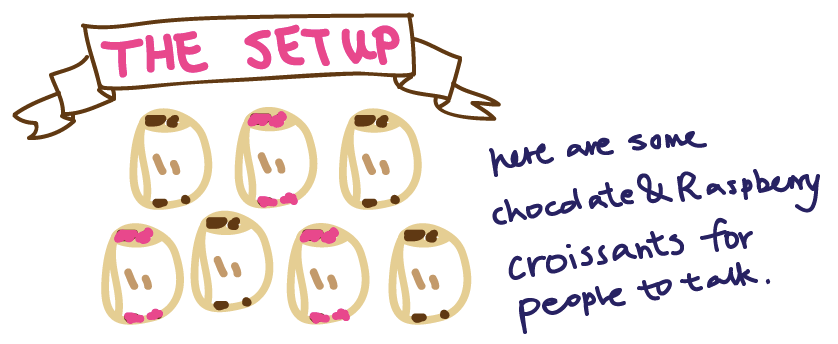
A collection of chocolate and raspberry croissants
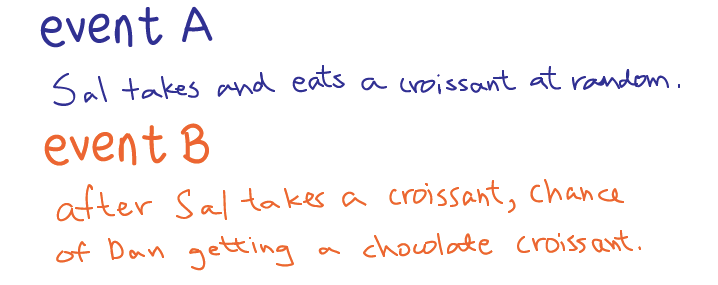
Event A: Sal takes and eats a random croissant; Event B: after Sal takes a croissant, Dan gets a chocolate croissant

The chance of Dan getting a chocolate croissant is then dependent on the kind of croissant Sal takes and eats, since we have a specific amount of chocolate and raspberry croissant.

Let's take a look at the notation of this kind of situation.

Let's say we have two dependent events AA and B.B.

If the probability of event A is dependent on event B,B, when we talk about the probability of A,A, we say the probability of event AA given event BB is P(A∣B)P(A|B).

If the probability of event BB is dependent on event A,A, when we talk about the probability of B,B, we say the probability of event BB given event AA is P(B∣A)P(B|A). In general P(A∣B)P(A|B) and P(B∣A)P(B|A) are not the same.

When the probability of one thing is dependent on another, we call it conditional probability. Go here to learn more about conditional probability and how to calculate it.

Try the questions below!

You have to toss a dice twice for a game you are playing. The most ideal situation is, of course, getting a 66 for both tosses. Are tossing a 66 the first time and the second time dependent events?

Choose one answer

Type a concept, like “slope” or “photosynthesis”.

↑ ↓ to choose · Enter to openSearch explanations and problems