Here's a video by mathantics that shows you how to round numbers and their decimals.
Summary
Rounding a number is a way to make a number less accurate by turning it into an estimate.
Why would you want a number to be less accurate you might ask. For starters, rounded numbers are easy to do calculations with. It's a lot easier to add,
300+500,
than to add,
312+498
Other times you just don't need precision. If you went to a concert, you don't need to say there were 399,342 people in the stadium. You would just say there were about 400,000.
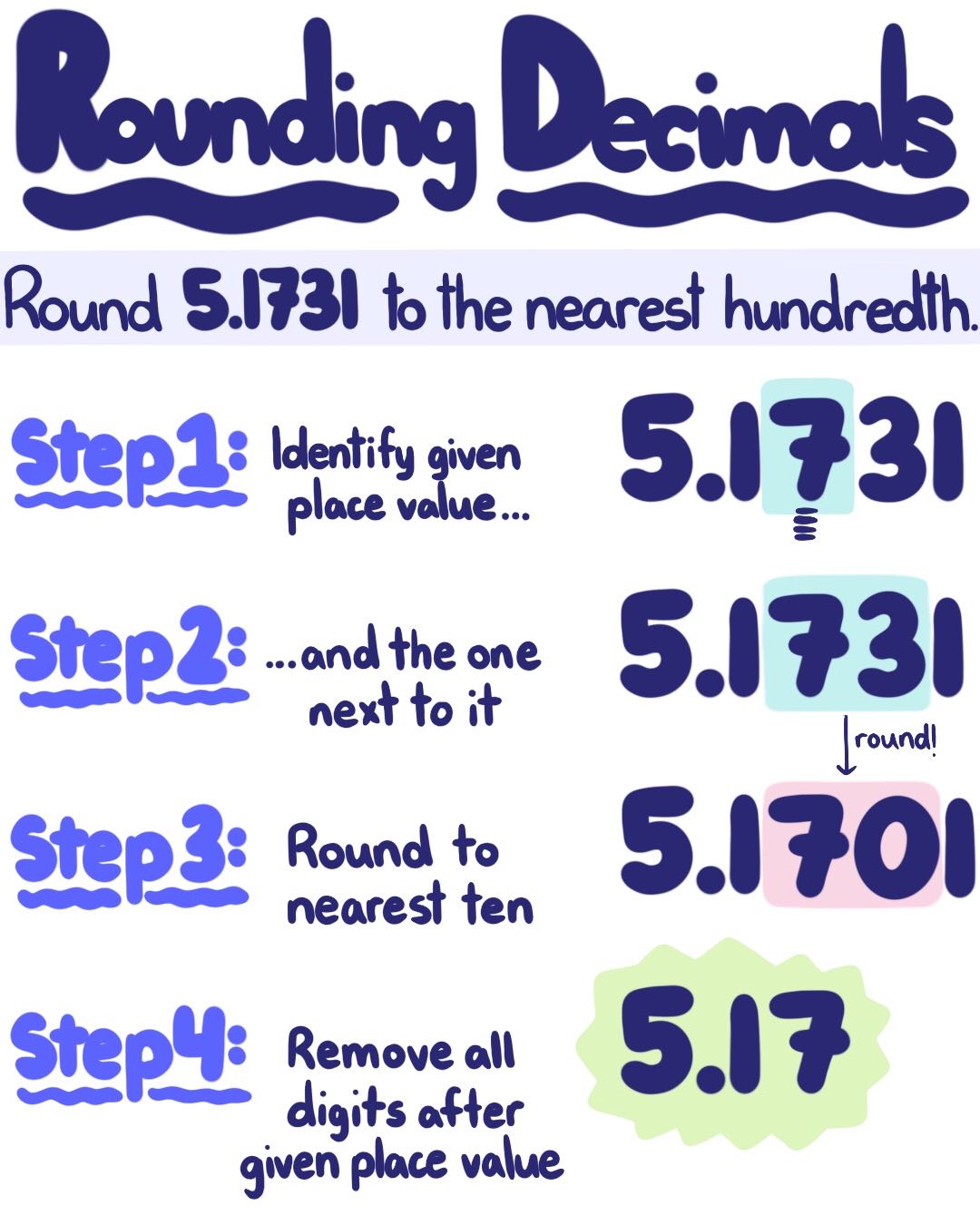
To round decimals, you first need to make sure you know their place values. You'll mostly be asked to round a number to a specific place value.
To do this, look at the number to the right of the place value.
- If it is a 5 or higher, raise the number at the place value by one.
- If it is a 4 or lower, leave the number at the place value alone.
Once you do this, turn all the digits to the right of the place value to 0.
Example
Suppose we want to raise 42.49275 to the nearest thousandth. We want to first find the place value given. In this case, thousandths.
42.49275
Next we look at the digit to the right of it.
42.49275
Here, it's 7. Since this is greater than 5, we raise the place value number by one.
42.49375
Finally, make all of the digits to the right of the place value 0.
42.49300
Example with 9
Now suppose we want to raise 42.09998 to the nearest ten-thousandth. Locating the place value we have a 9.
42.09998
The number to it's right, 8, is larger than 5 so we raise our place value by one. But this turns our 9 into a 10. What do we do? Turn the 9 into a 0 and raise the next digit to the left by one. This'll turn any 9's in a row to 0's finally raising our tenths place by one.
42.10008
Finally, we turn any digit to the right of our place value to 0.
42.10000
We can omit any excess zeros.
42.1
In the special case where we want to round to the nearest whole number, there will be nothing after the decimal point once we're done.