Segundo teste de derivação

Before this, knowPrimeiro teste de derivação

Interactive · 2 questions

The problem with the First Derivative Test is that it will produce any and all critical points of the function, with, in particular, no distinction between maxima and minima. Why is this such a problem? In most circumstances, only either the maximum or the minimum is desired, while the other is superfluous. Furthermore, some functions lack an upper bound, a lower bound, or both. The Second Derivative Test is a way to differentiate between maxima and minima.

Recall the effect the sign of the second derivative has on the first derivative.

Let f(x)f(x) be a twice-differentiable function. When f′′(x)>0f''(x) > 0, f′(x)f'(x) is increasing, i.e. the function is concave upward. When f′′(x)<0f''(x)<0, f′(x)f'(x) is decreasing, i.e. the function is concave downward. When it is 0, the first derivative is locally constant, i.e. the function has an inflection point. What do these facts mean when the first derivative is 0?

When f′(x)=0f'(x) = 0 and f′′(x)>0f''(x)>0, f(x)f(x) is concave upward, and the point in question is a minimum. Similarly, when f′(x)=0f'(x) = 0 and f′′(x)<0f''(x)<0, f(x)f(x) is concave downward, and the point in question is a maximum.

What about when f′(x)=f′′(x)=0f'(x) = f''(x) = 0?

Choose one answer

Interactive · 1 question

The critical points of a function are the points of the function where the derivative is equal to zero, or does not exist. The critical points are very useful if we want to graph a function by hand, and we don't have a calculator with us. Critical points are Local Maximum, Local minimum, absolute maximum, absolute minimum, and saddle point (for multi-variable functions). When we have a maximum or minimum, the tangent line is zero. (Remember the tangent line is the rate of change at a specific point.) A local maximum is the highest point on a graph around that point, but not necessarily the highest point on the graph. A local minimum is the lowest point on a graph around that point, but not necessarily the lowest point on the graph. A local extrema is a local maximum or minimum. A saddle point is a point where it is a local maximum in one direction, but a local maximum in the other direction. To find the saddle points and local extrema, we must first take the second derivatives. A second derivative is the derivative of a derivative.

We then plug all of the second derivatives into a formula and then we can determine the local extrema and any saddle points.

The formula we use is D=fxxfyy+[fxy]2D=f_{xx}f_{yy}+[f_{xy}]^2.

First, we must take the second derivatives fxxf_{xx}, fyyf_{yy}, fxyf_{xy}, and fyxf_{yx}. Note: fxyf_{xy} and fyxf_{yx} should always be the same.

In order to take the second derivative, we must first take the first derivatives: If f(x,y)=3x4+4y2f(x,y)=3x^4+4y^2, then fx(x,y)=12x3f_x(x,y)=12x^3 and fy(x,y)=8yf_y(x,y)=8y.

Now that we have the two first derivatives, we can now take the four second derivatives: fxx(x,y)=36x2f_{xx}(x,y)=36x^2 fyy(x,y)=8f_{yy}(x,y)=8 fxy(x,y)=0f_{xy}(x,y)=0 fyx(x,y)=0f_{yx}(x,y)=0 Now, we plug these four into the formula: D=36x2(8)−0(0)D=36x^2(8)-0(0) which simplifies to D=288x2D=288x^2.

Next, we can find a point to plug into the equation and find out if the point is a critical point or not. If we plug in the point (0,0)(0,0), we get D=0D=0, so it is a saddle point.
If we plug in a point and get a positive answer for DD, then we look back at the second derivative with respect to xx. If fxx(x,y)f_{xx}(x,y) is positive, then the point is a local minimum. If fxx(x,y)f_{xx}(x,y) is negative, then the point is a local maximum. If D is negative, we can't determine any critical points from this method.


Is (0,0)(0,0) a critical point of the function f(x,y)=7x3+9y5f(x,y)=7x^3+9y^5? If so, which critical point?

Choose one answer

Video · + 1 min read

(Video) Second Derivative Test to Find Local Extrema

by PatrickJMT

Here's a video by patrickJMT where he shows you how to use the second derivative test in order to figure out if a critical point is a local max or a local min.

The second derivative test tells us that, given cc is a critical point,

  • if f′′(c)>0f''(c)>0 then cc is a local minimum
  • if f′′(c)<0f''(c)<0 then cc is a local maximum
  • if f′′(c)=0f''(c)=0 then anything could happen

If the last option happens then you have to go back and use the first derivative test in order to figure it out.

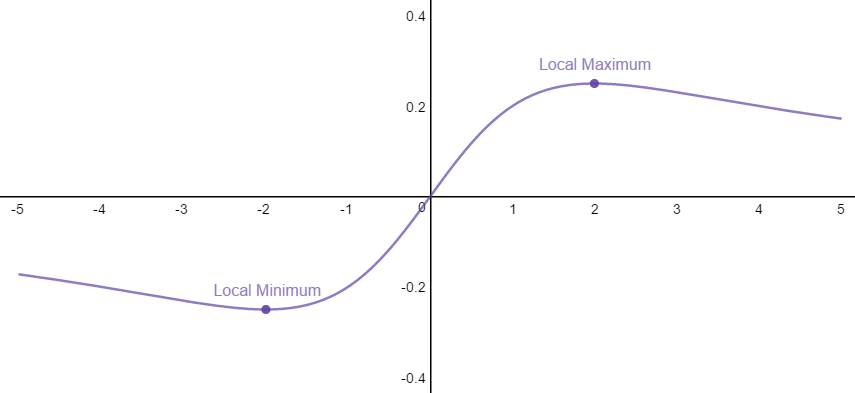
The example he looks at is the function: f(x)=xx2+4f(x)=\frac{x}{x^2+4}

Let's begin by finding the derivative. f(x)=xx2+4f′(x)=[x]′(x2+4)−x[x2+4]′[x2+4]2=(x2+4)−x(2x)(x2+4)2=x2+4−2x2(x2+4)2=4−x2(x2+4)2\begin{align} f(x)&=\frac{x}{x^2+4}\\ f'(x)&=\frac{\color{red}{[x]'}(x^2+4)-x\color{red}{[x^2+4]'}}{[x^2+4]^2}\\ &=\frac{(x^2+4)-x(2x)}{(x^2+4)^2}\\ &=\frac{x^2+4-2x^2}{(x^2+4)^2}\\ &=\frac{4-x^2}{(x^2+4)^2}\\ \end{align}

Now we can find the critical points by looking at where the derivative equals zero or is undefined. f′(x)=04−x2(x2+4)2=04−x2=0x2=4x=±2\begin{align} f'(x)&=0\\ \frac{4-x^2}{(x^2+4)^2}&=0\\ 4-x^2&=0\\ x^2&=4\\ x&=\pm2 \end{align}

These are points within the functions domain so they are critical points.

Next we take the second derivative of this function. f′(x)=4−x2(x2+4)2f′′(x)=[4−x2]′(x2+4)2−(4−x2)[(x2+4)2]′[(x2+4)2]2=−2x(x2+4)2−(4−x2)(2)(x2+4)[x2+4]′(x2+4)4=−2x(x2+4)2−2(4−x2)(x2+4)(2x)(x2+4)4=−2x[(x2+4)2+2(4−x2)(x2+4)](x2+4)4=−2x[(x2+4)+2(4−x2)](x2+4)3=−2x[x2+4+8−2x2](x2+4)3=−2x[12−x2](x2+4)3\begin{align} f'(x)&=\frac{4-x^2}{(x^2+4)^2}\\ f''(x)&=\frac{\color{red}{[4-x^2]'}(x^2+4)^2-(4-x^2)\color{red}{[(x^2+4)^2]'}}{[(x^2+4)^2]^2}\\ &=\frac{-2x(x^2+4)^2-(4-x^2)(2)(x^2+4)\color{red}{[x^2+4]'}}{(x^2+4)^4}\\ &=\frac{-2x(x^2+4)^2-2(4-x^2)(x^2+4)(2x)}{(x^2+4)^4}\\ &=\frac{-2x[(x^2+4)^2+2(4-x^2)(x^2+4)]}{(x^2+4)^4}\\ &=\frac{-2x[(x^2+4)+2(4-x^2)]}{(x^2+4)^3}\\ &=\frac{-2x[x^2+4+8-2x^2]}{(x^2+4)^3}\\ &=\frac{-2x[12-x^2]}{(x^2+4)^3}\\ \end{align}

We want to check the points x=−2x=-2 and x=2x=2. f′′(−2)=−2(−2)[12−(−2)2]((−2)2+4)3=4[8]83=116f′′(2)=−2(2)[12−(2)2]((2)2+4)3=−4[8]83=−116\begin{align} f''(-2)&=\frac{-2\color{red}{(-2)}[12-\color{red}{(-2)}^2]}{(\color{red}{(-2)}^2+4)^3}\\ &=\frac{4[8]}{8^3}\boxed{=\frac1{16}}\\ \\ f''(2)&=\frac{-2\color{red}{(2)}[12-\color{red}{(2)}^2]}{(\color{red}{(2)}^2+4)^3}\\ &=\frac{-4[8]}{8^3}\boxed{=-\frac1{16}}\\ \end{align}

Since x=−2x=-2 gives us a positive value in the second derivative, we can conclude that that point is a local minimum.

Similarly, since x=2x=2 gives us a negative value in the second derivative, we can conclude that that point is a local maximum.

If we graph this function, we can see we we're correct.

Type a concept, like “slope” or “photosynthesis”.

↑ ↓ to choose · Enter to openSearch explanations and problems