Equações trigonometricas metodos de resolução

Before this, knowSolve Trigonometric Equations Using the Unit Circle

Illustrated · 3 min

So far, we have learned many trigonometric identities. We have also learned several ways to solve equations, especially linear and quadratic equations.

Now it’s time to combine those skills. In this section, we will use what we know about identities and equation solving to work through more complicated problems.

There are many identities you can use, so the best way to understand this topic is by practicing examples. That’s exactly what we’re going to do.

Equation vs Identity

Before we begin, we need to understand an important difference between an equation and an identity.

An identity is a statement that is always true, no matter what value you choose for the variable.

An equation, on the other hand, is only true for certain values of the variable. Our job is to find those values, if they exist.

Even though identities and equations can look similar, they are not the same. Knowing the difference will help you solve problems correctly.

Our first example is to solve the equation

2sin⁡2(x)+cos⁡2(x)=12\sin^2(x) + \cos^2(x) = 1

on the interval x∈[0,2π).x \in [0, 2\pi).

Many of these equations are easily solvable once one or more identities are applied to them, so it's important to be able to recognize when they might be helpful. One of THE MOST\color{purple}{\text{THE MOST}} important identities is this one, the Pythagorean Identity:

sin⁡2(x)+cos⁡2(x)=1\sin^2(x) + \cos^2(x) = 1

The reason we bring this up is because the left-hand side of the equation we want to solve almost looks like this.

2sin⁡2(x)+cos⁡2(x)=12\sin^2(x) + \cos^2(x) = 1

We just have an extra sin⁡2(x)\sin^2(x) term, which we make explicit by rewriting the equation as

sin⁡2(x)+sin⁡2(x)+cos⁡2(x)=1.\sin^2(x) + \sin^2(x) + \cos^2(x) = 1.

Our special identity tells us that the second and third terms on the left-hand side equal 1,1, so we replace them with 11 and get

sin⁡2(x)+1=1.\sin^2(x) + 1 = 1.

This is a good sign because instead of having sines and cosines, we only have sines. A good goal to work towards is writing equations in terms of as few different trigonometric functions as possible.

Now then, the next step should be obvious: subtract 11 from both sides of the equation:

sin⁡2(x)=0.\sin^2(x) = 0.

Now take the square root of both sides:

sin⁡(x)=0.\sin(x) = 0.

In the interval [0,2π],[0, 2\pi], this equation is true twice: once at x=0,x = 0,once at x=π,x = \pi, and again at x=2π,x = 2\pi, so these are our solutions. One can see this by looking at a graph of sine.

Graph of sin(x) from x = 0 to 8

Graph courtesy of Desmos

Graphing equations is always a good way to check your algebra. But for now let's try another problem.

We're going to try solving

sin⁡(2x)+2cos⁡(2x)+4sin⁡2(x)=1\sin(2x) + 2\cos(2x) + 4\sin^2(x) = 1

on the interval [0,2π].[0, 2\pi].

Sadly we can't just add the sine and cosine directly, but we know some identities about double-angles, so let's give them a try. We know that

sin⁡(2x)=2sin⁡(x)cos⁡(x),\sin(2x) = 2\sin(x)\cos(x),

so using this on our equation gives

2sin⁡(x)cos⁡(x)+2cos⁡(2x)+4sin⁡2(x)=1.2\sin(x)\cos(x) + 2\cos(2x) + 4\sin^2(x) = 1.

Some of the trig functions have xx inside, while some have 2x.2x. Let's use a double-angle identity for cos⁡(2x)\cos(2x) since this will turn the 2x2x argument into x.x. In particular we're going to try

cos⁡(2x)=cos⁡2(x)−sin⁡2(x).\cos(2x) = \cos^2(x) - \sin^2(x).

Substitute this into the equation:

2sin⁡(x)cos⁡(x)+2cos⁡2(x)−2sin⁡2(x)+4sin⁡2(x)=1.2\sin(x)\cos(x) + 2\cos^2(x) - 2\sin^2(x) + 4\sin^2(x) = 1.

Combine like terms:

2sin⁡(x)cos⁡(x)+2cos⁡2(x)+2sin⁡2(x)=1.2\sin(x)\cos(x) + 2\cos^2(x) + 2\sin^2(x) = 1.

The next step might be a bit hard to recognize but we actually want to factor this. We can split the terms up in a clever way to suggest how this might be done:

sin⁡2(x)+2sin⁡(x)cos⁡(x)+cos⁡2(x)+cos⁡2(x)+sin⁡2(x)=1.\sin^2(x) + 2\sin(x)\cos(x) + \cos^2(x) + \cos^2(x) + \sin^2(x) = 1.

The first three terms should look like (a+b)2=a2+2ab+b2.(a + b)^2 = a^2 + 2ab + b^2. Grouping like this is pretty smart since the other two terms equal 11 by using the Pythagorean Identity again:

(sin⁡(x)+cos⁡(x))2+1=1.(\sin(x) + \cos(x))^2 + 1 = 1.

Subtract 11 from both sides:

(sin⁡(x)+cos⁡(x))2=0.(\sin(x) + \cos(x))^2 = 0.

Take the square root:

sin⁡(x)+cos⁡(x)=0.\sin(x) + \cos(x) = 0.

This is another equation most readily studied with the unit circle. We want to find x∈[0,2π]x \in [0, 2\pi] for which

sin⁡(x)=−cos⁡(x).\sin(x) = -\cos(x).

On the unit circle these are the points where the two coordinates of a point on the circle have opposite signs. Therefore the solutions are x=3π4x = \frac{3\pi}{4} and 7π4.\frac{7\pi}{4}.

Read · 5 min

Our goal is to solve trigonometric equations that have one variable.

In most trigonometric equations, the variable appears inside a trigonometric function, such as sine, cosine, or tangent.

To solve the equation, we try to isolate one trigonometric function. We treat that function like it is its own variable for a moment.

Once the function is isolated, it becomes much easier to solve for the original variable.

Before diving into examples, here are a couple of important principles to remember:

  • It is best to rewrite the equation in terms of as few trigonometric functions as possible. Usually it is easiest to just use sines and cosines, but if one of the other trigonometric functions appears more frequently, use that one.

  • Along with the previous point, remember that sec⁡(x)=1cos⁡(x),\sec(x) = \frac{1}{\cos(x)}, csc⁡(x)=1sin⁡(x),\csc(x) = \frac{1}{\sin(x)}, and cot⁡(x)=1tan⁡(x).\cot(x) = \frac{1}{\tan(x)}. The Pythagorean Identity sin⁡2(x)+cos⁡2(x)=1\sin^2(x) + \cos^2(x) = 1 is also extremity helpful when there are squared trigonometric functions floating around.

  • In many cases one can factor a trigonometric equation treating each trigonometric function as a variable.

  • Many problems that are about solving a trigonometric equation have multiple ways to get to the final answer.

With that, let's get into an example!

We are going to solve the equation

sin⁡3(x)+sin⁡(x)cos⁡2(x)=0\sin^3(x) + \sin(x)\cos^2(x) = 0

over the domain x∈[0,π]x \in [0, \pi] in THREE different ways. I'm going to show two ways that are quite simple, and then a third, more complicated way that demonstrates how far we can really push these techniques.

Solution 1: The left-hand side has two terms, with a common factor of sin⁡(x),\sin(x), so we factor it out:

sin⁡(x)(sin⁡2(x)+cos⁡2(x))=0\sin(x)(\sin^2(x) + \cos^2(x)) = 0

The Pythagorean Identity tells us the second factor is 1,1, so

sin⁡(x)(1)=0,\sin(x)(1) = 0,

which is

sin⁡(x)=0.\sin(x) = 0.

We know that this equation is true when x=0x = 0 or x=πx = \pi (can check the unit circle or a graph of the sine function to be sure), so these are the solutions.

Solution 2: The second solution revolves around the idea of turning the cosine into sine immediately, since the equation has more sine functions than anything else. We know that sin⁡2(x)+cos⁡2(x)=1,\sin^2(x) + \cos^2(x) = 1, which means that cos⁡2(x)=1−sin⁡2(x).\cos^2(x) = 1 - \sin^2(x). We can substitute this into our equation to solve:

sin⁡3(x)+sin⁡(x)(1−sin⁡2(x))=0.\sin^3(x) + \sin(x)(1 - \sin^2(x)) = 0.

Now distribute the sin⁡(x):\sin(x):

sin⁡3(x)+sin⁡(x)−sin⁡3(x)=0.\sin^3(x) + \sin(x) - \sin^3(x) = 0.

Luckily for us, the cubic terms cancel out and we're left with

sin⁡(x)=0.\sin(x) = 0.

Once again, our solutions are x∈[0,π].x \in [0, \pi].

It's worth noting that solving the problem multiple different ways is a means of checking our work.

If you only want a quick review of solving trigonometric equations, you can skip this last example. It is more complicated and uses the Binomial Theorem.

However, working through this harder example is helpful. It shows many of the ideas we’ve learned being used together in one problem.

By seeing all the steps in one place, you can better understand how the different methods connect.

Solution 3: Once again we have the equation

sin⁡3(x)+sin⁡(x)cos⁡2(x)=0.\sin^3(x) + \sin(x)\cos^2(x) = 0.

This solution is motivated by realizing that

(sin⁡(x)+cos⁡(x))3=sin⁡3(x)+3sin⁡2(x)cos⁡(x)+3sin⁡(x)cos⁡2(x)+cos⁡3(x)(\sin(x) + \cos(x))^3 = \sin^3(x) + 3\sin^2(x)\cos(x) + 3\sin(x)\cos^2(x) + \cos^3(x)

is true because of the Binomial Theorem. We think about "completing" this perfect cube and then dealing with the terms that are left over.

To get a perfect cube on the left-hand side of

sin⁡3(x)+sin⁡(x)cos⁡2(x)=0,\sin^3(x) + \sin(x)\cos^2(x) = 0,

we need to add 3sin⁡2(x)cos⁡(x)+2sin⁡(x)cos⁡2(x)+cos⁡3(x)3\sin^2(x)\cos(x) + 2\sin(x)\cos^2(x) + \cos^3(x) to both sides.

sin⁡3(x)+3sin⁡2(x)cos⁡(x)+3sin⁡(x)cos⁡2(x)+cos⁡3(x)=3sin⁡2(x)cos⁡(x)+2sin⁡(x)cos⁡2(x)+cos⁡3(x).\sin^3(x) + 3\sin^2(x)\cos(x) + 3\sin(x)\cos^2(x) + \cos^3(x) = \\ 3\sin^2(x)\cos(x) + 2\sin(x)\cos^2(x) + \cos^3(x).

The left-hand side is now our perfect cube:

(sin⁡(x)+cos⁡(x))3=3sin⁡2(x)cos⁡(x)+2sin⁡(x)cos⁡2(x)+cos⁡3(x).(\sin(x) + \cos(x))^3 = 3\sin^2(x)\cos(x) + 2\sin(x)\cos^2(x) + \cos^3(x).

The left-hand side has a cube, so our goal should be to lower that power of 33 by trying to find factors of sin⁡(x)+cos⁡(x)\sin(x) + \cos(x) on the right-hand side.

All terms on the right-hand side have a factor of cos⁡(x)\cos(x) so let's start by factoring that out:

(sin⁡(x)+cos⁡(x))3=cos⁡(x)(3sin⁡2(x)+2sin⁡(x)cos⁡(x)+cos⁡2(x)).(\sin(x) + \cos(x))^3 = \cos(x)(3\sin^2(x) + 2\sin(x)\cos(x) + \cos^2(x)).

The factor that's left is actually pretty close to (sin⁡(x)+cos⁡(x))2,(\sin(x) + \cos(x))^2, which would be awesome to introduce into the right-hand side for the reasons stated earlier. There are two extra sin⁡2(x)\sin^2(x) terms, though, so we pull those aside and factor what's left:

(sin⁡(x)+cos⁡(x))3=cos⁡(x)(2sin⁡2(x)+sin⁡2(x)+2sin⁡(x)cos⁡(x)+cos⁡2(x))(sin⁡(x)+cos⁡(x))3=2cos⁡(x)sin⁡2(x)+cos⁡(x)(sin⁡(x)+cos⁡(x))2.\begin{align} (\sin(x) + \cos(x))^3 &= \cos(x)(2\sin^2(x) + \sin^2(x) + 2\sin(x)\cos(x) + \cos^2(x)) \\ (\sin(x) + \cos(x))^3 &= 2\cos(x)\sin^2(x) + \cos(x)(\sin(x) + \cos(x))^2. \end{align}

Should we subtract cos⁡(x)(sin⁡(x)+cos⁡(x))2\cos(x)(\sin(x) + \cos(x))^2 from both sides of the equation the left-hand side becomes

(sin⁡(x)+cos⁡(x))3−cos⁡(x)(sin⁡(x)+cos⁡(x))2.(\sin(x) + \cos(x))^3 - \cos(x)(\sin(x) + \cos(x))^2.

To simplify, factor out (sin⁡(x)+cos⁡(x))2:(\sin(x) + \cos(x))^2:

(sin⁡(x)+cos⁡(x))2(sin⁡(x)+cos⁡(x)−cos⁡(x))=sin⁡(x)(sin⁡(x)+cos⁡(x))2.(\sin(x) + \cos(x))^2(\sin(x) + \cos(x) - \cos(x)) = \sin(x)(\sin(x) + \cos(x))^2.

Then our equation becomes

sin⁡(x)(sin⁡(x)+cos⁡(x))2=2cos⁡(x)sin⁡2(x).\sin(x)(\sin(x) + \cos(x))^2 = 2\cos(x)\sin^2(x).

Both sides have a common factor of sin⁡(x),\sin(x), which means both sides of the equation are equal if sin⁡(x)=0\sin(x) = 0 (namely, both sides of the equation equal zero). As seen earlier, sin⁡(x)=0\sin(x) = 0 if x=0x = 0 or x=πx = \pi (in the domain of this question, which is [0,π][0, \pi]).

So now we assume xx does NOT equal either of these values so we can divide both sides of the equation by sin⁡(x):\sin(x):

(sin⁡(x)+cos⁡(x))2=2cos⁡(x)sin⁡(x).(\sin(x) + \cos(x))^2 = 2\cos(x)\sin(x).

Now we need to consider if there are OTHER solutions. We just have to play with this equation a bit to check. Let's expand the square:

sin⁡2(x)+2cos⁡(x)sin⁡(x)+cos⁡2(x)=2cos⁡(x)sin⁡(x).\sin^2(x) + 2\cos(x)\sin(x) + \cos^2(x) = 2\cos(x)\sin(x).

Both sides have a term of 2cos⁡(x)sin⁡(x),2\cos(x)\sin(x), which we subtract away:

sin⁡2(x)+cos⁡2(x)=0.\sin^2(x) + \cos^2(x) = 0.

But this equation is never true, because the left-hand side must equal 11 (this is the Pythagorean Identity again)! So there are no additional solutions.

Video · + 1 min read

(Video) Solving Trigonometric Equations By Factoring & By Using Double Angle Identities

by The Organic Chemistry Tutor

In this video by [The Organic Chemistry Tutor](Solving Trigonometric Equations By Factoring & By Using Double Angle Identities), you will learn how to solve trig equations by factoring and using identities.

Summary

There are a couple of different ways to tackle these types of problems.

Solving by Factoring via Substitution

To start, you'll want to convert trig equations into polynomial form. For example, given sin2(x)+2sin(x)−3=0\text{sin}^2(x) + 2 \text{sin}(x)-3=0, substitute y=sin⁡(x)y=\sin(x). You will get y2+2y−3=0y^2+2y-3=0. Solve for yy, then replace the yy back with sin⁡(x)\sin(x) to find the corresponding angles.

Exploring Valid Solutions

You can factor the equation, and each factor will lead to an equation like sin⁡(x)=A\sin(x)=A or sin⁡(x)=B\sin(x)=B. Determine which valid angles will fall within the specified interval.

Using Identities

For expressions that have terms like sin⁡(2x)\sin(2x) or cos⁡(2x)\cos(2x), use double-angle formulas to rewrite them. This simplifies equations into solvable forms. After you simplify, you can apply the inverse functions and solve. However - make sure you think about periodicity and domain! You can also use these tricks to tackle trig inverses and solve equations with trig inverses.

Illustrated · 1 min

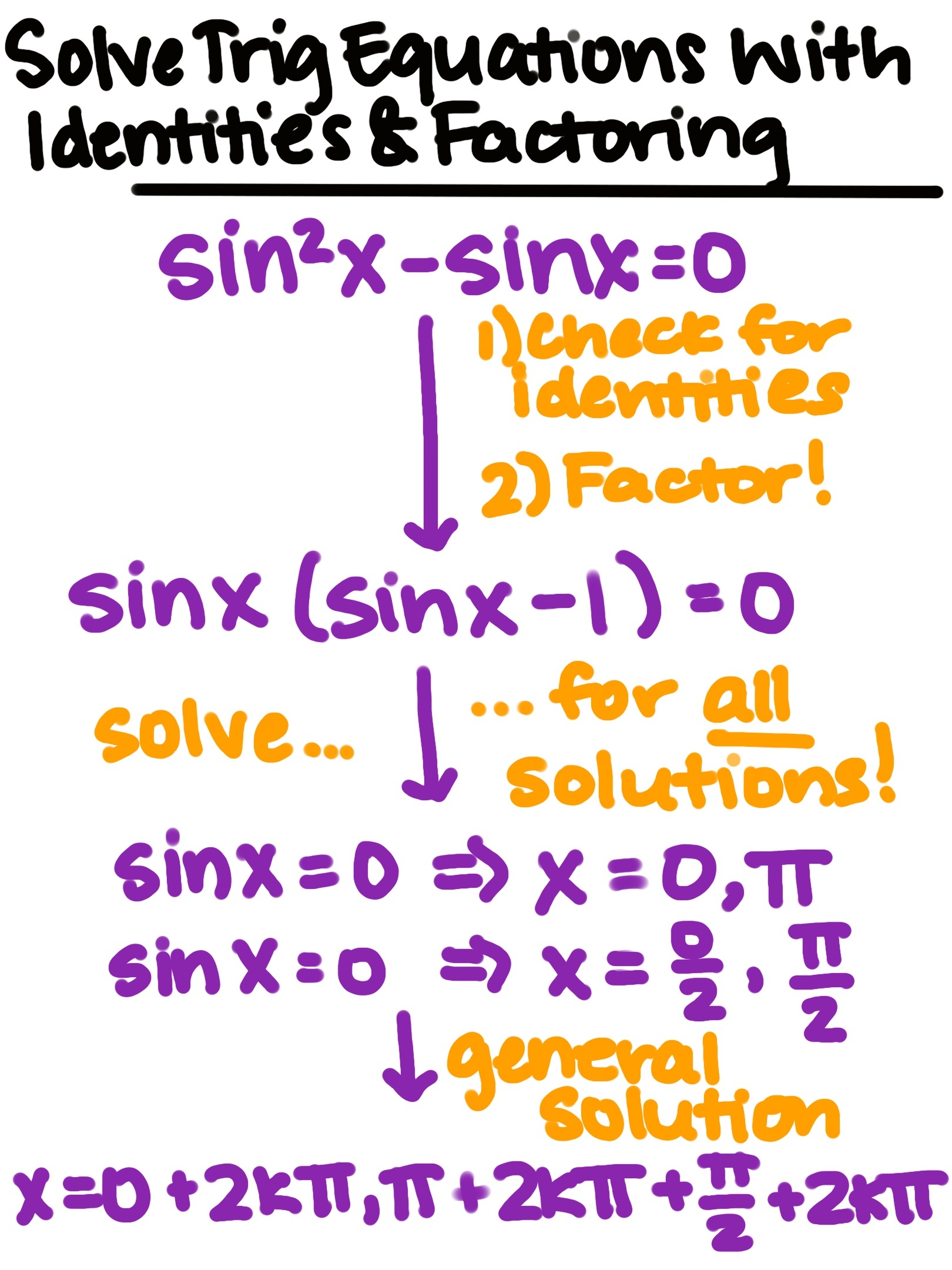
Solve Trigonometric Equations with Identities and Factoring

When we solve trig equations, we often use special math rules called identities. These rules help you rewrite the equation in a simpler form. The first step is to look at the equation you are given, like sin⁡2x−sin⁡x=0\sin^2x-\sin x=0.

1) Check for identities
2) Factor
3) Solve for all solutions
4) Find the general solution

Image source: by Anusha Rahman

Next, check if you can use any identities, such as sin⁡2x+cos⁡2x=1\sin^2x + \cos^2 x=1. Sometimes, you can replace one function with another to make the problem easier. If you can't do that, like in this example, you can move on to factoring.

Factoring trig equations is the same as the normal factoring we know. For example, sin⁡2x−sin⁡x=0\sin^2x-\sin x=0 becomes sin⁡x(sin⁡x−1)=0\sin x(\sin x -1) = 0. This gives you two smaller factors we can use to solve.

Each factor can now be set equal to zero, which means you solve sin⁡x=0\sin x=0 and sin⁡x=1\sin x =1. To find where these happen, think about the unit circle or sine wave. For sin⁡x=0\sin x =0, the solutions are at x=0x=0 and x=πx=\pi. For sin⁡x=1\sin x=1, the solution is x=π2x=\frac{\pi}{2}.

Once you find these values, you need to include all other times these values happen. Remember that trig equations are periodic - which means they repeat. So, we add +2kπ+2k\pi (where kk is any integer) to cover any general solution.

Your last step will be to check for extraneous solutions. These are solutions that may not actually work after you apply identities. Remember to always write the general solution and include all quadrants.

In the last lesson of this section, you will combine all of this knowledge to solve trig word problems.

Type a concept, like “slope” or “photosynthesis”.

↑ ↓ to choose · Enter to openSearch explanations and problems