Interactive · 2 questions

+4 contributors





By PublicDomainPictures CC0, via pixabay.com
Oh no! You missed all of your favorite college basketball games last weekend because your mom had you too busy doing chores to watch any TV! You stink mom!
After you pout in anger at the situation, your dad gives you some clues about the score of the game you wanted to see. In order to understand his clues, we'll need to understand how to combine inequalities using the words "AND," and "OR".
You were eager to watch University of Minnesota play against the University of Indiana in men's basketball on Saturday, February 16, 2019. Your dad leaves clues for you to guess how many points each team scored.
He says, "let be the score of the University of Indiana." I'll tell you that Indiana scored more than points, and if you double their score, it wasn't more than points.
The goal is to find the value of . This is known as a compound inequality with "AND," because the description contains the word "AND." We'll turn this into a compound inequality and then solve it. We call these words connecting words.
We are given two pieces of information that both must be true. Since Indiana scored more than points, this is a STRICT inequality. We know that At the same time, we know that double the score is no more than This inequality, unlike the previous one, is non-strict, so we represent it as In summary, we have two pieces of information.
Remind me, does our compound inequality use "AND" or "OR?"
We write a compound inequality as the two inequalities with a connecting word in the middle:
What do we do? We solve all of the inequalities to get information about . The first inequality is already simplified, but we can do a bit of work on the second inequality to rewrite it.
For now, just forget about the first inequality for a bit, and we'll solve
As you might remember, our goal is to isolate the variable. We do this by dividing both sides of the inequality by to get
We have found a new way to write so we replace it in the compound inequality:
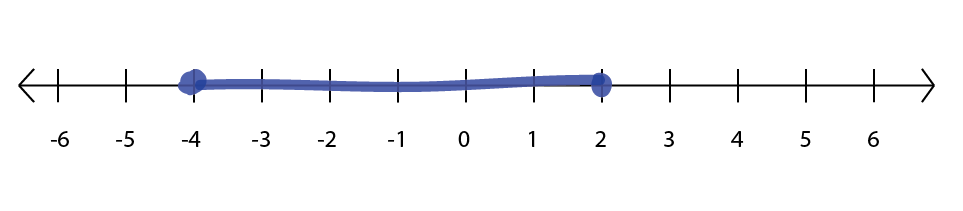
What numbers satisfy both inequalities? We need a number more than , and a number not more than . Also, since these are basketball scores we're talking about, we'd surely bet the scores were integers. The only integer satisfying both inequalities is , so we conclude Indiana scored points.
"Not bad," your Dad chuckles. "You seem to remember what you learned in math class!"
You smile back. Knowing your dad, it will only get harder. He hasn't yet given you any clues about the University of Minnesota's score.
"Ok, so let me help you out in figuring out the University of Minnesota's score in this game. Either six points more than their score was less than points, or half their score was at most points. Let be Minnesota's score. Can you tell me what is?"
You accept the challenge and begin moving towards solving another riddle.
Let's set up another compound inequality. The strategy is the same as before:
-
Identify each regular inequality that comprises the compound inequality.
-
Decide whether to use "AND" or "OR."
The first piece of information is "six points more than Minnesota's score was less than points". The word "more" implies addition, and "less than" implies use of the strict inequality . Piecing these elements together gives us
What about the second inequality? Dad gave it to us in words: "half their score was at most points." Here, the word "half" implies division, and "at most" implies the use of the non-strict inequality . So our second regular inequality is
How do we construct the compound inequality? We need to decide which connecting word to use: "AND" or "OR."
Remind me, which connecting word did Dad use?
We connect the two regular inequalities with the connecting word:
We need to solve each inequality individually to get information about . Let's try the first one.
On the same side of the inequality as is an addition by . We isolate the variable by undoing this. In other words subtracting from both sides of the inequality.
Simplifying gives
Now we replace with in the compound inequality.
Let's address the other regular inequality.
This time, the operation needed to isolate in the inequality is multiplication by . Doing so gives
In summary, our compound inequality becomes
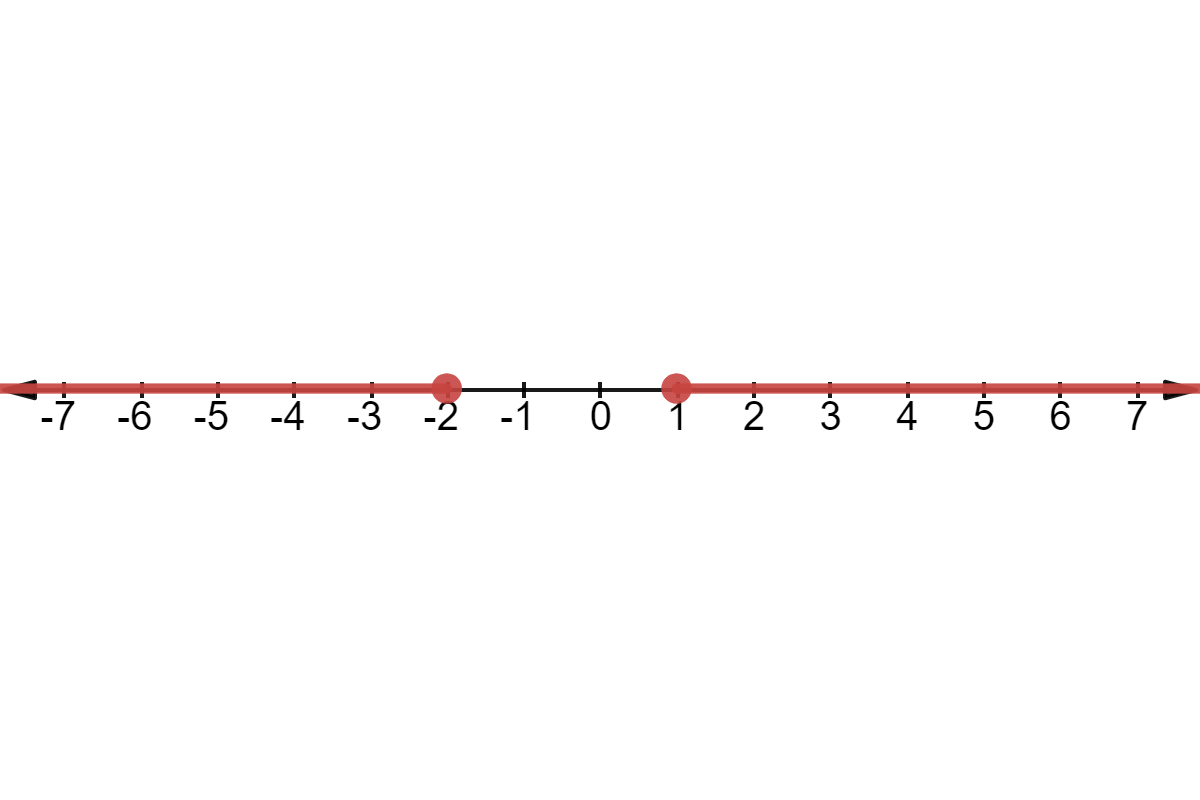
There is a problem. This is all correct, but it isn't enough information to determine Minnesota's score in the game. In general,
Before your Dad can praise you for deciphering his riddles, you storm back to your room and pout once again. He sits and laughs, greatly satisfied with himself. He knew you thought you'd find what is after solving his compound inequality.
Epilogue: Your birthday comes around two months later, for which your parents decide to get you your first cell phone as a present.
The first thing you search for is the score of the Indiana-Minnesota basketball game, and find this website.
It turns out Minnesota had won the basketball game ! Fittingly enough, your parents buy you a University of Minnesota t-shirt as a second present.