Illustrated · 2 min

Optimization problems focus on finding the best or most effective solutions within everyday life scenarios. The problems presented in calculus often have a focus on maximizing areas, volumes, and profits and minimizing distances, times, and cost for the most productive results.

Optimization problems are related to the finding of* absolute extrema *in the study of calculus. But instead of finding the possible smallest or largest value a function could take on (like in the case of the absolute extrema), there is an additional condition that the problem will take on. This condition will be true regardless of the solution.

In a common example, a farmer is trying to enclose a rectangular field with fence that borders the side of a straight-running river. He has 500 feet of fencing in total and is seeking to maximize the area of the field.
Our job here now is to find the formula for the area and identify the condition at hand. In this scenario, it is the limit of the 500 feet of fencing.

This means, we can assign values to each side of the fence and set the sum of those values equal to our given perimeter: 500 feet.

We can also identify that our area will be

A = x⋅\cdoty

So now that we have this graphic, we can say that:

2y + x = 500 feet
Our next goal is to get like variables so we can more easily work with them. In this case, we can solve for x to get it in terms of y:

x = 500 - 2y

Then, we plug this value back into our area formula (as a function of y) and we get

A(y) = (500 - 2y) ⋅\cdot y = 500y - 2y2^2

Almost there! We now need to solve for critical points, meaning we need to take the derivative of the above equation. It will look like

A' (y) = 500 - 4y

and we set this equal to 0:

500 - 4y = 0 y = 125

This shows the one critical point of 125, indicating for this value of y we will have the largest possible area for the fenced field!

So, we have to find the x value once again:

x = 500 - 2 (y) x = 500 - 2 (125) x = 250

To conclude, a y value of 125 and an x value of 250 will give you the largest possible area, 31,250 feet, using 500 feet of fencing:
A = 125 ⋅\cdot 250 A = 31,250 feet2^2

Video · + 3 min read

(Video) Optimization of a Corridor

by PatrickJMT

Here's a tricky optimization problem that anyone who's helped a friend move would understand. The problem states:

Two corridors meet at a right angle. One has a width of 88 meters, the other has a width of 2727 meters. Find the length of the largest pipe that can be carried horizontally from one hall around the corner and into the other hall.

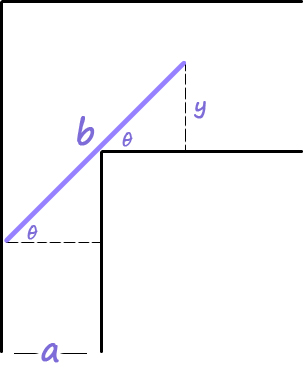
A diagram is given.

If you don't understand what the problem is asking, Patrick explains it well in the video. If not, here's a gif of how the pipe is moving through the hallway.

We want to find the maximum length that the pipe can be while still being able to move around the corner.

Patrick, being the absolute madman that he is, decides to solve the problem for arbitrary lengths instead of the ones given. He denotes the smaller hallway as having a with of aa. He also let's the pipe have a length of bb. He starts by looking at the pipe when it is halfway around the corner.

Note that a<ba<b in this problem. If aa was greater than bb we wouldn't need to rotate the pipe and could just move it down horizontally.

We can now create two triangles. We will let yy be the length of the top of the pipe down to the wall.

Let θ\theta be the angle opposite of yy. Because of geometry, θ\theta would be the angle of the other triangle too.

What we're going to do is express yy in terms of θ\theta. Since aa and bb are constant, fixed lengths we leave them as is. Let's split the pipe in half at the corner to make b1b_1 and b2b_2.

Here, b=b1+b2b=b_1+b_2. Now, if we look at our bottom triangle we can say that: cos⁡θ=ab1\cos\theta=\frac{a}{b_1} From the top triangle we can say: sin⁡θ=yb2\sin\theta=\frac{y}{b_2}

If we solve these for the b1b_1 and yy we get b1=acos⁡θ=asec⁡θy=b2sin⁡θ\begin{align} b_1&=\frac{a}{\cos\theta}=a\sec\theta\\ y&=b_2\sin\theta \end{align}

Now we can rearrange b=b1+b2b=b_1+b_2 and substitute in b1b_1 to get: b2=b−b1b2=b−asec⁡θ\begin{align} b_2&=b-b_1\\ b_2&=b-\color{red}{a\sec\theta} \end{align}

We can substitute this into our yy equation to get: y=b2sin⁡θy=(b−asec⁡θ)sin⁡θy=bsin⁡θ−asec⁡θsin⁡θy=bsin⁡θ−a1cos⁡θsin⁡θy=bsin⁡θ−atan⁡θ\begin{align} y&=b_2\sin\theta\\ y&=(\color{red}{b-a\sec\theta})\sin\theta\\ y&=b\sin\theta-a\sec\theta\sin\theta\\ y&=b\sin\theta-a\frac{1}{\cos\theta}\sin\theta\\ y&=b\sin\theta-a\tan\theta\\ \end{align}

Now we want to find the value of θ\theta that maximizes this equation. We do this by taking the derivative. y=bsin⁡θ−atan⁡θy′=bcos⁡θ−asec⁡2θ\begin{align} y&=b\sin\theta-a\tan\theta\\ y'&=b\cos\theta-a\sec^2\theta \end{align}

Next, set the derivative equal to zero in order to find the critical points. bcos⁡θ−asec⁡2θ=0bcos⁡θ−acos⁡2θ=0cos⁡2θ(bcos⁡θ−acos⁡2θ)=0⋅cos⁡2θbcos⁡3θ−a=0bcos⁡3θ=acos⁡3θ=abcos⁡θ=ab3cos⁡θ=a3b3\begin{align} b\cos\theta-a\sec^2\theta&=0\\ b\cos\theta-\frac{a}{\cos^2\theta}&=0\\ \cos^2\theta\bigg(b\cos\theta-\frac{a}{\cos^2\theta}\bigg)&=0\cdot\cos^2\theta\\ b\cos^3\theta-a&=0\\ b\cos^3\theta&=a\\ \cos^3\theta&=\frac{a}{b}\\ \cos\theta&=\sqrt[3]{\frac ab}\\ \cos\theta&=\frac{\sqrt[3]{a}}{\sqrt[3]{b}}\\ \end{align}

We want to to now write y=bsin⁡θ−atan⁡θy=b\sin\theta-a\tan\theta only in terms of aa and bb. To do this we need to make a right triangle and use cos⁡θ=a3b3\cos\theta=\frac{\sqrt[3]{a}}{\sqrt[3]{b}}. Doing this, then applying the Pythagorean Theorem, we get the sides of the triangle to be those below.

Now we can rewrite our yy equation in terms of aa and bb. y=bsin⁡θ−atan⁡θy=b(b23−a23b13)−a(b23−a23a13)y=b23b23−a23−a23b23−a23\begin{align} y&=b\sin\theta-a\tan\theta\\ y&=b\color{red}{\bigg(\frac{\sqrt{b^{\frac23}-a^{\frac23}}}{b^{\frac13}}\bigg)}-a\color{red}{\bigg(\frac{\sqrt{b^{\frac23}-a^{\frac23}}}{a^{\frac13}}\bigg)}\\ y&=b^{\frac23}\sqrt{b^{\frac23}-a^{\frac23}}-a^{\frac23}\sqrt{b^{\frac23}-a^{\frac23}} \end{align}

Now let's look back to our original problem. The small corridor was a width of 88 so then a=8a=8. Also, the largest value that yy could be is 2727 because that's the width of the large corridor. So, y=27y=27. If we plug in these values we can find the value of bb, the maximum length the pipe can be. y=b23b23−a23−a23b23−a2327=b23b23−823−823b23−82327=b23b23−4−4b23−427=b23−4(b23−4)27=(b23−4)329=b23−413=b23b=1313 meters\begin{align} y&=b^{\frac23}\sqrt{b^{\frac23}-a^{\frac23}}-a^{\frac23}\sqrt{b^{\frac23}-a^{\frac23}}\\ 27&=b^{\frac23}\sqrt{b^{\frac23}-8^{\frac23}}-8^{\frac23}\sqrt{b^{\frac23}-8^{\frac23}}\\ 27&=b^{\frac23}\sqrt{b^{\frac23}-4}-4\sqrt{b^{\frac23}-4}\\ 27&=\sqrt{b^{\frac23}-4}(b^{\frac23}-4)\\ 27&=(b^{\frac23}-4)^{\frac32}\\ 9&=b^{\frac23}-4\\ 13&=b^{\frac23}\\ b&=13\sqrt{13}\text{ meters} \end{align}

Illustrated · 2 min

(Video) Optimization of a Perimeter

by PatrickJMT

Here's a video by patrickJMT showing you how to work through and solve an optimization problem. Optimization problems are, hands down, the most fun (please note that this author, Alex, is extremely biased). Optimization problems are problems in which there's something that needs to be maximized or minimized.

The general steps to solving these types of problems are:

  1. Come up with a formula.
  2. Take the derivative.
  3. Find the critical points.

The first problem he looks at is:

Find the dimensions of a rectangle with an area of 1000 m21000\text{ m}^2, whose perimeter is as small as possible.

So you should always start by drawing a diagram when applicable.

We have our rectangle and it has a width of xx and a height of yy.

What we're trying to minimize in this problem is the perimeter. Min: P=2x+2y\text{Min: }P=2x+2y

This is what we'll be taking the derivative of. Whatever you need to minimize or maximize is what you need to take the derivative of. But before we do that we want to get our equation down to a single variable. We're able to do this with a constraint. Our constraint in this problem is that the area has to equal 10001000. Constraint: 1000=xy\text{Constraint: }1000=xy

We can rewrite the constraint in terms of a variable and substitute that into our minimization or maximization function in order to reduce the amount of variables there are. xy=1000y=1000x\begin{align} xy&=1000\\ y&=\frac{1000}{x} \end{align} Now we can plug this back into our minimization function. \begin{align} P&=2x+2y\ P&=2x+2\color{red}{\bigg(\frac{1000}{x}\bigg)}\ P&=2x+\frac{2000}{x}\ P&=\frac{2x^2}{x}+\frac{2000}{x}\ P&=\frac{2x^2+2000}{x} \end{align}

Next, we take the derivative. \begin{align} P&=\frac{2x^2+2000}{x}\ P'&=\frac{\color{red}{[2x^2+2000]'}x-(2x^2+2000)\color{red}{[x]'}}{[x]^2}\ P'&=\frac{4x\cdot x-(2x^2+2000)}{x^2}\ P'&=\frac{2x^2-2000}{x^2} \end{align}

Then, we find the critical points. \begin{align} \frac{2x^2-2000}{x^2}&=0\ 2x^2-2000&=0\ 2x^2&=2000\ x^2&=1000\ x&=\pm10\sqrt{10} \end{align} Notice that we're dealing with the dimensions of an object and dimensions aren't negative. So our critical point is actually just x=1010x=10\sqrt{10}.

Similarly, if we look at where the derivative is undefined (denominator equals zero) we get that it's undefined when xx equals zero. We can't have the length of a rectangle be zero, so this isn't one either.

So we have one critical point. But is this an extrema? We can check by looking at where the function is increasing and decreasing.

So let's test a value above zero and below 101010\sqrt{10}. Let's use 11. If we plug this into the derivative we get: P′(1)=2(1)2−2000(1)2=−1998\begin{align} P'(1)&=\frac{2\color{red}{(1)}^2-2000}{\color{red}{(1)}^2}\\ &=-1998 \end{align} We get a negative number. Therefore, our function is decreasing on this interval. (0,1010) ↘(0,10\sqrt{10})\ \searrow

If we plug in a number above 101010\sqrt{10} you'll find we get a positive number. This means our graph is increasing on this interval. (1010,∞) ↗(10\sqrt{10},\infty)\ \nearrow

Since the graph is shifting from decreasing to increasing at 101010\sqrt{10} we know that that point is a local minimum.

And what are we looking to do to our function? Minimize it! And we found a minimum value for xx. x=1010x=10\sqrt{10}

How do we find the minimum value of yy? We can just plug our minimum xx value into the constraint function. \begin{align} y&=\frac{1000}{x}\ y&=\frac{1000}{\sqrt{1000}}\ y&=\sqrt{1000}\ y&=10\sqrt{10} \end{align}

So if a rectangle has an area of 1000 m21000\text{ m}^2, the smallest perimeter it can have is with the dimensions 1010×101010\sqrt{10}\times10\sqrt{10}.

Video · + 2 min read

(Video) Optimization Under a Parabola

by PatrickJMT

The optimization problem he looks at in this video is:

Find the dimensions of the rectangle with the largest area that has its base on the xx-axis, its other two verticies above the xx-axis, and lying on the parabola y=8−x2y=8-x^2.

To start, we should draw a diagram of what is going on. Here we have our rectangle who's vertices touch the parabola and we want to find the maximum area it can have.

Let's label the point the vertex touches the parabola as some arbitrary (x,y)(x,y).

This means that our rectangle has a width of 2x2x and a height of yy.

So the area of our rectangle is: A=2xyA=2xy This is the function we are trying to maximize. It is our maximization function. It is what we'll need to take the derivative of later. Before that though, we want to get the maximization function down to a single variable.

We do this with our constraint function which we're given. Constraint: y=8−x2\text{Constraint: }y=8-x^2

So we start by substituting this into the maximization function. A=2xyA=2x(8−x2)A=16x−2x3\begin{align} A&=2xy\\ A&=2x\color{red}{(8-x^2)}\\ A&=16x-2x^3 \end{align}

Next, we take the derivative. \begin{align} A&=16x-2x^3\ A'&=16-6x^2 \end{align}

Then, set the derivative equal to zero to find the critical points. \begin{align} 16-6x^2&=0\ 6x^2&=16\ x^2&=\frac{8}{3}\ x&=\pm\sqrt{\frac83} \end{align}

Since this problem is dealing with length, we don't have to consider any xx value less than or equal to zero. So, the only critical point we have is x=83x=\sqrt{\frac83}.

Because this is our only critical point we can be fairly certain it's a maximum. But if you wanted to check you just need to plug a value above and below 83\sqrt{\frac83} into the derivative and take note of its sign. If it goes from positive to negative that means its going from increasing to decreasing on the function. This means the function reaches a maximum xx at that point.

To find the yy-coordinate that maximizes the area, we need to plug our xx-coordinate back into the constraint function. \begin{align} y&=8-x^2\ y&=8-\color{red}{\bigg(\sqrt{\frac{8}{3}}\bigg)}^2\ y&=8-\frac83\ y&=\frac{16}3 \end{align}

So our rectangle reaches a maximum area with the dimensions 283×1632\sqrt{\frac83}\times\frac{16}3.

Video · + 2 min read

(Video) Optimization of a Rain Gutter

by PatrickJMT

Here's another video by patrickJMT where he solves an optimization problem in which you have to make a rain gutter. The problem states:

A rain gutter is to be constructed from a metal sheet of width 30 cm30\text{ cm} by bending up one-third of the sheet on each side through an angle θ\theta. How should θ\theta be chosen so that the gutter will carry the maximum amount of water?

The diagram is given to us.

This problem is asking for the maximum amount of water that the gutter can hold. In other words, it wants the maximum area. So if we add a horizontal line up top, we can break this gutter into a rectangle and two triangles.

We also know the top triangle angle is also θ\theta and we can call the height hh and the base of the triangle ww.

So we have this scary looking diagram. Our next step is to define our maximization function. Since, it asks for the largest area, the area of this shape will be our function. Area=Rectangle+2 TriangleA=10h+2(12wh)A=10h+wh\text{Area}=\text{Rectangle}+2\text{ Triangle}\\ A=10h+2(\frac12wh)\\ A=10h+wh

We now have to figure out a way to express the width and height in terms of θ\theta. Let's take a closer look at one of the triangles.

We can use our good ol' trig functions to do this! These actually become our constraint functions too. sin⁡θ=h10h=10sin⁡θ\sin\theta=\frac{h}{10}\\ \boxed{h=10\sin\theta} cos⁡θ=w10w=10cos⁡θ\cos\theta=\frac{w}{10}\\ \boxed{w=10\cos\theta}

Let's plug these back into our maximization function. \begin{align} A&=10h+wh\ A&=10\color{red}{(10\sin\theta)}+\color{red}{(10\cos\theta)(10\sin\theta)}\ A&=100\sin\theta+100\cos\theta\sin\theta \end{align}

Next, we take the derivative. \begin{align} A&=100\sin\theta+100\cos\theta\sin\theta\ A'&=100\cos\theta+100(\color{red}{[\cos\theta]'}\sin\theta+\cos\theta\color{red}{[\sin\theta]'})\ A'&=100\cos\theta+100(-\sin^2\theta+\cos^2\theta)\ A'&=100\cos\theta-100\sin^2\theta+100\cos^2\theta\ \end{align}

Recall that, cos⁡2θ+sin⁡2θ=1\cos^2\theta+\sin^2\theta=1 So then, sin⁡2θ=1−cos⁡2θ\sin^2\theta=1-\cos^2\theta

Plug this back into our derivative. \begin{align} A'&=100\cos\theta-100\sin^2\theta+100\cos^2\theta\ A'&=100\cos\theta-100(1-\cos^2\theta)+100\cos^2\theta\ A'&=100\cos\theta-100+100\cos^2\theta+100\cos^2\theta\ A'&=200\cos^2\theta+100\cos\theta-100\ A'&=100(2\cos^2\theta+\cos\theta-1)\ A'&=100(2\cos\theta-1)(\cos\theta+1) \end{align}

Now, set the derivative equal to zero in order to find the critical points. 100(2cos⁡θ−1)(cos⁡θ+1)=02cos⁡θ−1=0orcos⁡θ+1=02cos⁡θ=1orcos⁡θ=−1cos⁡θ=12orθ=πθ=π3orθ=180∘θ=60∘or100(2\cos\theta-1)(\cos\theta+1)=0\\ \begin{alignat}{3} &2\cos\theta-1=0\quad&&\text{or}\quad&&\cos\theta+1=0\\ &2\cos\theta=1\quad&&\text{or}\quad&&\cos\theta=-1\\ &\cos\theta=\frac12\quad&&\text{or}\quad&&\theta=\pi\\ &\theta=\frac{\pi}3\quad&&\text{or}\quad&&\theta=180^{\circ}\\ &\theta=60^{\circ}\quad&&\text{or} \end{alignat}

It doesn't make sense to bend our gutter 180∘180^{\circ} because it would fold in on itself. So that only leaves our other critical point 60∘60^{\circ}.

In order for our gutter to collect the maximum amount of rain we need to bend the sides 60∘60^{\circ}.

Video · + 2 min read

(Video) Optimization of a Fence

by PatrickJMT

Here's a video by patrickJMT showing you how to solve yet another optimization problem. This one deals with a perimeter of fencing. The problem states:

A man has a farm that is adjacent to a river. Suppose he wants to build a rectangular pen for his cows with 500 ft500\text{ ft} of fencing. If one side of the pen is the river (his cows will not swim away!), what is the area of the largest pen he can build?

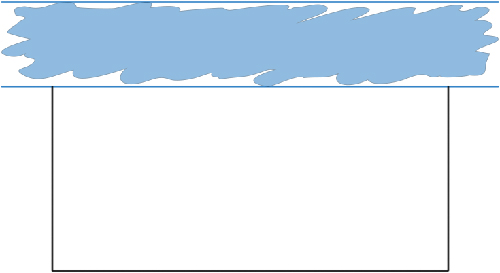
Let's begin by drawing our diagram. We have a river and a rectangular pen next to it.

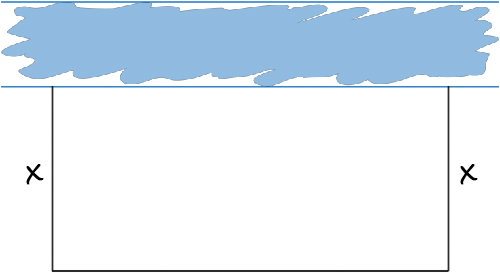
We want to find a way to build this fence so that it gives us the maximum area possible, but we only have 500 ft500\text{ ft} of fencing to use. We need to come up with some way to label these lengths. Well, let's call the left side xx. Since, the right side is the same length, we can also call that xx.

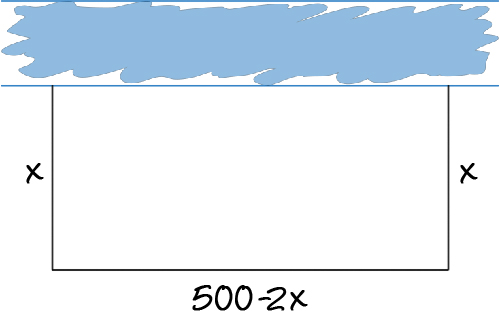
If there has to be 500 ft500\text{ ft} of fencing and you use x ftx\text{ ft} on the left and x ftx\text{ ft} on the right, then the remaining length of fence will be 500−2x ft500-2x\text{ ft}.

Since we want to maximize area, our maximization function is just the width times the length. A(x)=x(500−2x)=500x−2x2\begin{align} A(x)&=x(500-2x)\\ &=500x-2x^2 \end{align}

Next, we take the derivative. A(x)=500x−2x2A′(x)=500−4x\begin{align} A(x)&=500x-2x^2\\ A'(x)&=500-4x \end{align}

Then we set our derivative equal to zero to find the critical points. 500−4x=04x=500x=125\begin{align} 500-4x&=0\\ 4x&=500\\ x&=125 \end{align}

Because this is the only critical point, we can assume that it's the maximum. But if you want to check just plug in a point below 125125 and a point above into the derivative. If the answer comes out positive you know the original function is increasing. If it comes out negative then the function is decreasing. You should get that: (0,125) ↗(125,∞) ↘(0,125)\ \nearrow\\ (125, \infty)\ \searrow Because it's shifting from increasing to decreasing at the critical point, we know the critical point is a maximum.

So the optimal xx that maximizes the area is x=125x=125. Bu the problem asks for the maximized area. So we need to calculate this rectangles area. A(x)=500x−2x2A(125)=500(125)−2(125)2=62500−31250=31250 ft2\begin{align} A(x)&=500x-2x^2\\ A(125)&=500\color{red}{(125)}-2\color{red}{(125)}^2\\ &=62500-31250\\ &=31250\text{ ft}^2 \end{align}

Video · + 2 min read

(Video) Optimization of a Box's Volume

by PatrickJMT

Here's another optimization problem by patrickJMT. This problem deals with the volume of a box. It says,

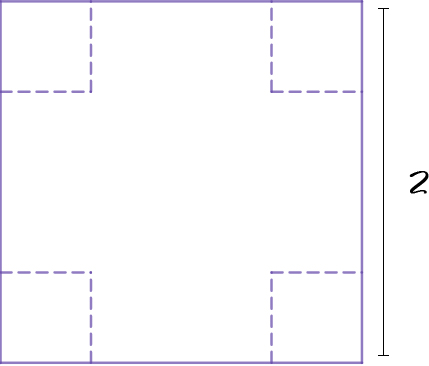
A woman is creating a box with an open top by removing squares of equal size from the corners of a sheet of metal and folding the sides upwards. If the sheet of metal is 2 ft2\text{ ft} by 2 ft2\text{ ft}, what is the maximum possible volume of such a box?

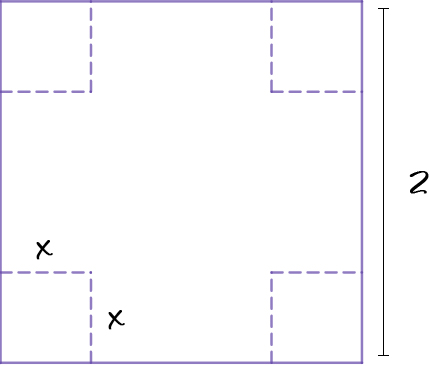
So begin as always by drawing the diagram. We have a square with a length of 2 ft2\text{ ft} and this woman is removing perfect squares from each corner. Then she bends the flaps up to create a box without a lid.

What is unknown to us is the amount that is removed from the corners. Let's label them as being xx feet.

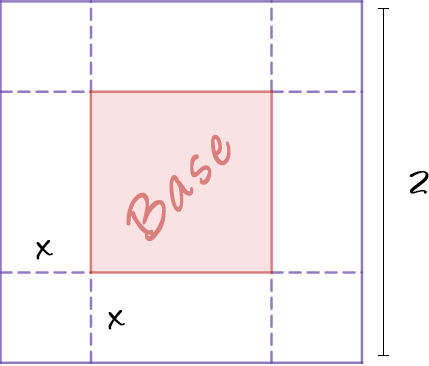
We want to maximize the volume of this box. So the maximization function will be: V(x)=lwhV(x)=lwh So we need to come up with a way to express these variables in terms of xx. Well, if we fold the edges up this middle square becomes the base of our box.

Originally, our base's length would be 22 feet long but we're removing xx feet from one side and xx feet from the other. So our new length will become l=2−2x ftl=2-2x\text{ ft}. The same goes for the width of the box. It too is w=2−2x ftw=2-2x\text{ ft}. Finally, the height of the box is going to be the length of what she cuts off because that's being folded up. So the height is just h=xh=x.

Plugging these back into our maximization function we get, V(x)=lwhV(x)=(2−2x)(2−2x)xV(x)=(4−8x+4x2)xV(x)=4x−8x2+4x3\begin{align} V(x)&=lwh\\ V(x)&=(2-2x)(2-2x)x\\ V(x)&=(4-8x+4x^2)x\\ V(x)&=4x-8x^2+4x^3\\ \end{align}

Before we continue, notice the domain of xx. If has to be bigger than zero, because we can't tear away zero feet or a negative amount of feet. 0<x0<x But it also has to be smaller than one because if we remove one foot from each side we have nothing left. 0<x<10<x<1 So the xx value we get must lie in-between these two numbers.

Let's now find the derivative of our maximization function. V(x)=4x−8x2+4x3V′(x)=4−16x+12x2V′(x)=4(1−4x+3x2)\begin{align} V(x)&=4x-8x^2+4x^3\\ V'(x)&=4-16x+12x^2\\ V'(x)&=4(1-4x+3x^2) \end{align}

Now we set this equal to zero in order to find our critical points. \begin{align} 4(1-4x+3x^2)&=0\ 1-4x+3x^2&=0\ (3x-1)(x-1)&=0\ \end{align} \begin{alignat}{3} &3x-1=0\quad&&\text{or}\quad&&x-1=0\ &3x=1\quad&&\text{or}\quad&&x=1\ &x=\frac13\quad&&\text{or}\quad \end{alignat}

Because our value needs to be between zero and one we know that the critical point we want is x=13x=\frac13.

If we plug this back into our maximization function we get the maximum volume to be, V(x)=(2−2x)(2−2x)xV(13)=(2−2⋅13)(2−2⋅13)⋅13=(2−23)(2−23)(13)=(43)(43)(13)=1627 ft3\begin{align} V(x)&=(2-2x)(2-2x)x\\ V(\frac13)&=(2-2\cdot\color{red}{\frac13})(2-2\cdot\color{red}{\frac13})\cdot\color{red}{\frac13}\\ &=(2-\frac23)(2-\frac23)(\frac13)\\ &=(\frac43)(\frac43)(\frac13)\\ &=\frac{16}{27}\text{ ft}^3 \end{align}

Video · + 1 min read

(Video) Optimization of a Can

by PatrickJMT

Here's a video by patrickJMT where he hows you how to solve an optimization problem about the volume of a can. The problem states,

Suppose a can is made up of 25.625π25.625\pi square inches of material. What dimensions (to the nearest hundredth) would maximize the volume of this cylindrical can?

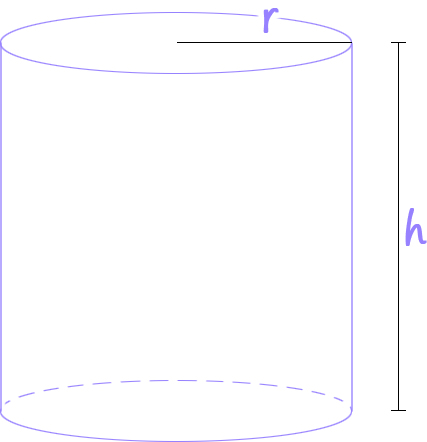
To begin, let's draw our can.

The problem is asking us to maximize the volume so our maximization function will be V=πr2hV=\pi r^2h

Now we need to figure out a way to reduce this function to one variable. The other information that is given is that the surface area contains 25.625π25.625\pi square inches of material. The surface area of the can is composed of two circles' area (top and bottom) and a rectangle area. 25.625π=πr2+πr2+Rectangle25.625\pi=\pi r^2+\pi r^2+\text{Rectangle}

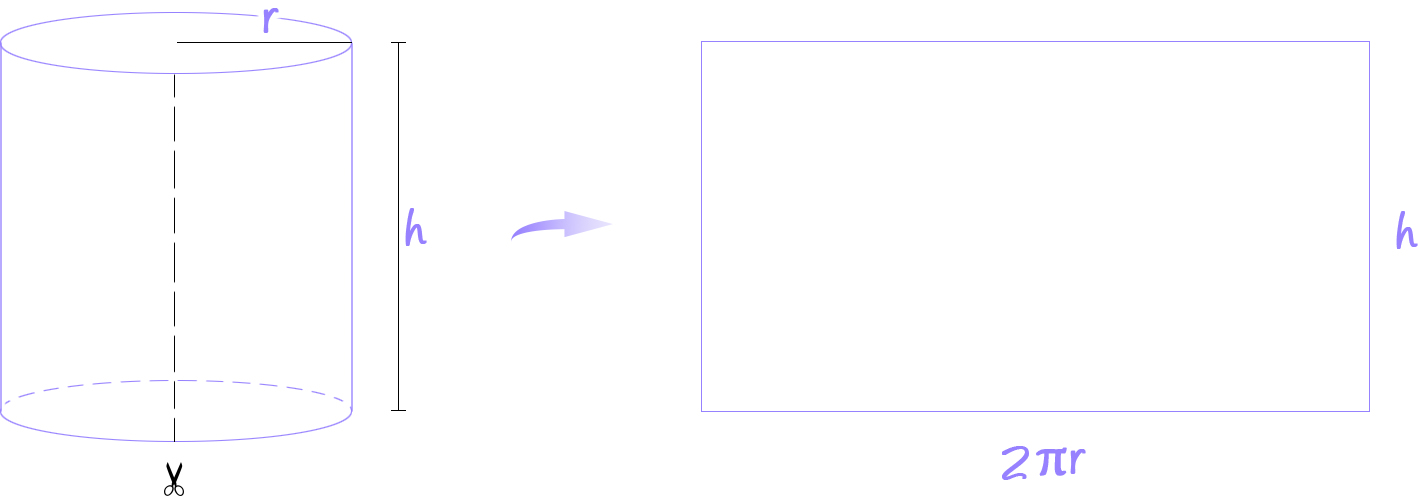
To get the rectangle, imagine cutting the surface of the can along a side and unrolling it.

The height stays hh but the length of the rectangle is the circumference of of a circle (because we rolled it up into a tube). 25.625π=πr2+πr2+2πrh25.625π=2πr2+2πrh25.625π=2πr(r+h)25.625π2πr=r+hh=12.8125r−r\begin{align} 25.625\pi&=\pi r^2+\pi r^2+2\pi rh\\ 25.625\pi&=2\pi r^2+2\pi rh\\ 25.625\pi&=2\pi r(r+h)\\ \frac{25.625\pi}{2\pi r}&=r+h\\ h&=\frac{12.8125}{r}-r\\ \end{align}

We can substitute this into our maximization function. V=πr2hV=πr2(12.8125r−r)V=12.8125πr2r−πr3V=12.8125πr−πr3\begin{align} V&=\pi r^2h\\ V&=\pi r^2\color{red}{\bigg(\frac{12.8125}{r}-r\bigg)}\\ V&=\frac{12.8125\pi r^2}{r}-\pi r^3\\ V&=12.8125\pi r-\pi r^3\\ \end{align}

Now take the derivative. V=12.8125πr−πr3V′=12.8125π−3πr2\begin{align} V&=12.8125\pi r-\pi r^3\\ V'&=12.8125\pi-3\pi r^2 \end{align}

Set it equal to zero to find the critical points. 12.8125π−3πr2=03πr2=12.8125πr2=4.27083333r=2.07\begin{align} 12.8125\pi-3\pi r^2&=0\\ 3\pi r^2&=12.8125\pi\\ r^2&=4.27083333\\ r&=2.07 \end{align}

We only took the positive value because we can't have a negative radius. So the radius in which our can has the maximum volume is r=2.07 inr=2.07\text{ in}.

The problem asks for the dimensions of the can. So plug our radius back into the surface area function in order to find the maximizing height. h=12.8125r−rh=12.81252.07−2.07h=4.12 in\begin{align} h&=\frac{12.8125}{r}-r\\ h&=\frac{12.8125}{2.07}-2.07\\ h&=4.12\text{ in} \end{align}

So the maximizing dimensions are a height of 4.124.12 inches and a radius of 2.072.07 inches.

Video · + 1 min read

(Video) Optimization of Two Squares

by PatrickJMT

Here's a video by patrickJMT going over another optimization problem. The problem states:

A 20 inch20\text{ inch} wire is cut in two and shaped into two squares. What is the minimum possible sum of the two areas?

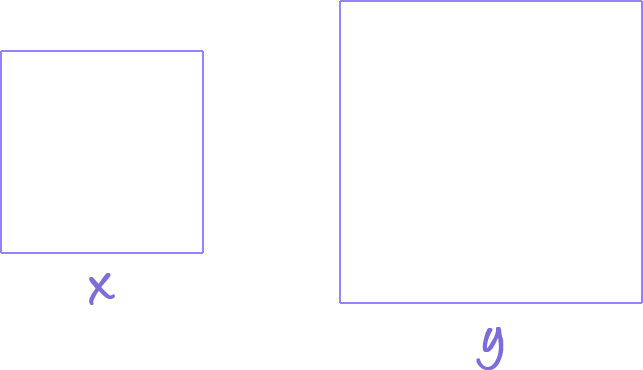
Let's begin by drawing a diagram with two squares. One could have a length of xx inches and the other a length of yy inches.

We want to find the minimum area of these two squares. So our minimization function is the area of one square plus the area of the other square. Minimize: A=x2+y2\text{Minimize: }A=x^2+y^2

We want to reduce this down to one variable. To do that we need to create a constraint function. We know that these two squares are made up of 2020 inches of wire. So the perimeter of both the squares needs to add to 2020. Constraint: 20=4x+4y\text{Constraint: }20=4x+4y

Solve the constraint function for one of the variables. 4x+4y=204y=20−4xy=5−x\begin{align} 4x+4y&=20\\ 4y&=20-4x\\ y&=5-x \end{align}

Now we can substitute this into the minimization function to reduce it down to one variable. A=x2+y2A=x2+(5−x)2A=x2+25−10x+x2A=2x2−10x+25\begin{align} A&=x^2+y^2\\ A&=x^2+\color{red}{(5-x)}^2\\ A&=x^2+25-10x+x^2\\ A&=2x^2-10x+25 \end{align}

Next, take the derivative. A=2x2−10x+25A′=4x−10\begin{align} A&=2x^2-10x+25\\ A'&=4x-10 \end{align}

Set it equal to zero in order to find the critical points. 4x−10=04x=10x=52\begin{align} 4x-10&=0\\ 4x&=10\\ x&=\frac52 \end{align}

You can justify that this is the minimum by looking at the signs of the derivative. A number below 52\frac52 will make the derivative positive and a number above it will make the derivative negative.

The problem asks for the smallest area of the two squares. We need to find the length of yy and then add the areas together. To find yy plug our minimizing xx back into the constraint function. y=5−xy=5−52y=52\begin{align} y&=5-x\\ y&=5-\color{red}{\frac52}\\ y&=\frac52 \end{align}

The two squares are of the same size. Finally, we plug these numbers in to find the combined area of the two. \begin{align} A&=x^2+y^2\ A&=\color{red}{\bigg(\frac52\bigg)}^2+\color{red}{\bigg(\frac52\bigg)}^2\ A&=\frac{25}4+\frac{25}4\ A&=\frac{50}{4}\ A&=\frac{25}{2}\text{ in}^2 \end{align}

Video · + 1 min read

(Video) Optimization of a Rectangle in an Ellipse

by PatrickJMT

Here's another video by patrickJMT where he finds the optimal rectangle to fit inside an ellipse. The problem states:

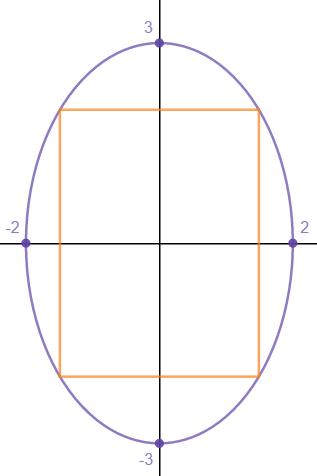
Find the area of the largest rectangle that can be inscribed in the ellipse given by: x24+y29=1\frac{x^2}{4}+\frac{y^2}{9}=1

Begin by drawing a diagram.

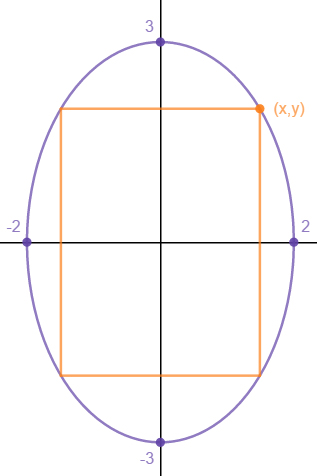
We want to maximize the area of this rectangle. Let's say that the top right corner is touching the ellipse at some point (x,y)(x,y).

Now we can say that the rectangle's length is 2x2x and its height is 2y2y. So the area becomes: A=lhA=(2x)(2y)A=4xy\begin{align} A&=lh\\ A&=(2x)(2y)\\ A&=4xy \end{align}

We want to somehow reduce this equation down to one variable. We can do this with our constraint equation which is the equation for the ellipse. Let's solve this for yy. x24+y29=1y29=1−x24y2=9(1−x24)y=±9(1−x24)y=±31−x24\begin{align} \frac{x^2}{4}+\frac{y^2}{9}&=1\\ \frac{y^2}{9}&=1-\frac{x^2}{4}\\ y^2&=9\bigg(1-\frac{x^2}{4}\bigg)\\ y&=\pm\sqrt{9\bigg(1-\frac{x^2}{4}\bigg)}\\ y&=\pm3\sqrt{1-\frac{x^2}{4}}\\ \end{align}

The positive part is referring to the top half of the ellipse. The negative part is referring to the bottom half. So he's just gonna use y=31−x24y=3\sqrt{1-\frac{x^2}{4}}. We can substitute this into the equation we want to maximize. A=4xyA=4x⋅31−x24A=12x1−x24\begin{align} A&=4xy\\ A&=4x\cdot\color{red}{3\sqrt{1-\frac{x^2}{4}}}\\ A&=12x\sqrt{1-\frac{x^2}{4}} \end{align}

Now take the derivative. A=12x1−x24A′=[12x]′1−x24+12x[1−x24]′A′=121−x24+12x⋅121−x24⋅[1−x24]′A′=121−x24+12x⋅121−x24⋅−12xA′=121−x24−3x21−x24A′=12(1−x24)1−x24−3x21−x24A′=12−3x2−3x21−x24A′=12−6x21−x24\begin{align} A&=12x\sqrt{1-\frac{x^2}{4}}\\ A'&=\color{red}{[12x]'}\sqrt{1-\frac{x^2}{4}}+12x\color{red}{\bigg[\sqrt{1-\frac{x^2}{4}}\bigg]'}\\ A'&=12\sqrt{1-\frac{x^2}{4}}+12x\cdot\frac{1}{2\sqrt{1-\frac{x^2}{4}}}\cdot\color{red}{\bigg[1-\frac{x^2}{4}\bigg]'}\\ A'&=12\sqrt{1-\frac{x^2}{4}}+12x\cdot\frac{1}{2\sqrt{1-\frac{x^2}{4}}}\cdot-\frac12x\\ A'&=12\sqrt{1-\frac{x^2}{4}}-\frac{3x^2}{\sqrt{1-\frac{x^2}{4}}}\\ A'&=\frac{12(1-\frac{x^2}{4})}{\sqrt{1-\frac{x^2}{4}}}-\frac{3x^2}{\sqrt{1-\frac{x^2}{4}}}\\ A'&=\frac{12-3x^2-3x^2}{\sqrt{1-\frac{x^2}{4}}}\\ A'&=\frac{12-6x^2}{\sqrt{1-\frac{x^2}{4}}}\\ \end{align}

Next, we find the points where the function equals zero or is undefined. These will be the critical points. 12−6x21−x24=012−6x2=06x2=12x2=2x=±2\begin{align} \frac{12-6x^2}{\sqrt{1-\frac{x^2}{4}}}&=0\\ 12-6x^2&=0\\ 6x^2&=12\\ x^2&=2\\ x&=\pm\sqrt2 \end{align}

Since we're only worried about positive distances we only need to look at x=2x=\sqrt2.

If we look at where the derivative is undefined, that happens when the denominator is equal to zero. 1−x24=01−x24=0x24=1x2=4x=±2\begin{align} \sqrt{1-\frac{x^2}{4}}&=0\\ 1-\frac{x^2}{4}&=0\\ \frac{x^2}{4}&=1\\ x^2&=4\\ x&=\pm2 \end{align} But we can rule these out by looking back at our picture. If x=2x=2 that means it's extending out to the middle of the ellipse. This won't leave any room for the rectangle to have a height.

So the only critical point we have is x=2x=\sqrt2. If we plug back into our area function we get the maximum area to be: A=12x1−x24A=12(2)1−(2)24A=1221−12A=12212A=12\begin{align} A&=12x\sqrt{1-\frac{x^2}{4}}\\ A&=12\color{red}{(\sqrt2)}\sqrt{1-\frac{\color{red}{(\sqrt2)}^2}{4}}\\ A&=12\sqrt2\sqrt{1-\frac12}\\ A&=12\sqrt2\frac{1}{\sqrt2}\\ A&=12 \end{align}

Type a concept, like “slope” or “photosynthesis”.

↑ ↓ to choose · Enter to openSearch explanations and problems