Interactive · 3 questions
+3 contributors


A rational number is any number or quantity that can be written as a fraction. This includes numbers that look like fractions right away (like , for example) and numbers that are fractions in disguise (like , which is a reduced form of the fraction ).
Examples of rational numbers are: , -,
So, a rational inequality is an expression that includes rational numbers and any of the inequality signs (, , , ).
An example of a rational inequality is:
The left side of the inequality has the rational component, while the right hand side has a constant value.
When solving rational inequalities, there are four steps we need to take:
1. Rearrange the inequality so there's a single fraction on one side and on the other
2. Determine what values make the top and bottom of the fraction equal
3. Construct a number line
4. Test points
Let's start with this example:
This example is a rational inequality because
- is used to compare values
- Fractions are included
Step 1: Rearrange the inequality so there's a single fraction on one side and on the other
Do this just like you normally would - add or subtract values from both sides of the expression until you get the format you want.
Step 2: Determine what values make the top and bottom of the fraction equal
If we plug into the numerator:
If we plug in the value into the denominator:
These two values ( and ) are called your critical values.
For practice, identify the critical values for the inequality:
Step 3: Construct a number line
We want to construct a number line that includes our two critical values. Let's take a look at the number line and then go over how we got there.
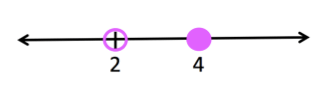
Image source: by Hannah Bonville
Recall that an open circle on a number line means that point is not included in the range of possible values, while a closed circle means that the point is included.
No matter what, the critical value that makes the bottom of your fraction equal will have an open circle on the number line. In our case, this is . This value makes the denominator zero, making the whole expression undefined. (If you want to know why, ask Siri what happens when you divide by zero).
Now, here's where we need to pay special attention to inequality sign.
- If you're using a plain old or sign, the other critical value will have an open circle on the number line.
- If you're using or , the critical value will have a closed circle.
This should make sense, since those signs include the phrase "OR equal to." That means that the solution could be equal to the critical value, so we need to give it a closed circle and include it in our range.
Consider the inequality below. What will the number line look like?
Step 4: Test values
So far, we only know what happens when we plug either of our two critical values into the expression. For us, if we plug in , the expression becomes undefined and if we plug in , the expression equals .
But we need to figure out what happens when we plug in values from other parts of the number line. To do this, we'll use test values.
We'll need one test value from each "segment" of our number line:
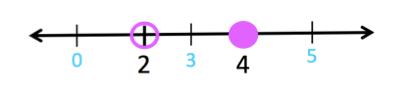
Image source: by Hannah Bonville
In our case, we need three test values. We've selected , , and , but any number in each segment will do. That means, instead of , you could've picked ; any number less than will work. The same idea is true for the other segments.
What we need to do now is actually TEST our test values. We'll do this by plugging each one into our inequality and seeing if the result produced can be described as "true."
Let's try this with our first test value, .
When you plug in for into the inequality, what is the result?
Recall that our example inequality is:
This is "true," since is in fact greater than or equal to . So, we need to include this part of the number line in our solution.
We can write it like this: .
This covers every possible value less than (but not including - remember it's an open circle) .
Try plugging in the other two test values and then check what we've got below!
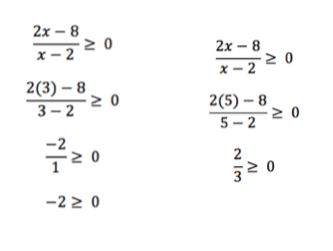
Okay, so let's see what we've got here.
The test value doesn't produce a true statement (on the left in the image above), since is NOT greater than or equal to . This means that no values in that segment of the number line are solutions to our inequality.
The test value produces a true statement (on the right), since is greater than or equal to . So, we need to include this range in our solution.
We can write it like this: .
This covers every value from and including (notice the bracket instead of the normal parenthesis, and recall the closed circle on the number line) all the way to infinity.
So, our final answer needs to show all of the ranges of solutions we identified. We can write it like this: