Infinidade de soluções

Before this, knowResolvendo a partir do gráficoResolvendo sistemas lineares

Illustrated · 1 min

Infinity and Beyond!

You may have heard of infinity and beyond from a favorite toy adventurer...

...but we're not really talking about flying here. Instead, we're talking about systems of equations. Most systems of equations in Algebra 1 (where we are now) will have just one solution—just one set of variable values where all the equations are true. You'll also have systems with no solutions. But some systems have infinite solutions.

How can systems have infinite solutions? If you solve a system with graphing, you might notice that the solution is where the lines cross. Let's look at a system of equations that has infinite solutions:

22x+11y=4414x+7y=28\begin{gather} 22x+11y=44\\ 14x+7y=28 \end{gather}

Try simplifying the top equation. What do you notice?

2x+y=42x+y=4\begin{gather} 2x+y=4 \\ 2x+y=4 \end{gather}

These are same equation! They'll both be exactly the same line on a graph. In other words, they'll overlap completely. This is easier to tell because both equations are in standard form.

You'll notice that if you convert from standard form to slope-intercept form, you'll see that they both have the same slope!

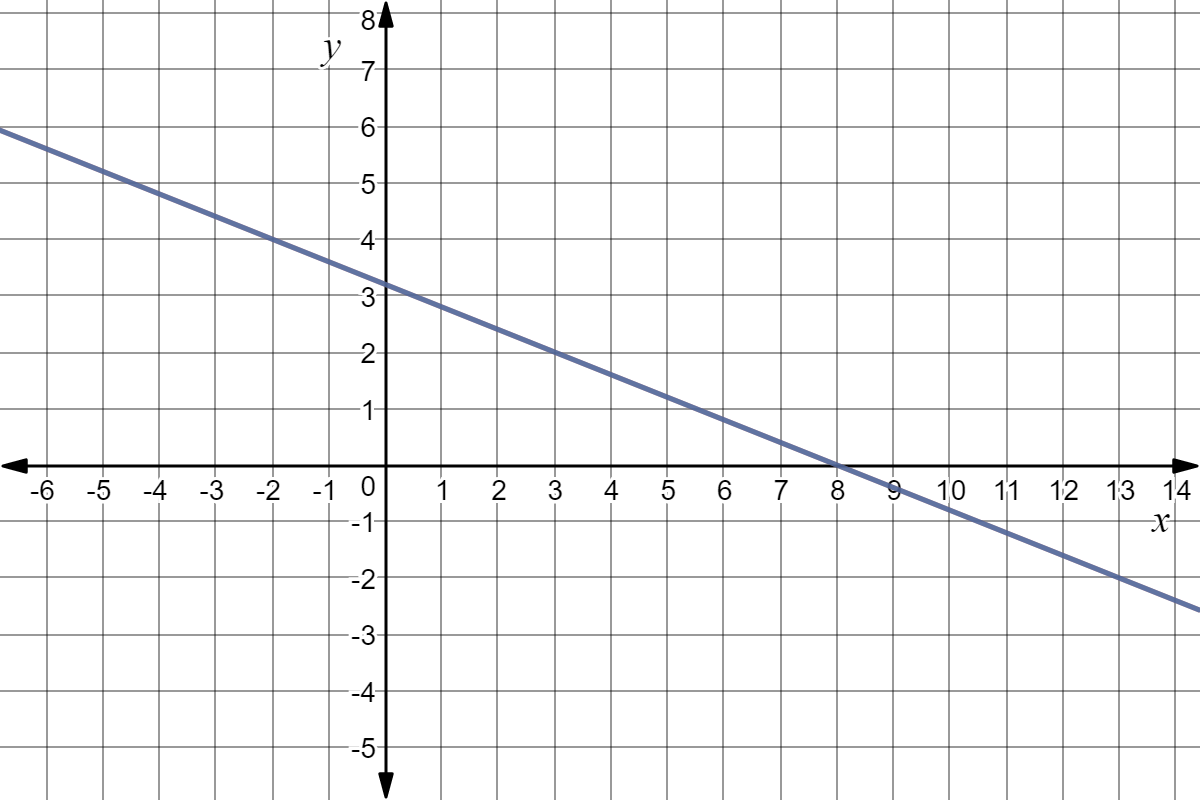
The Graph

Viola!

System of linear equations where the red line is 22x + 11y = 44 and the blue line is 2x + y = 4.

Created using Desmos

Every point on the line will satisfy both equations. The line extends infinitely, so there are an infinite number of solutions.

Interactive · 1 question

Systems with Infinitely Many Solutions

There is always a possibility that a system of equations has infinite solutions.

A beautiful picture of a galaxy, composed of black, blues, purples and white stars.

By ESO/T. Preibisch CC BY 4.0

While this sounds like a really BIG idea, there's a pretty simple way to tell if your system of equations has infinite solutions.

If the equations in your system are the same, then there are infinite solutions.

This is why it's important to simplify your equations as much as possible before you really dig into a problem.

Let's take a look at an example:

2x+5y=1610y=32−4x\begin{gather} 2x + 5y = 16\\ 10y = 32 - 4x \end{gather}

Check off all the true statements.

Choose all correct answers

Video

(Video) Systems of Equations with Infinitely Many Solutions

by The Math Sorcerer

This video above by The Math Sorcerer shows linear systems with infinitely many solutions.

Summary\large{\text{Summary}}

Suppose we have the system: x+y=43x+3y=12\begin{align} x+y&=4\\ 3x+3y&=12 \end{align}

Let's multiply all terms in the first equation by −3-3 so that we can add and cancel variables. x+y=4−3(x+y)=−3(4)−3x−3y=−123x+3y=12\begin{align} x+y&=4\\ -3(x+y)&=-3(4)\\ -3x-3y&=-12\\ 3x+3y&=12 \end{align}

Now our new system is:

3x+3y=123x+3y=12\begin{align} 3x+3y&=12\\ 3x+3y&=12 \end{align}

These are the same equation!! If we graphed them, they would be the same line.

When we graph systems of equations, the intersection of the lines is the solution. If a system has infinitely many solutions, then the lines overlap at every point. In other words, they're the same exact line! This means that any point on the line is a solution to the system. Thus, the system of equations above has infinitely many solutions.

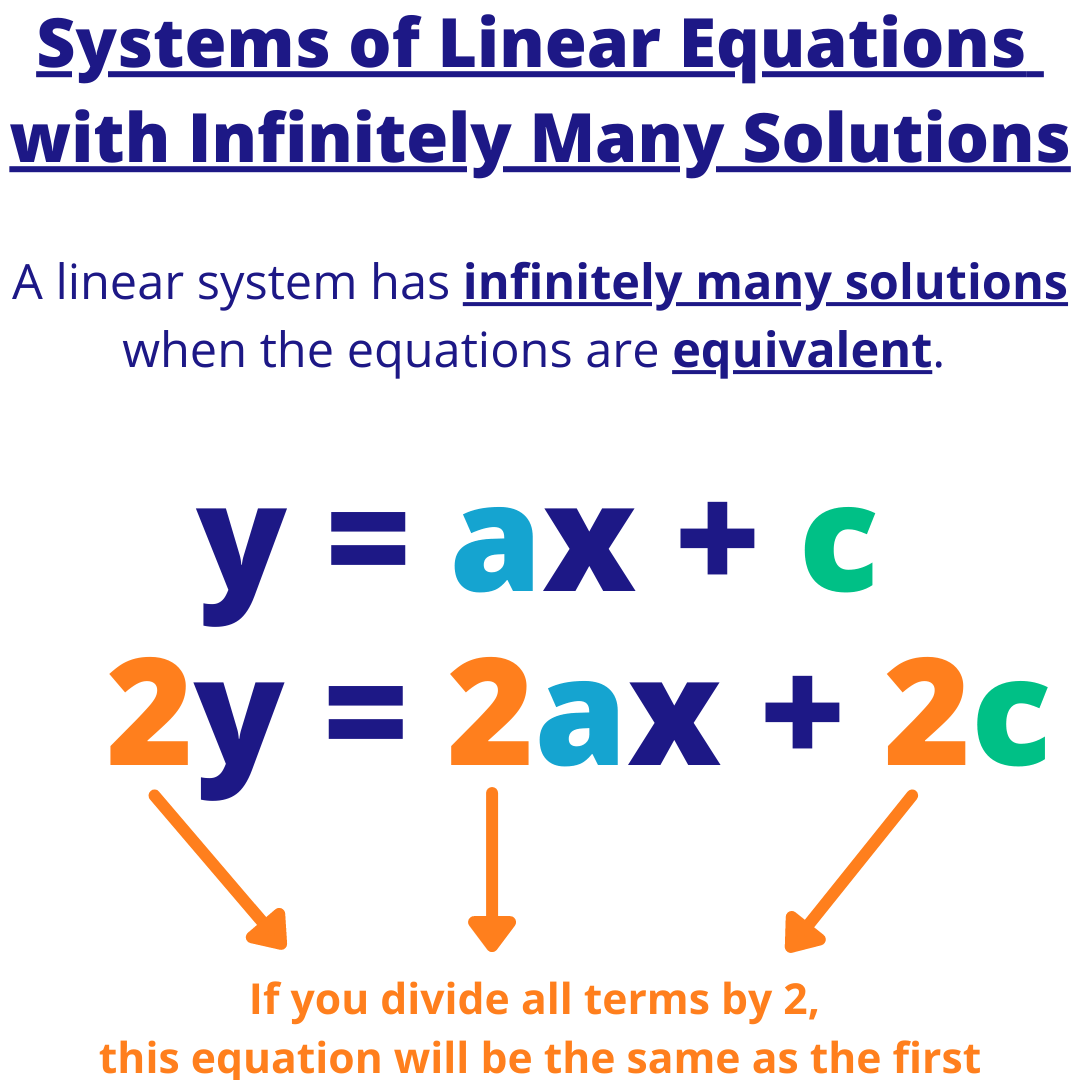
Systems of Linear Equations with Infinitely Many Solutions. A linear system has infinitely many solutions when the equations are equivalent. {y=ax+c, 2y=2ax+2c} --> If you divide all terms in the second equation by 2, the second equation will be the same as the first.

Image source: By Caroline Kulczycky

Type a concept, like “slope” or “photosynthesis”.

↑ ↓ to choose · Enter to openSearch explanations and problems