Identidades reciprocas

Before this, knowIdentificação da tangente

Illustrated · 1 min

By this point you're probably familiar with how sine, cosine, and tangent are defined. These are the "foundational trig functions" because we define the other trig functions using these ones, and the most commonly used trigonometric identities involve sine, cosine, and tangent.

From here on we will abbreviate sine as sin⁡,\sin, cosine as cos⁡,\cos, and tangent as tan⁡.\tan.

Now let's introduce the reciprocal functions. The secant is the reciprocal of cosine, and is abbreviated sec⁡.\sec. We define sec⁡(x)\sec(x) as

sec⁡(x)=1cos⁡(x).\sec(x) = \frac{1}{\cos(x)}.

The cosecant is the reciprocal of sine, and is abbreviated csc⁡.\csc. We define csc⁡(x)\csc(x) as

csc⁡(x)=1sin⁡(x).\csc(x) = \frac{1}{\sin(x)}.

Finally, the cotangent is the reciprocal of tangent, and is abbreviated cot⁡.\cot. We define cot⁡(x)\cot(x) as

cot⁡(x)=1tan⁡(x).\cot(x) = \frac{1}{\tan(x)}.

In practice, we often use this formula combined with the fact that tan⁡(x)=sin⁡(x)cos⁡(x).\tan(x) = \frac{\sin(x)}{\cos(x)}. Thus another very useful identity to know is

cot⁡(x)=1sin⁡(x)cos⁡(x)=cos⁡(x)sin⁡(x).\cot(x) = \frac{1}{\frac{\sin(x)}{\cos(x)}} = \frac{\cos(x)}{\sin(x)}.

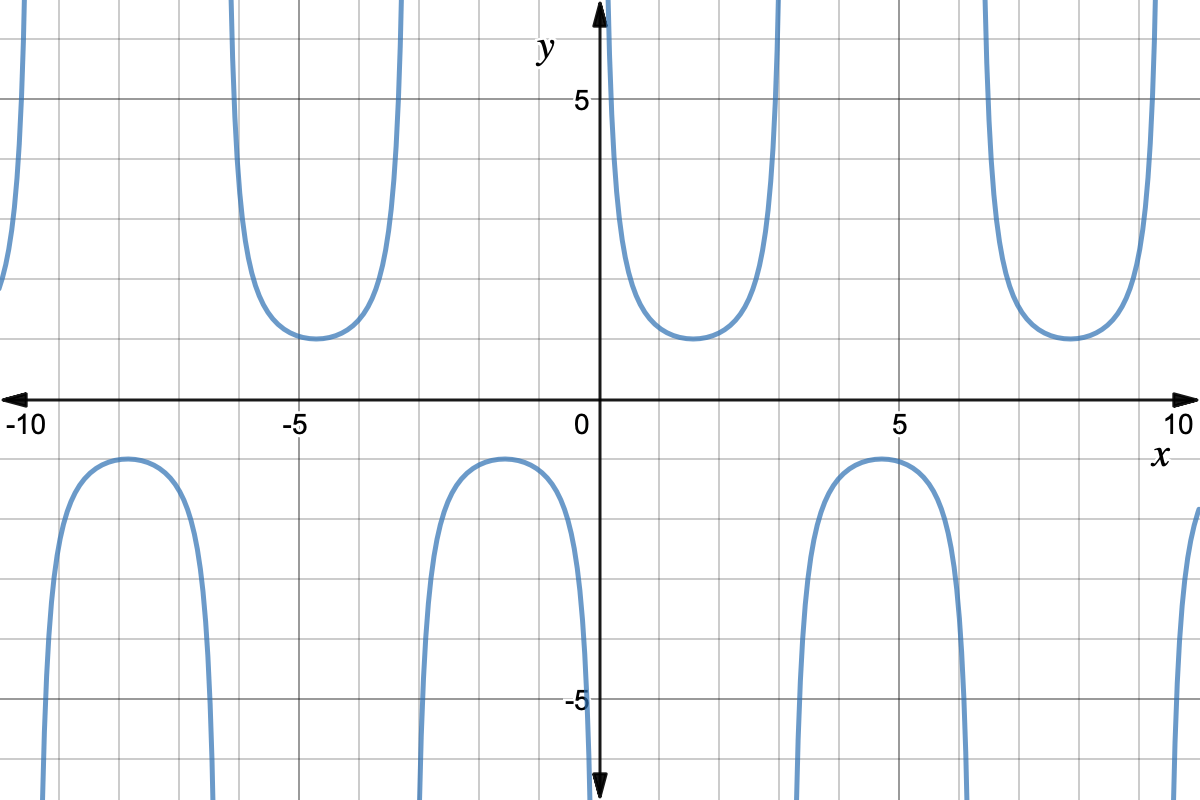
One other thing to keep in mind: all three definitions, those of secant, cosecant, and cotangent, involve dividing something that might be zero. For instance, if sin⁡(x)=0\sin(x) = 0 then csc⁡(x)\csc(x) isn't defined because we'd be dividing by zero. This causes secant, cosecant, and cotangent to have "holes" in their domains. To see what I mean, take a look at graphs of all three functions.
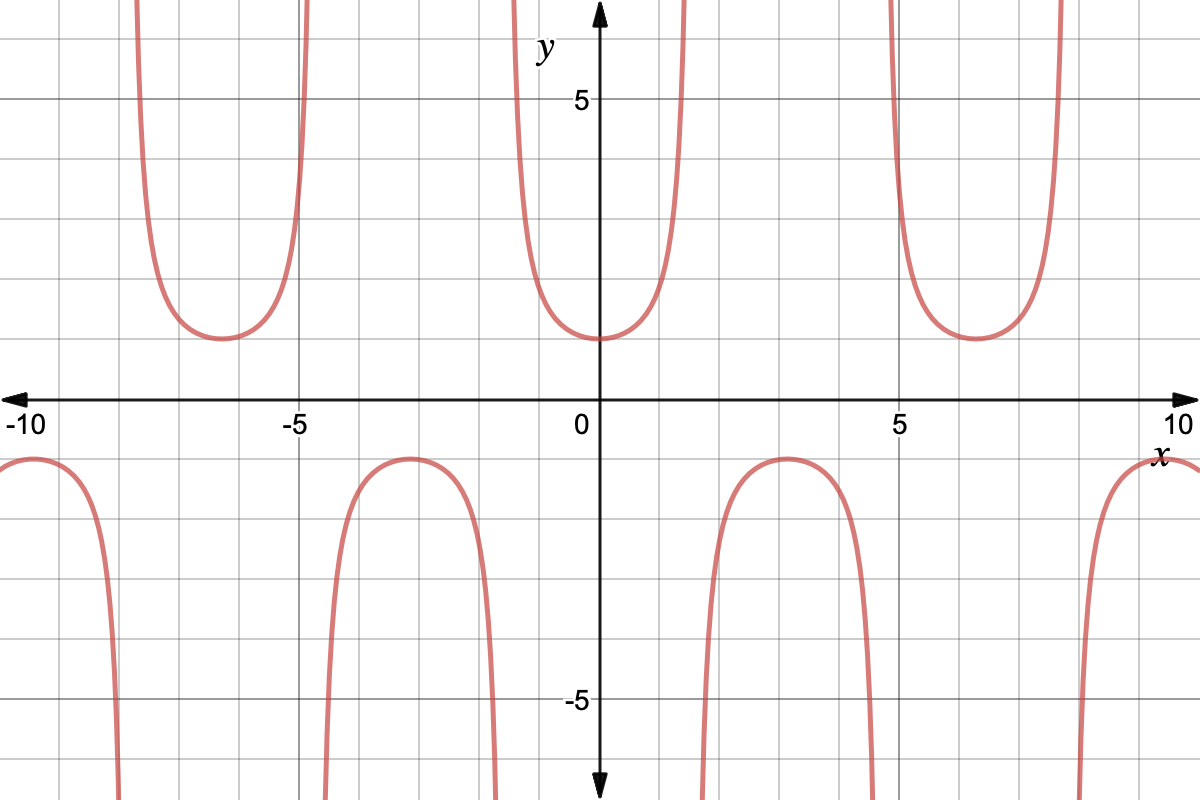
Graph of sec(x)

Graph courtesy of Desmos

Graph of csc(x)

Graph courtesy of Desmos

Graph of cot(x)

Graph courtesy of Desmos

Video

(Video) What are the reciprocal identities of trigonometric functions

by Brian McLogan

Watch this video by Brian Logan about the reciprocal identities in trigonometry!

To summarize, the reciprocal identities are:

sin⁡θ=1csc⁡θ\sin{\theta} = \frac{1}{\csc{\theta}} csc⁡θ=1sinθ\csc{\theta} = \frac{1}{sin{\theta}}

and

cos⁡θ=1sec⁡θ\cos{\theta} = \frac{1}{\sec{\theta}} sec⁡θ=1cos⁡θ\sec{\theta} = \frac{1}{\cos{\theta}}

and tan⁡θ=1cot⁡θ\tan{\theta} = \frac{1}{\cot{\theta}} cot⁡θ=1tan⁡θ\cot{\theta} = \frac{1}{\tan{\theta}}

Illustrated · 1 min

Trigonometry: Reciprocal Identities

We've already covered the tangent identity! Now we will move on in our series of definition identities.

We've written out these reciprocal identities as quotient identities! That means that we have these formulas dictated with "sine", "cosine", and "tangent", etc.

Trigonometry: Reciprocal Functions

sec{x} = fraction{1}/{cos{x}} --> cos{x} = fraction{1}/{sec{x}}
csc{x} = fraction{1}/{sin{x}} --> sin{x} = fraction{1}/{csc{x}}
cot{x} = fraction{1}/{\tan{x}} --> tan{x} = fraction{1}/{cot{x}}
^the opposite functions are also true

Image source: by Trisha

In trig, reciprocal functions are pairs of functions that "flip" each other. That means if you know one, you know the other because you can take 11 divided by the function.

This concept is useful when solving equations and understanding the relationships between trig functions.

####Looking Further

In the next couple of lessons, you will learn about the pythagorean identity and how to derive identities.

Type a concept, like “slope” or “photosynthesis”.

↑ ↓ to choose · Enter to openSearch explanations and problems