Illustrated · 1 min
+5 contributors





What Is a Carbohydrate?
Carbohydrates are sugars. They're the primary energy storage molecule for life on Earth. They have a simple chemical ratio of 1 carbon to 2 hydrogen to 1 oxygen atom. This is often written as .
Plants perform photosynthesis to make these sugars by using a water molecule, (carbon dioxide), and energy from the sun.
The simplest carbohydrates are called monosaccharides. A monosaccharide is the monomer, or building block, for all other types of carbohydrates. Glucose is the most important monosaccharide and is used by organisms in cellular respiration to produce usable energy for the body.

Image source: By Hannah Bonville

These are all examples of monosaccharides—single, little sugars. They are monomers (building blocks) used to make bigger sugars when they're chained together. If something ends in -ose, it's a sugar.
Image source: By OpenStax College CC BY 3.0, via Wikimedia Commons
When two monosaccharides bond together, they are called a disaccharide. (It helps to remember that di means two and mono means one.) Examples of disaccharides include sucrose and lactose. These are easily broken down by animals and bacteria to get glucose, which is then used for cell functions.

Sucrose is just one example of a disaccharide.
Image source: By Hannah Bonville
Large strings or clusters of monosaccharides are called polysaccharides (poly means many). They are used either as energy storage molecules or as structural molecules.
Examples include glycogen, cellulose, starch, and chitin. Glycogen stores energy for humans (in the liver), while starch performs the same function in plants. Cellulose makes up plant cell walls, giving them their square shape. Finally, chitin is what makes up the hard exoskeletons of insects.

Polysaccharides like starch, glycogen, and cellulose are big molecules. Each little blue hexagon in this picture represents a single monosaccharide (like glucose).
Image source: By OpenStax College CC BY 3.0, via Wikimedia Commons
To summarize, carbohydrates are efficient at energy storage. Plants form them through photosynthesis, and animals eat plants to access the energy trapped in them.
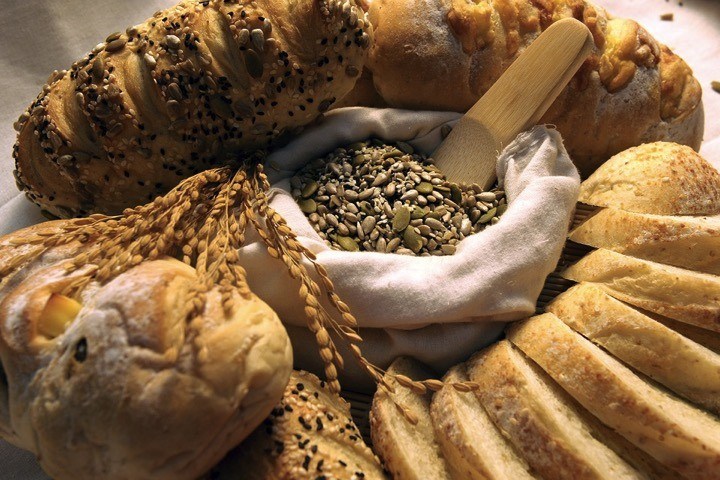
Plant starches need to be processed into bread before humans can consume the energy created by wheat.
Image source: By Zefe Wu CC0, via pixabay.com
Key Vocabulary:
- Carbohydrate
- Polysaccharide
- Monosaccharide
- Disaccharide
- Glucose