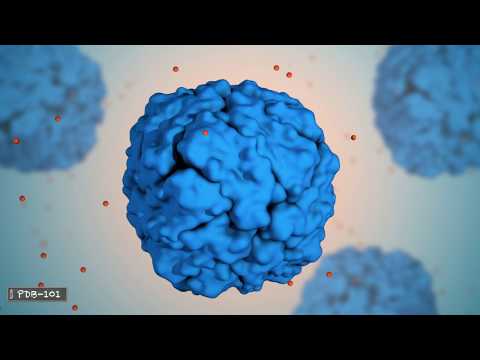
Proteins are polymers formed from monomers called amino acids joined together by peptide bonds. A chain of amino acids can also be called a polypeptide. (Anything with "pep" in it probably refers to a protein.)
There are 20 amino acids from which all protein molecules are made. Some proteins contain just a few amino acids in a chain. Other proteins are chains of thousands of amino acids. The largest known protein is titin. It's made of a chain of 33,000 amino acids.
Here are the 20 amino acids. Note that many (though not all) have names ending in -ine. All amino acids contain nitrogen.
All amino acids have four identical parts: An amino group, a carboxyl group, a central carbon, and a hydrogen. They only differ in their fifth part, which has many names. It can be called a functional group, R group, side chain, or amino acid residue. Let's go with functional group.
In the table above, the functional groups are highlighted in blue. Note how every other part of the amino acids is always the same.
Proteins are the most diverse of the four biomolecules. In fact, they perform the majority of a cell's functions. For example, proteins can catalyze (speed up) reactions as enzymes, act as signaling proteins, transport molecules, replicate DNA, respond to stimuli, and form structures within cells.
Proteins are an important part of the cell membrane (also called the phospholipid bilayer or the plasma membrane). They are shown in blue above, nestled in amongst the phospholipids.
There are two types of membrane proteins you should know about:
Here's how I remember the difference:
- Integral proteins are well-integrated into the cell membrane
- Peripheral proteins are like your peripheral vision—just on the side
As you can see in the picture, integral proteins can act like channels. They allow things to pass through the cell membrane more easily.
Proteins do not store energy; they are the workers of a cell.
This is so important that it's worth repeating: proteins are not energy storage molecules. Eating lots of protein will not give you a burst of energy.
Proteins do things. They perform and carry out the functions that enable a cell to move, use energy, respond to stimuli, and everything else that keeps a cell alive.
Vocabulary Review:
Monomer : Any molecule that can react with other molecules of the same or different makeup to form a chain, or polymer
Polymer : A chain of monomers made of a specific type of compound
Macromolecule : A polymer that has a large (macro) molecular mass. There are four main types in organisms: carbohydrates, proteins, lipids, and nucleic acids
Amino Acids : Molecules with a carboxyl group (−COOH) and an amino group (−NH2). The building blocks of proteins
Polypeptide : A molecule made up of peptide bonds, or covalent bonds, that hold amino acids together
Protein : Complex polymer made of carbon, hydrogen, nitrogen, and oxygen. They are made of amino acids