Interactive · 2 questions

+1 contributors

The Unit Circle

By Gustavb via Wikimedia Commons
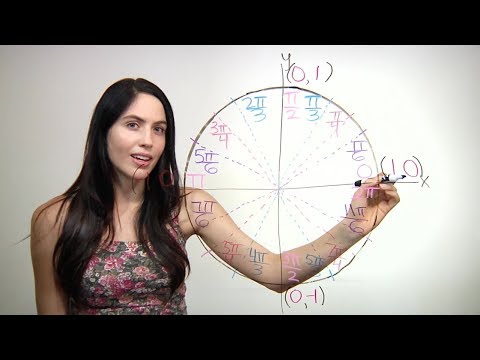
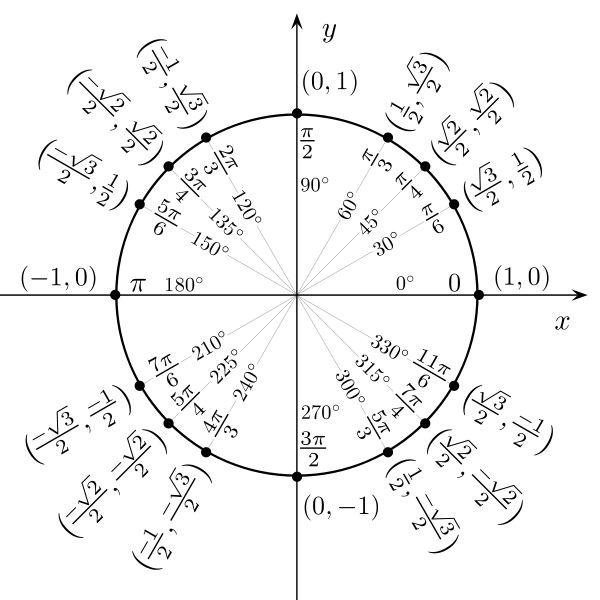
At first the unit circle can look a little overwhelming but it is very useful once you understand all of the parts. Let's look at some basics.
- The unit circle is a circle with a radius of unit (hence the name)
- Each point along the circumference of the circle relates to a cosine and sine of the angle from the positive -axis, called , and can be listed as .
- The listed angles and points are used in relation to special triangles (45-45-90 Triangles and 30-60-90 Triangles)
Sine, Cosine, and Right Triangles

By MartinThoma via Wikimedia Commons
At any given point on the unit circle, a line can be made perpendicular to the -axis from the point to the -axis. This creates a right triangle with side lengths of , , and . We can relate this back to our special triangles (45-45-90 Triangles and 30-60-90 Triangles).
If , we get our triangle. Our expansive knowledge of this kind of triangle and our good friend soh-cah-toa let us know that both the sine and cosine of is . This is reflected by the point on the unit circle where
If , we get the triangle. From this triangle we have calculated that and . This same triangle is used for . Calculating from our triangle we get that and . Once again this is reflected on our unit circle.
We can find any point on the circle given the corresponding angle through the same process as above. When using the unit circle, , but we can do the same calculations with circles with larger radius by multiplying each function by the radius.
Reference Angles
The unit circle is equally as useful once we leave the first quadrant.

By Kaboldy via Wikimedia Commons
The picture above shows the same triangle rotated to match each of the four possible quadrants. The key to finding the correct sine and cosine when in quadrants is to relate each angle to a reference angle.
A reference angle is the smallest angle that brings you to the closest horizontal line, and is always between and .

Made with Desmos
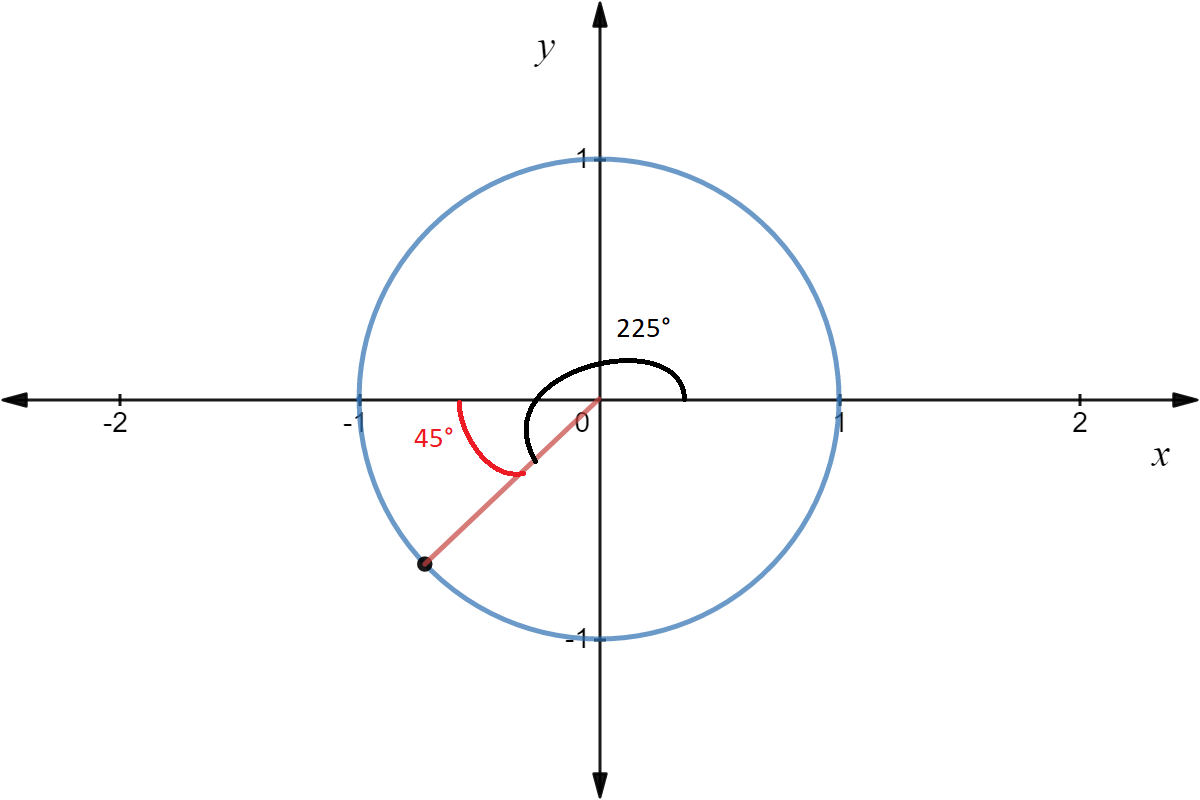
The circle above shows the angle . The closest horizontal line is at , so it's reference angle is . This means that the magnitude of its cosine and sine are the same as for .
Checking with the unit circle, we can see that has a cosine of and a sine of .
By Gustavb via Wikimedia Commons
This matches our cosine and sine for , but it has a negative sine as it is in the second quadrant.
What is the reference angle for ?
The reference angle for is ! The cosine and sine will have the same magnitude as (), but both will be negative as the related triangle would be in the third quadrant. Let's see what this looks like on a graph.
Made with Desmos
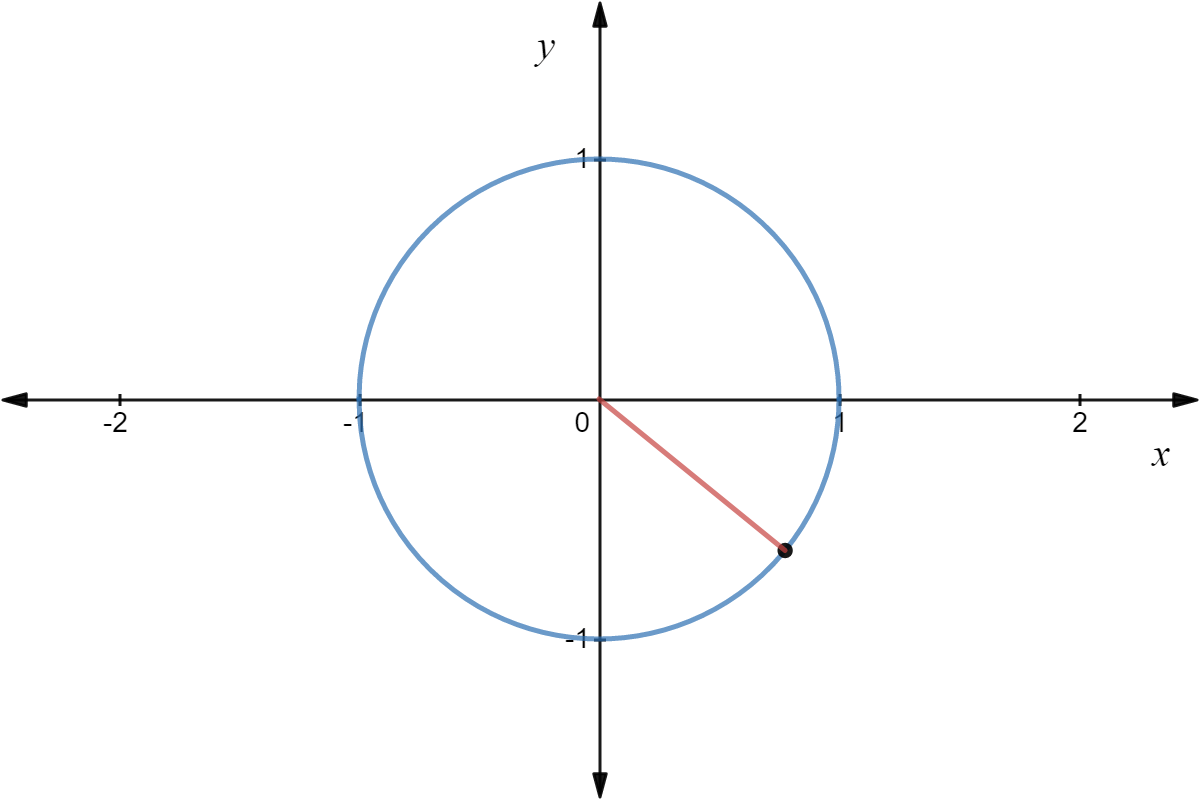
Which component(s) would be negative for an angle that reaches the fourth quadrant?
Made with Desmos
Only sine would be negative. The fourth quadrant has positive -values, and therefore positive values for cosine, but it has negative -values, and therefore negative values for sine.
Wrap Up
The unit circle is a concise way to show common relationships and components of angles. It is a circle with a radius of , but can be expanded to deal with angles and circles of any size. Every point on the circle has a corresponding cosine and sine as the and components, and angles greater than have a corresponding reference angle that shares attributes.