Funções e relação "relaçoes entre funções"

Before this, knowFunções entre séries

Interactive · 2 questions

Relations vs. Functions

A relation is just a relationship between xx and yy-coordinates. It maps inputs to outputs. example:y2=x\text{example:}\quad y^2=x

Notice that, given an input of x,x, there can be multiple outputs of yy that satisfy the relation represented by this equation. For example, if x=4,x=4, then yy can be 22 or −2.-2.

In the set of all relations, there's a smaller subset which we call functions. A function is just a special kind of relation: any input has exactly one output. example:y=x+3\text{example:}\quad y=x+3

Here, there is only one output yy per input x.x. For example, if x=4,x=4, then yy can only be 7.7.

Relations and their subset: functions

Image source: by Ben Ferrara

Is it a Function?

So how do we tell if something if a function or just a relation? As touched upon above, we look at the inputs and outputs.

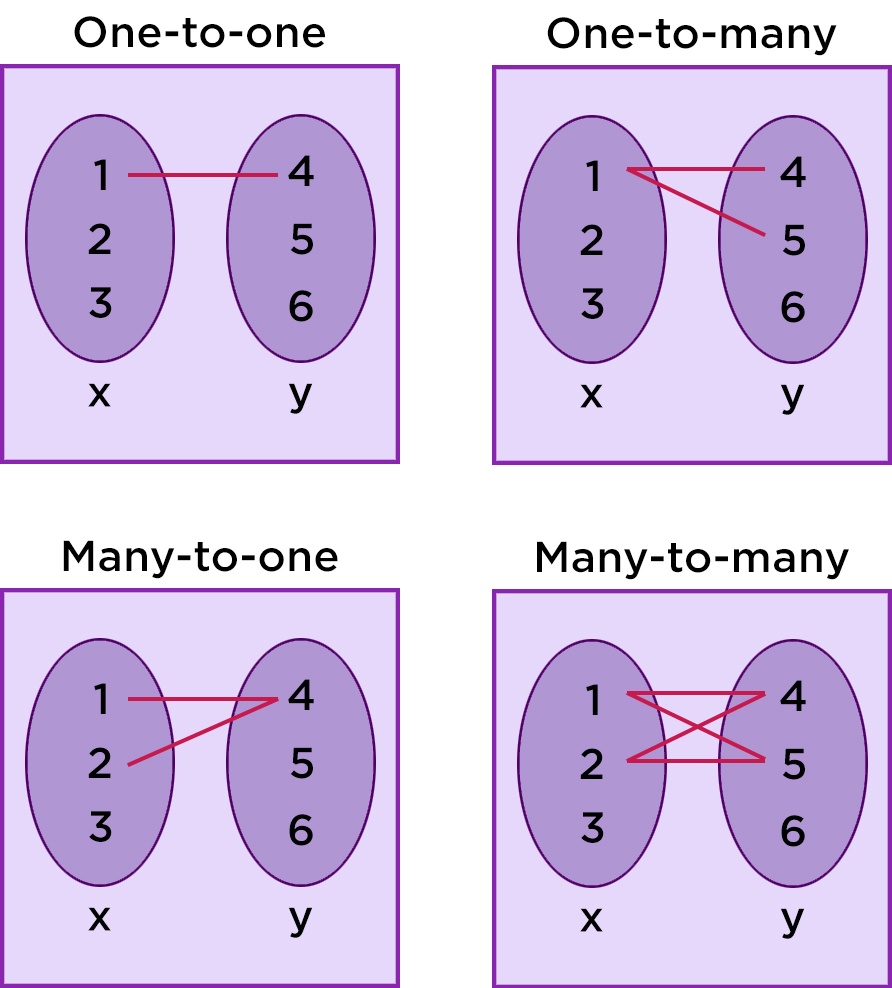
There are 44 different relations we can come across: one-to-one, one-to-many, many-to-one, and many-to-many.

  • One-to-one: Each xx-value corresponds to one distinct yy-value.
  • One-to-many: One xx-value corresponds to multiple yy-values.
  • Many-to-one: Multiple xx-values correspond to the same yy-value.
  • Many-to-many: Multiple xx-values correspond to multiple yy-values.
Four different relations: one-to-one, one-to-many, many-to-one, and many-to-many

Image source: by Ben Ferrara

A relation is a function if the xx-values map to only one yy-value. In other words, if a relation is one-to-one or many-to-one it is a function. FunctionNot a Functionone-to-onemany-to-manymany-to-oneone-to-many\begin{array}{c|c} \text{Function}&\text{Not a Function}\\ \hline \text{one-to-one}&\text{many-to-many}\\ \text{many-to-one}&\text{one-to-many} \end{array}

Example 1

Let's figure out what kind of relation the following is and if it's also a function. y=3x2−3y=3x^2-3

Start by plugging in a few values for xx and making a table. xy−29−100−31029\begin{array}{c|c} x&y\\ \hline -2&9\\ -1&0\\ 0&-3\\ 1&0\\ 2&9 \end{array}

From here we can already find what kind of relation this is, but it's easier to visualize by mapping so let's do that.

Mapping of the relation y = 3x^2 - 3

Image source: by Ben Ferrara

Each input only has one output. However, many inputs have the same output. So, this is a many-to-one function.

Graphically

Graphically, we can easily tell if a relation is a function using the vertical line test. This will be covered in more detail in a later section.

Practice Problem 1

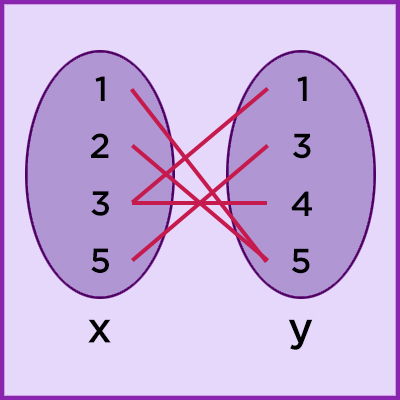
What kind of relation is the following set of points? {(5,3),(2,5),(1,5),(3,4),(3,1)}\{(5,3),(2,5),(1,5),(3,4),(3,1)\}

Choose one answer

Illustrated · 1 min

When is a Relation a Function?

Recall that a relation can map inputs to multiple outputs. It is a function when it maps each input to exactly one output. The set of all functions is a subset of the set of all relations. That means all functions are relations, but not all relations are functions.

Consider y2=x.y^2=x. This equation represents a relation that is not a function. Why? Because each nonzero input xx maps to two outputs y.y. For example, if x=9,x=9, then y=±3.y=\pm 3.

Now, consider y=2x.y=2x. This equation represents a function (and so also a relation). Why? Because each nonzero input xx maps to exactly one output y.y. For example, if x=9,x=9, then y=18.y=18.

You can use the vertical line test to check if you are graphing a function or not!

Relations map each input to oat least one output. Within relations, there are functions and not functions (relations is a big oval, functions are a smaller oval within relations, and non-functions are the rest of the big oval. Functions map each input to exactly one output. One-to-one functions map each input to a distinct output (represented by two sets with 3 dots each, each dot from the first set pointing to a different dot in the second set) and many-to-one functions map multiple inputs to the same output (represented by two sets with 3 dots each, one dot from the first set pointing to its own point in the second set, and the other two dots from the first set pointing to the same dot in the second set). Non-functions map some inputs to multiple outputs (represented by two sets with 3 dots each, two dots from the first set pointing to a different dot in the second set, and a third dot from the first set pointing to two dots in the second set.)

Image source: By Caroline Kulczycky

Video · + 2 min read

(Video) Determining if a Relationship is a Function

by HCCMathHelp

Here's a video by HCCMathHelp that goes over how you can tell when a relation is a function.

Summary\large{\text{Summary}}

Recall that a function is a rule where for any given input, it gives one specific output.

For example, y=x+2y=x+2 is a function. For any input xx, you get out a yy. When x=3x=3, the function always gives the output y=5y=5.

Tables

Example 1\\ Relations and functions can also be expressed using tables of values. For example: xy−13051729\begin{array}{c|c} x&y\\ \hline -1&3\\ 0&5\\ 1&7\\ 2&9 \end{array} The xx column is the inputs, and the yy column is the outputs.

So when you input a −1-1 you get an output of 33. When you input 00 you get an output of 55. And so on. This is a function because whatever we input, we know exactly what we'll get as an output.

Example 2\\ Let's now look at an example where this isn't the case. xy−1305−1729\begin{array}{c|c} x&y\\ \hline -1&3\\ 0&5\\ -1&7\\ 2&9 \end{array} Here our input of −1-1 gives us two different outputs: either y=3y=3 or y=7y=7. This is not a function. But it is still a relation.

Example 3\\ What if the yy-values repeat. For example: xy−15061726\begin{array}{c|c} x&y\\ \hline -1&5\\ 0&6\\ 1&7\\ 2&6 \end{array} Even though different inputs lead to the same output, it's still a function. We have one specific output we know we'll get when we put in the input.

In general, as long as the xx-values don't repeat, we will have a function!

Set of Ordered Pairs

Example 1\\ Sometimes instead of tables, there'll bet sets of ordered pairs. For example: {(3,5),(4,7),(5,9),(6,11)}\{(3,5),(4,7),(5,9),(6,11)\}

To tell if this is a function, we just need to look at the xx-values. Do any of them repeat? {(3,5),(4,7),(5,9),(6,11)}\{({\color{#8925ae}{3}},5),({\color{#8925ae}{4}},7),({\color{#8925ae}{5}},9),({\color{#8925ae}{6}},11)\} No. Therefore, this is a function.

Example 2\\ What about this set? {(3,5),(4,8),(3,7),(4,9)}\{(3,5),(4,8),(3,7),(4,9)\} Here, we have a repeat of 33 for the xx's. Therefore, this is not a function.

Example 3\\ Finally, what about this one? {(3,6),(4,6),(5,6),(6,6)}\{(3,6),(4,6),(5,6),(6,6)\} Even though the yy-values repeat, a distinct xx-value goes to each of them. This is still a function.

Graphs

You can easily tell if a graph is a function by using the vertical line test. This will be covered in more detail in a later section.

The basic gist is if a vertical line touches more than one point at any time on your graph, the graph is not a function.

Equations

As long as an xx-value doesn't give multiple yy-values, the equation will be a function.

Example 1\\ The equation y=−2x+4y=-2x+4 only gives one yy-value for any xx-value. Therefore, it is a function.

Example 2\\ The equation y=x2−4x+3y=x^2-4x+3 only gives one yy-value for any xx-value. The yy-values may repeat, but that's okay. Therefore, this is a function.

Example 3\\ The equation y=±xy=\pm x is not a function. The plus/minus symbol, ±\pm, means our xx input will either give out plus that amount or minus that amount. If x=2x=2, then the output is either y=2y=2 or y=−2y=-2.

Type a concept, like “slope” or “photosynthesis”.

↑ ↓ to choose · Enter to openSearch explanations and problems