Illustrated · 1 min
An acid acts as a proton donor. The general form of an acid is HA, formed from a hydrogen ion () and an anion (). When HA is placed in water, the and tend to dissociate, or separate. The degree to which this dissociation occurs depends on the acid.
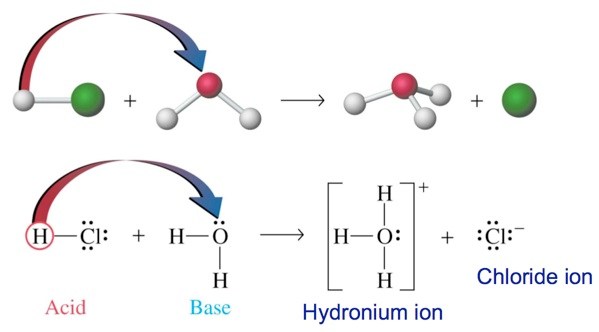
Hydrochloric acid (HCl) acts as a proton donor.
The example above shows hydrochloric acid dissociating in water. The hydrogen ion separates from the chloride ion and attaches to the water molecule. Since hydrochloric acid is a strong acid, this dissociation proceeds practically to completion, and very little HCl remains in solution, since most of it has dissociated.