Read · 3 min
We have studied the trends of the periodic table. Based on our study we may expect that the elements always behave in ordered ways. But, in nature, we find the elements in many unique forms. Remember, in nature, we often do not find individual atoms of an element. Instead, many elements bond with themselves. Elements that have multiple natural forms are allotropes. We say that an element exhibits allotropy. Allotropes are always in the same phase of matter. The differences between allotropes arise from the way the atoms bond. Pressure and temperature affect the bond geometry. The different molecular geometries cause allotropes to have different chemical and physical properties.
The term allotrope is only used for individual elements. If we are talking about compounds, we use the term polymorphism. Compounds with unique forms are polymorphs. To help you understand polymorphs, remember that ionic bonding forms a crystal lattice. The shape of the crystal lattice varies based on the number of atoms. For example, consider calcium carbonate (). Two of its polymorphs are calcite and vaterite. Both are common geological minerals. In calcite, each calcium atom interacts with six oxygens. So, it has an octahedral geometry. But, vaterite, forms sheets of alternating calcium atoms and carbonate ions. They have the same chemical formula. But, they have different molecular geometries. So, they're polymorphs!
To make things even more complicated, covalently bonded compounds also form crystal lattices. We know from VESPR theory that covalent compounds have specific geometries. When these geometries repeat, we form a crystal lattice. The properties of a covalently bonded polymorph depend on the shape of the lattice. Again, temperatures and pressure affect the shape of the lattice.
Common Allotropes of Oxygen
Two of the most well know allotropes are dioxygen () and ozone (). Both are gaseous. Both occur naturally in our atmosphere. But, they have very different chemical properties. Ozone is less stable than dioxygen. Ultraviolet light is the cause of ozone formation in the atmosphere. Ultraviolet light has a lot of energy. When ultraviolet light hits dioxygen it breaks the double bond. The result is two oxygen atoms. The oxygen atoms then react with another dioxygen molecule to form ozone. The formation of ozone is endothermic. Endothermic means that we added energy to the reaction. It also tells us that ozone is less stable than dioxygen. Ozone's instability makes it very reactive. So, ozone is a strong oxidizing agent.
For many years, environmental chemists had to worry about ozone. Because Ozone is so reactive it readily breaks down into dioxygen. In the 1960s refrigerants, called chlorofluorocarbons (CFCs), were leaking into the atmosphere. The CFCs acted as a catalyst for the breakdown of ozone to dioxygen. The ozone layer was thinning. We called the thinning of the ozone layer a hole.
Common Allotropes of Carbon
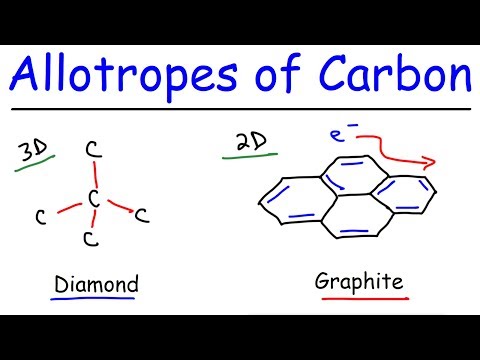
Carbon is one of the most diverse chemical elements on our planet. Currently, we know of almost five hundred different carbon allotropes. The most well-known allotropes of carbon are diamonds and graphite. Diamond and graphite are both made entirely of carbon atoms. But, they have completely different chemical properties. Diamond is hard and disperses light. It has applications from jewelry to industrial drilling. Graphite is soft and brittle. It is most commonly found as pencil lead. Graphite consists of stacked sheets of bonded carbon. The sheets are held together by London Dispersion forces. We call the individual sheets of graphite, graphene. As you write, you deposit thousands of graphene sheets on your paper.
Graphene is considered another allotrope of carbon. Humorously, chemists isolated graphene by pulling scotch tape along a piece of graphite. The scientists received the 2010 Nobel prize in chemistry! Sometimes science is more about luck. Graphene is a single sheet of carbon atoms that have bonded in a repeating hexagonal pattern. Graphene conducts electricity as well as many superconductors. In contrast, diamond does not conduct electricity. It is an insulator.
Key Takeaways
- Allotropes are elements that have multiple naturally occurring forms.
- Allotropes have different chemical and physical properties.
- Different bond geometries cause the differences between allotropes.
- Compounds with multiple naturally occurring forms are polymorphs.
- Some common allotropes of oxygen are dioxygen and ozone.
- Some common allotropes of carbon are diamond, graphite, and graphene.