Metric Conversions — Prefixes & Examples

Before this, knowSI Base Units — Definition & Overview

Illustrated · 1 min

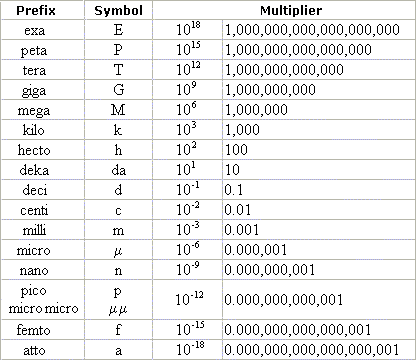
Table of metric prefixes from exa (E, 10^18) down to atto (a, 10^-18), with symbol, power of ten and multiplier, such as kilo (k, 10^3, 1,000) and milli (m, 10^-3, 0.001).

Image by OC Science.

Within the metric system, unit conversions revolve around prefixes. Prefixes are added to the base units (liters, meters, grams, etc.) in order to change the value of the unit. The same prefixes are used whether you are measuring length, area, volume, or anything else. In order to convert between the modified units and the base units or between modified units, you only need to multiply or divide by powers of 10.

In the table above the commonly used metric prefixes can be found. In order to convert between kilometers and meters for example, you can use dimensional analysis and establish a proportion between the two units of measurement. The prefix kilo means 1000 or 10 cubed. Therefore there are 1000 meters in 1 kilometer.

The same concept applies to any of the other prefixes. The safest way to learn how to convert metric units is to memorize the prefixes and their associated values. Using dimensional analysis you can convert any unit between prefixes through powers of 10.

Converting to units of the imperial system of measurement, like feet or pounds, is more complex. Luckily, these units are only really used in the United States. Even there, the scientific community sticks to metric units when conducting research. An example of these different unit conversions is absolute zero, which is 0 Kelvin, -273 degrees Celsius, and -459 degrees Fahrenheit.

Video · + 1 min read

(Video) Metric Conversion Trick!! Part 1

by BrainSTEM

Check out this video by BrainSTEM to learn a cool trick for converting metric units easily.

As countless people use the scientific method to design experiments and answer scientific questions, metric is the most commonly used measuring system and is part of the SI base units. We often use metric units when doing quantitative analysis. But, oftentimes if we measure in one unit (like meters), it can be more useful to use a smaller unit (like centimeters), so we convert the two! For example, oftentimes smaller units (like millimeters) are known to be more accurate and precise than larger units when doing experiments. Accuracy and precision are very important in science because factors like temperature play an important role in reaction rates, system and surrounding transfers, and physical properties of gases.

However, keep in mind that not just length, area, and volume that are metric units. Density and temperature are also metric units, being used to measure mixtures such as colloids, solutions, and suspensions.

Interactive · 1 question

SI Unit Conversions

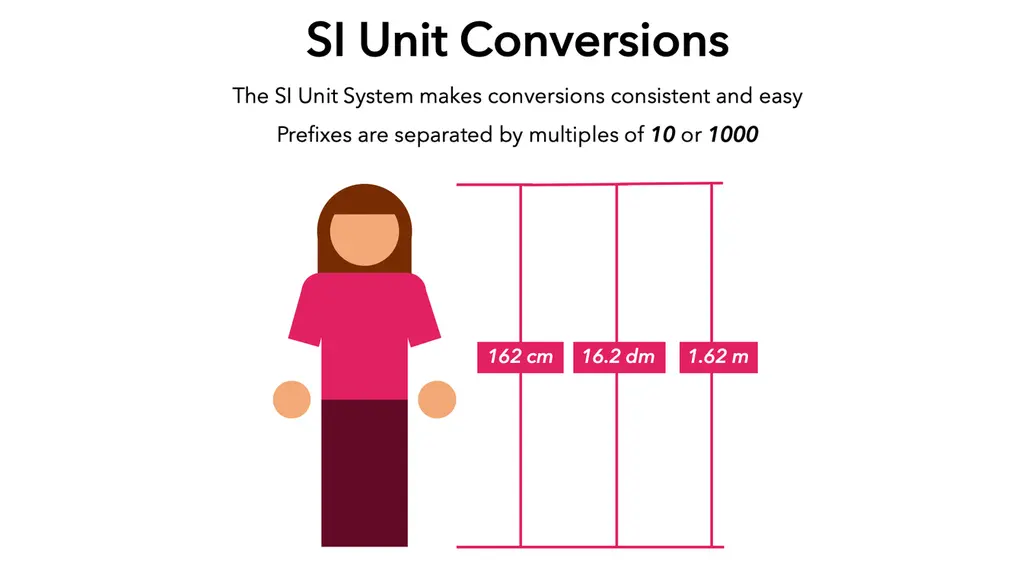
A woman beside three vertical lines of the same height labeled 162 cm, 16.2 dm and 1.62 m, showing one height in three units. Header: prefixes are separated by multiples of 10 or 1000.
Average height of American woman converting between centimeters and meters

by T. Gibbons

Metric conversions help us change a measurement from one unit to another. The metric system is used around the world to measure length, mass, and volume. Common metric units include meters, grams, and liters. Each type of measurement has different units that are connected by powers of 1010.

Metric prefixes tell us how large or small a unit is. For example, a kilo- means 1,0001,000, centi- means one hundredth, and milli- means one thousandth. These prefixes make metric system conversions easier because the units follow a pattern. A metric conversion chart or metric conversion table can help you to remember how the units are related.

What to know when converting metric units

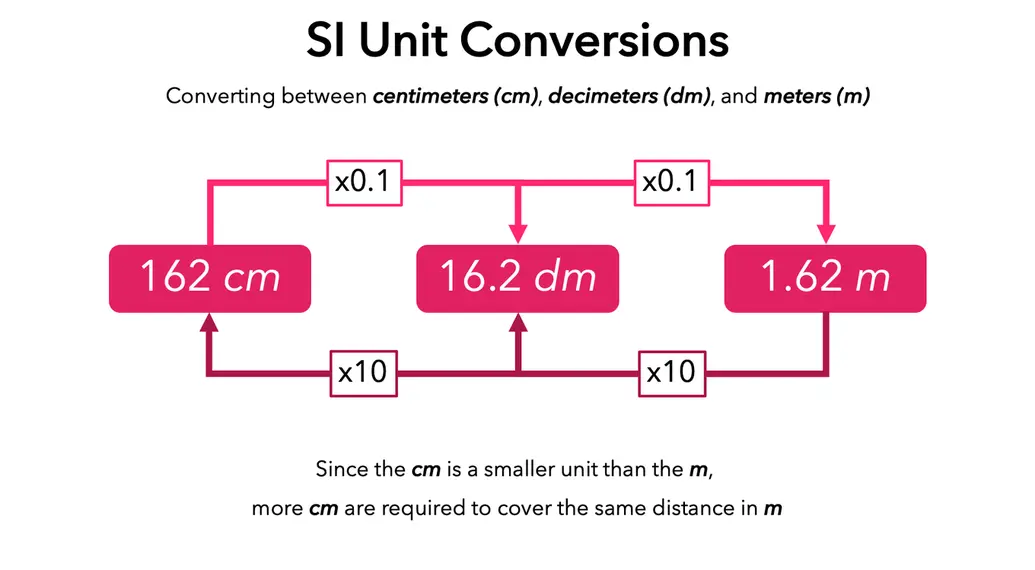
When converting metric units, you need to know whether you are moving to a larger or smaller unit. Moving to a smaller unit means multiplying by 1010 for each step. Moving to a larger unit means dividing by 1010 for each step. This is the basic metric conversion formula: multiply or divide by the correct power of 1010.

For example, there are 100100 centimeters in one meter. To convert 33 meters to centimeters, multiply by 100100; 3×100 centimeters=300 centimeters3 \times 100 \text{ centimeters} = 300 \text{ centimeters}

Once you understand the prefixes, how to convert metric units becomes much easier. You need to identify the starting unit, find the target unit, and decide whether to multiply or divide. No need to call a math superhero for help!

How many millimeters are in 22 meters?

Type a concept, like “slope” or “photosynthesis”.

↑ ↓ to choose · Enter to openSearch explanations and problems