Alternative Splicing — Definition & Function

Before this, knowWhat Are Exons? — Definition & Role in Transcription

Illustrated · 1 min

What Is Alternative Splicing?

Pre-mRNA is spliced to make two different mRNAs. Those are translated to two different protein isoforms.

Image source: By Agathman CC BY-SA 3.0, via Wikimedia Commons

Alternate splicing is a part of gene expression that lets one gene code for multiple proteins. Picking and choosing which exons are expressed leads to an mRNA strand that has a different series of exons than the original DNA sequence.

After transcription, the mRNA strand produced contains both exons and introns. The strand is cut at the splice site, between an exon and intron, and the introns are cut out. Depending on what protein needs to be made, some of the exons can get cut out as well. The remaining exons are stitched together to make the final mRNA sequence. This sequence gets translated into a protein.

Alternative splicing lets one gene code for several protein isoforms. These are different proteins that are still very similar.

Vocabulary Review:\color{#8925AE}{\text{Vocabulary Review:}}

Transcription\color{#8925AE}{\text{Transcription}} : How complementary RNA molecules are produced by copying part of the DNA sequence

RNA Polymerase\color{#8925AE}{\text{RNA Polymerase}} : The enzyme that separates the strands of DNA during transcription and creates a complementary piece of RNA

Introns\color{#8925AE}{\text{Introns}} : Parts of the DNA sequence that are not used to carry genetic information

Exons\color{#8925AE}{\text{Exons}} : The DNA sequences that code for proteins
Illustrated · 1 min

Making Many Proteins From One Gene

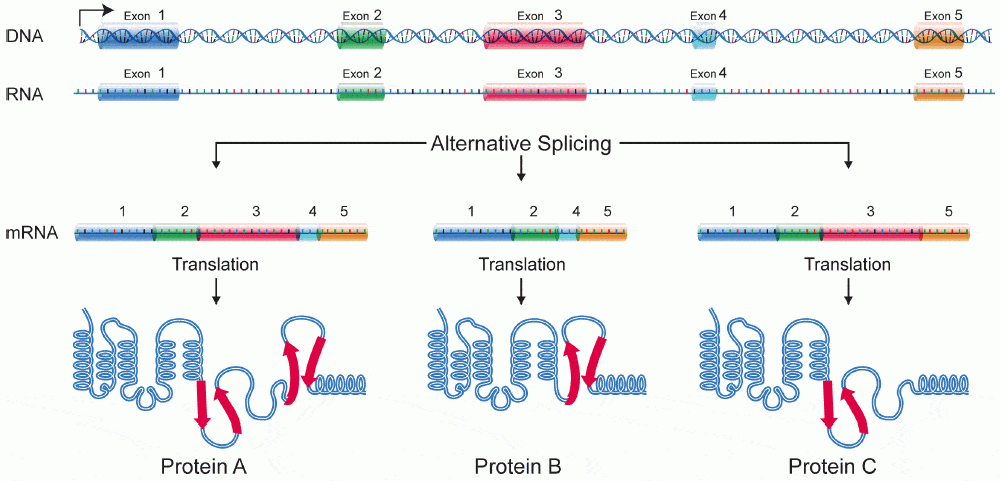
Alternative splicing is a process that allows one segment of DNA to produce different proteins by changing the way that it is cut.

Most genes need to go through some form of modification after transcription and before translation. This means that after DNA is turned into RNA, it is chopped up and put back together with some pieces missing. The pieces that are removed are called introns, while the ones left in are called exons. The chopping of RNA is called splicing.

Different proteins can be made depending on how RNA is spliced.

Image source: By National Human Genome Research Institute [Public domain], via Wikimedia Commons

In the above picture, the DNA is transcribed into RNA. The labeled exons of the RNA are the pieces that will be used to produce a protein. Excluding and including different sections will produce the different proteins A, B and C.

Illustrated · 1 min

What Are Introns and Exons?

In order to understand what alternative splicing is, it's important to first understand what exactly exons and introns are. First, an mRNA transcript is made from DNA. It is known as pre-mRNA, which is composed of both introns and exons. Through translation, exons will be expressed into proteins while introns will be cut out and not expressed into proteins. A good mnemonic to remember this difference is that Exons Express.

However, from a single pre-mRNA molecule, it isn't clear what will end up being expressed as protein and what will not. This is because, depending on the cell's needs at any moment in time, it may choose different exons to be expressed into different proteins.

A diagram of mRNA and pre-mRNA. Not all exons have to be included in the final strand of mRNA. This is called alternative splicing.

Image source: By Seru [Public domain], via Wikimedia Commons

In the above visual, the pre-mRNA is able to yield two different strands of mRNA. These are splice isoforms and an example of alternative splicing. In the mRNA at the top, the section labeled 1 is considered an intron, while in the bottom, 1 is considered an exon. In the bottom mRNA, the section labeled 2 is considered an intron, while in the top, 2 is considered an exon.

Why Is Alternative Splicing Important?

Alternative splicing events allow organisms to express a wide variety of proteins from a limited number of genes. What does this look like? Well, humans contain less than 20,000 genes, but we are able to create a much wider range of proteins by slicing genes in different ways.

A common example is the protein tropomyosin which is found in all the different types of muscle tissue. However, in each muscle tissue, different types of tropomyosin are used for each muscle's specific purpose. Each tropomyosin is encoded by the same gene, but alternative splicing allows different types of tropomyosin to be used depending on what muscle tissue the cell is located in.

Video

(Video) Alternate mRNA Splicing

by Ellen Kane

Check out this video to see a visual representation of how pre-mRNA can be spliced in different ways to create different proteins.

Type a concept, like “slope” or “photosynthesis”.

↑ ↓ to choose · Enter to openSearch explanations and problems

