Illustrated · 3 min
+3 contributors



Making Proteins
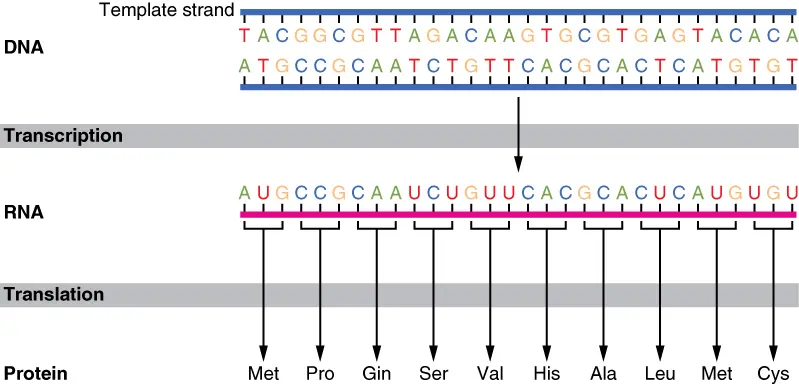
There is a central dogma of biology which helps explain the flow of genetic information in organisms. It states: DNA RNA Protein. There are a few exceptions to this central dogma, but overall most organisms follow this flow of genetic information.
The first segment of the central dogma DNA RNA represents transcription, which is the process by which DNA is transcribed or converted into RNA. The second segment of the central dogma RNA Protein represents translation, which is the process by which the code of RNA is made into a protein.
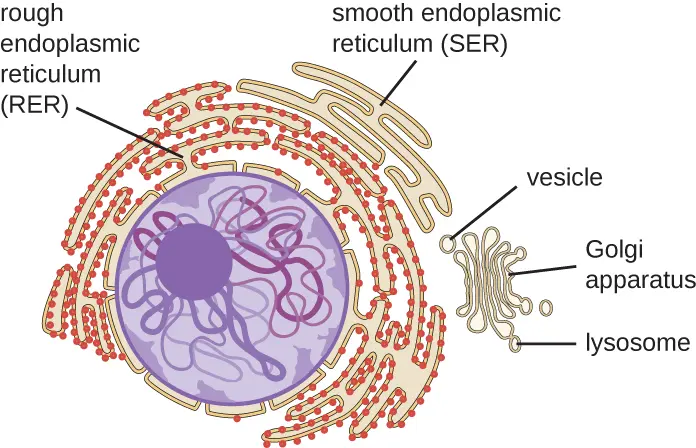
In prokaryotes DNA RNA and RNA Protein occur almost simultaneously, while in eukaryotes these two segments of the central dogma are separated in time and space. This is because prokaryotes have no nucleus, so their DNA is free-floating in their cytosol. This means that the ribosomes, which are responsible for translating RNA into protein, have immediate accesses to the RNA. However, in eukaryotes there is a nucleus which separates the DNA from the cytosol. Therefore, the RNA must first travel to the cytosol where the ribosomes are then able to translate the RNA into proteins.
Types of RNA
There are several types of RNA in the cell which are used for various processes. The two major types of RNA used in translation are mRNA (messenger RNA) and tRNA (transfer RNA). mRNA acts as the middleman between DNA and proteins, and each mRNA has a unique combination of four different amino acids–CGAU (Cytosine, Guanine, Adenine, Uracil). tRNA works as the middleman between mRNA and amino acids. On one end of tRNA is an amino acid, while the opposite end has an anticodon which corresponds to a codon on the mRNA. Therefore, each codon on mRNA has a matching anticodon on a tRNA molecule, which corresponds to a particular amino acid.
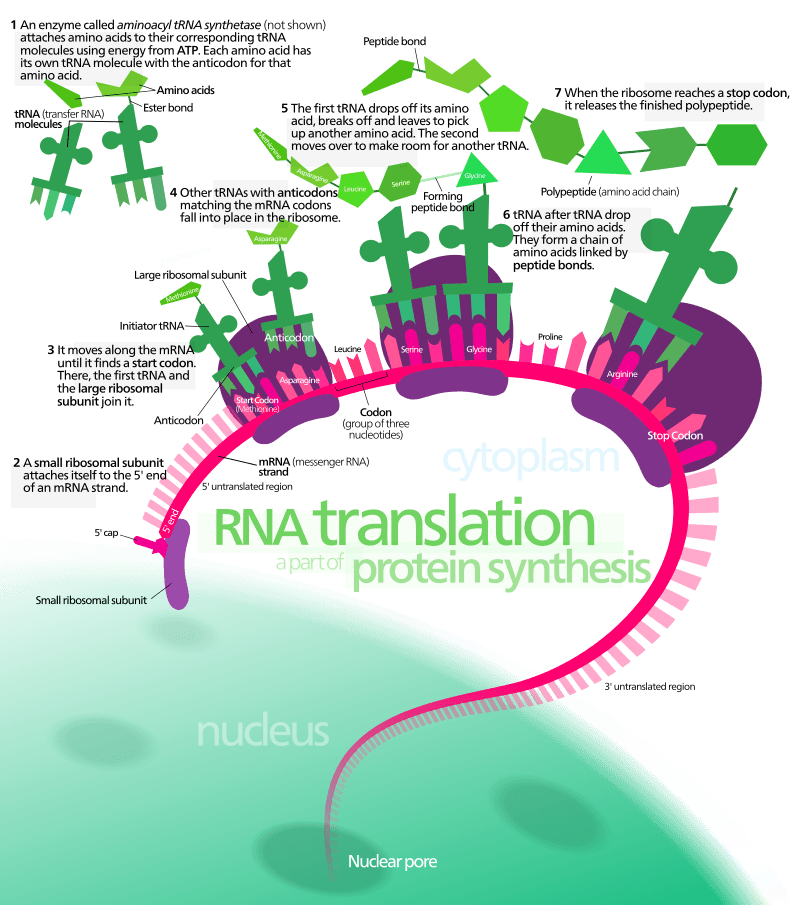
Image source: By Kelvinsong CC BY 3.0, via Wikimedia Commons
Steps of Translation
There are three major steps to translation: Initiation, Elongation, and Termination.
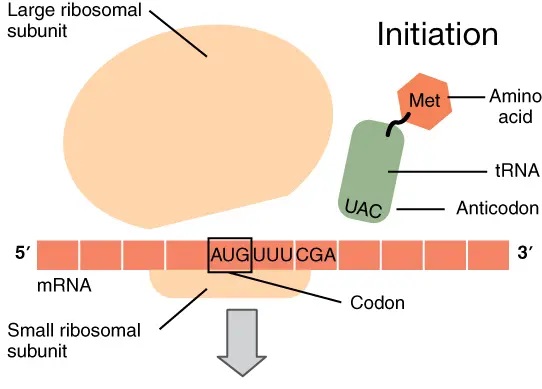
1) Initiation
- The ribosome is made of two separate subunits: the small subunit and the large subunit. During initiation the small subunit attaches to the 5' end of mRNA. It then moves in the 5' 3' direction. Once the small subunit hits the start codon (AUG), the corresponding tRNA will attach followed by the large subunit. The first tRNA molecule always carries the amino acid methionine.
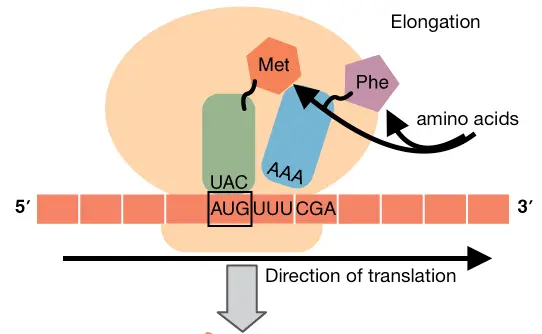
2) Elongation
- In the elongation phase of translation, the tRNA with the correct corresponding anticodon will match with the corresponding mRNA codon. A peptide bond, which is the type of bond that holds amino acids together, is formed between the methionine from the first tRNA with the second amino acid from the second tRNA. The ribosome then shifts down moving in the 5' 3' direction, making space for another tRNA to match with its corresponding codon and thereby allowing another peptide bond to form. This process continues with the ribosome moving down the mRNA strand, growing its amino acid chain the further it goes.
- An important thing to note is that once a tRNA transfers its amino acid to the amino acid chain, it then leaves the ribosome to be "recharged" with another amino acid.
3) Termination
- The final phase of translation is termination. When the ribosome reaches a stop codon (UAG, UAA, or UGA), a release factor will bind to the stop codon and cause the amino acid chain to be released and the ribosome subunits to separate.