Illustrated · 2 min
Orbitals in Atoms
In the center of the atom is the nucleus made of protons and neutrons. Around the nucleus is the space where electrons exist. Electrons are always moving in this space.

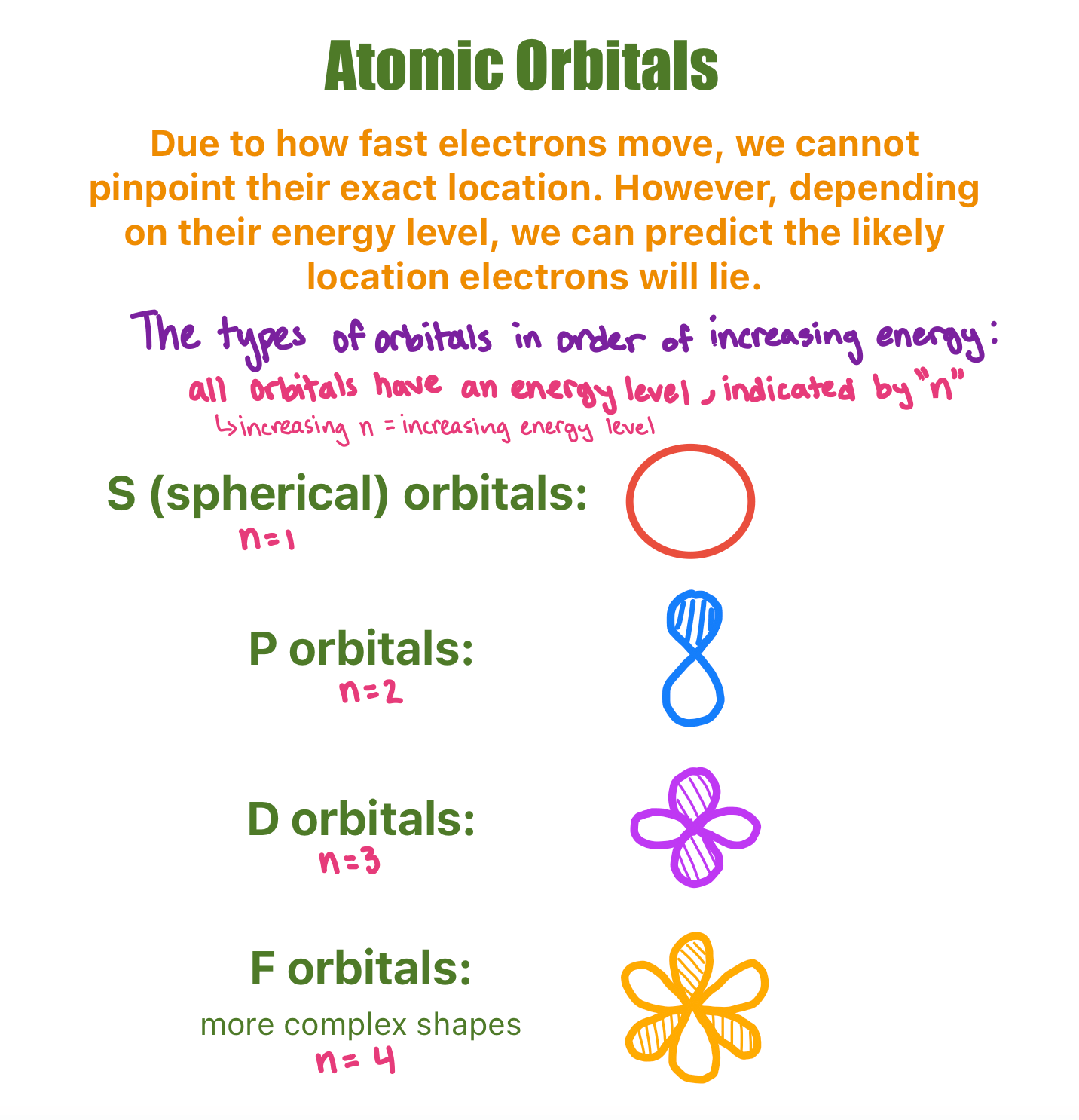
Atoms have electrons which orbit around the nucleus. The location where electrons can be found are called atomic orbitals.
Image source: By Cassie Gates
The exact location of an electron at a given time cannot be pinpointed, so it is hard to find an electron. However, the most likely location of electrons are represented by atomic orbitals. Atomic orbitals represent where the electrons can be found, there are different types of orbitals which are shaped differently.
Energy Levels and Sub-levels
Every atomic orbital has an energy level. The energy level is denoted by where . As increases, the energy of the orbital increases.
There are four types of orbitals: . Each type of orbital has different shapes. Each type of orbital has sub-levels, but each has a different amount: = 1 sub-level, = 3 sub-levels, = 5 sub-levels, and = 7 sub-levels.
Let's consider the energy level, . At this energy level there are two types of orbitals: and . The three sub-levels of the orbitals are broken down into and . The and represent the direction of the orbitals. For example would be a long the -axis. The orbitals in are: .
To connect back to an atom we all know and love, the hydrogen atom would be at the energy level n=1. Therefore, hydrogen would only have a half-filled 1s orbital as it only has 1 electron. Remember that each orbital can hold 2 electrons. On the other hand, carbon would be at the n=2 energy level, so it would have , , and orbitals. It's and orbitals would be full, but the orbitals would not be filled. Therefore, hydrogen is more likely to have its electron closer to the nucleus than carbon since only its orbital is populated.
Mathematical Functions
Information about orbitals and electron location are described by mathematical equations. Erwin Schrödinger is well known for his theoretical experiment known as "Schrödinger's Cat", but he is also known for his work on atomic structures. Remember, de Broglie taught us that all matter had a wavelength. Schrödinger built on his work by, describing the movement of electrons as waves. Wave equations are used to represent this movement mathematically. Solving wave equations gives wave functions or orbitals (). The square of a wavefunction () describes the probability of an electron occupying that space. When = 0, an electron has zero probability of being in that space. Spaces, where electrons are not found in an orbital, are called nodes.
What's the Point of Atomic Orbitals?
At this point, are you wondering, "so what?" Atomic orbitals are fascinating. But, it all seems a little theoretical. But, our knowledge of orbitals will pave the way for electron configurations. We want to understand an element's reactivity. To do that, we need to know where an atom's electrons are. For example, consider the periodic table. The elements on the far left behave very differently from the far right. An alkali metal like sodium wants to give up an electron. But, a halogen, like chlorine, wants to steal an electron. As we continue to learn, you'll use atomic orbitals to predict chemical bonding!