How Do Chemists Find the Atomic Radius?
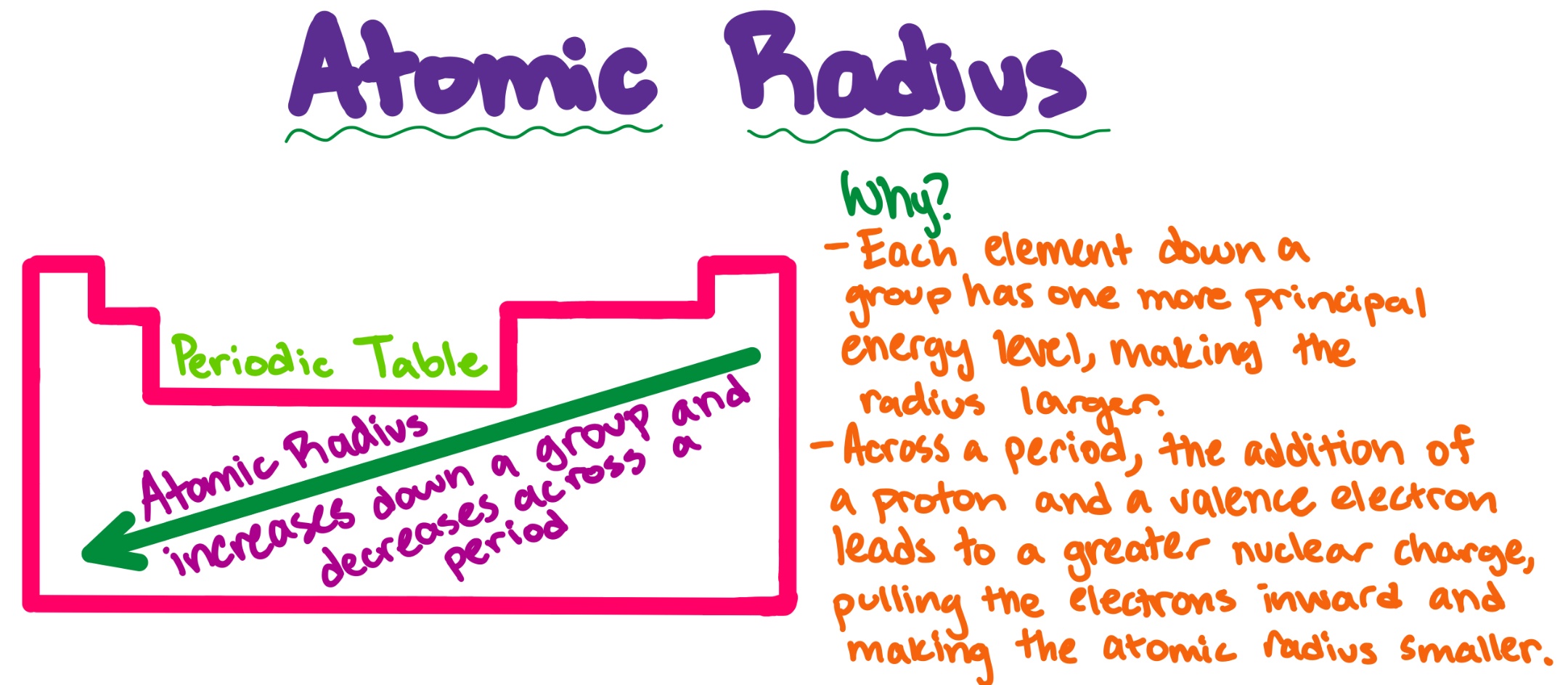
The atomic radius is the distance from the nucleus' center to the valence electron shell. Generally, we can use the principle quantum number (n) as our basis. The larger the n value, the greater our radius. But, how do chemists actually measure atomic radius? What experiments do they do? Let's find out!
Experimentally Determining Atomic Radius
How do we measure the distance between two atoms? Analytical chemists have a fancy technique called x-ray crystallography. Let's explore how it works!
First, what is a crystal? A crystal is an ordered, repeating structure. Many different compounds create them. All ionic bonds are crystals. Why? It's because the atoms bond in repeated patterns. One set is a unit cell. Repeated unit cells form a crystal lattice. But, covalent compounds can also generate crystals. How? An identical molecular geometry repeats itself. One example is diamond. In it, carbon-carbon bonds form repeating tetrahedrons. Metals and metallic bonds are also considered crystals.
Now, what about x-rays? They are a variety of electromagnetic radiation. But, they have minuscule wavelengths (0.1 -10.0 nanometers). Their wavelength is about the same as the distance between bonded atoms. So, what happens when we hit a crystal with x-rays? The x-ray bounces off the atoms' electrons. That's diffraction! Then, a sensor detects the diffracted x-rays. A computer converts the x-ray's deflection angle to a position. So, we know the atoms' locations. At that point, it's easy to find the distance between them. That would be the bond length. Halving the bond length gives us the atomic radius. Remember, chemists are super creative. So, we call the radius in ionic compounds the ionic radius. Covalent compounds have covalent radii. Metals have metallic radii.
What about atoms that don't bond? For example, the noble gases all have complete octets. So, they shouldn't form bonds. But they can still create crystals! How? They interact through Van der Waal's forces. Electrons are always moving around the atom. Sometimes, more electrons are on one side than the other. What's the result? A dipole! One side has a slight positive charge. The other side is partially negative. So, atoms can experience electrostatic attraction! At low temperatures, atoms have less kinetic energy. They don't move as much. So, Van der Waal's forces are strong enough to hold two atoms together. What is the result? A crystal structure. The fancy term is molecular crystal. Using x-ray diffraction on a molecular crystal gives us the Van der Waal's radius.
Computational Chemistry and Theoretical Methods
Let's say you didn't want to measure an atom's radius. Could you calculate it? At first, it may not seem challenging. Just gauge the distance between the center of the nucleus and the valence electrons. But, there's a problem! We have to remember our studies of quantum mechanics. Where are the valence electrons? We don't know. Remember, atomic orbitals give us a probability. Consider our electron cloud diagram. Our electron could be at any one of those places. So, computational chemists use theoretical models based on atomic orbitals. It's not an exact measurement. Instead, it's a calculation that defines the most probable radius. But, the math is complex. So, you need a computer to do it.