Illustrated · 1 min

In dilute solutions, the percent of light absorbed can be expressed as the product of the concentration, , path length, , and molar extinction coefficient, . That is,
This is known as the Beer-Lambert law, or Beer's law. It is a commonly used technique to determine the concentration of a solution. The molar extinction coefficient is an experimentally determined value that is unique to each substance.
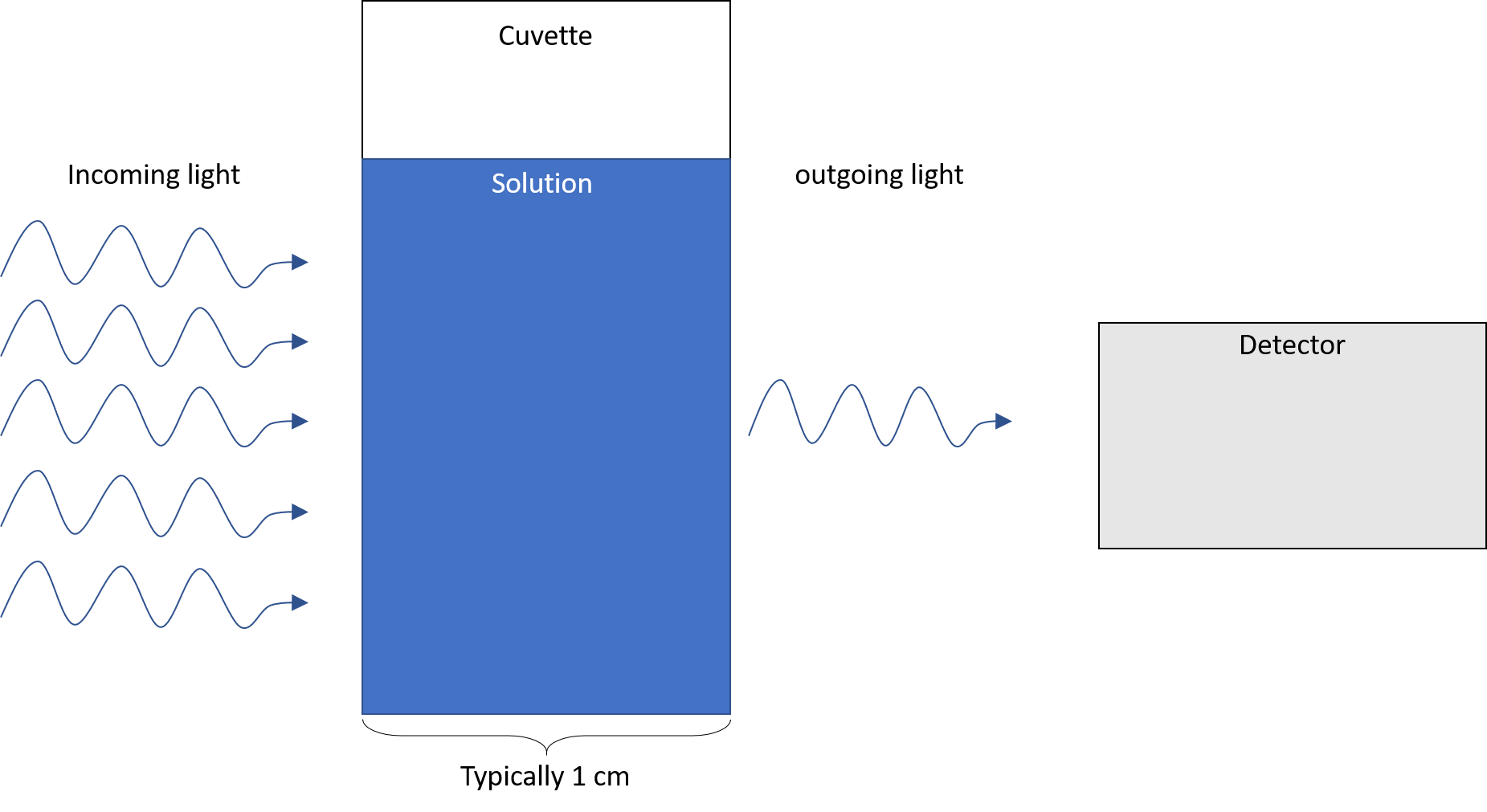
Examine the diagram above. This diagram shows the general process of the Beer-Lambert law. First a known amount of light enters the solution, then the solution absorbs some of the light, then a percent of the light exits the solution and is detected. The path length is almost always 1 cm, but as long as the it is taken in to account, any path length can be used.
The Beer-Lambert law is only valid for dilute solutions. This is because the absorptivity of a substance is only linearly related to the concentration at low concentrations. If an absorbance above 1 is recorded when applying the Beer-Lambert law, then the solution is too concentrated. The solution should be diluted until the absorbance is below 1 prior to the application of the Beer-Lambert law.