
Interactive · 1 question
+2 contributors

Boyle's Law
- A gas law created by Robert Boyle.
What is Boyle's Law?
-
Boyle's Law states that when temperature is constant: =.
-
Boyle's Law also states that pressure is inversely related to volume. This means that when pressure is increased, volume is decreased (and vice versa).
-
Boyle's Law also states: (k = the proportionality constant).
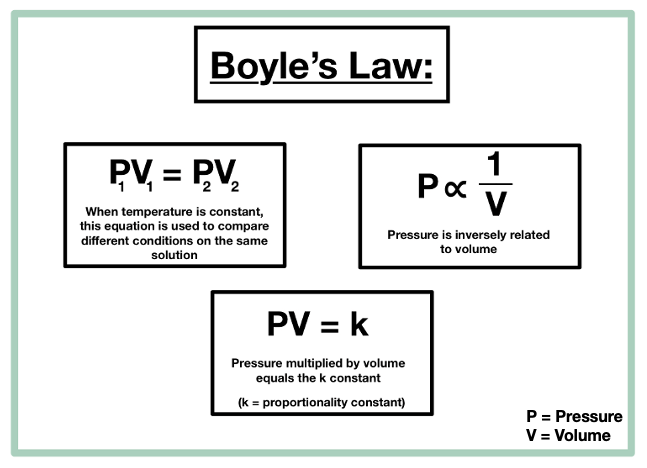
Image source: Caroline Monahan
Example of Boyle's Law

Image source: Caroline Monahan
-
The example above shows how at a constant temperature =.
-
The example above also shows the inversely proportional relationship between volume and pressure. In the first beaker, the pressure is at 400 mm Hg while the volume is at 50 milliliters. When the pressure decreased to 200 mm Hg, the volume increased to 100 milliliters.
Boyle's Law Practice Problem Walkthrough!
In one chamber, the pressure is 100 mm Hg, with a volume of 80 mL. If the volume decreases to 20 mL, what is the new pressure of the chamber? Assume the temperature is constant.
Solving this problem is simple, just plug the numbers into the Boyle's Law equation, and solve for the missing variable.
1. =
2. =
3. = 400 mm Hg
The new pressure is 400 mm Hg when the volume is decreased to 20 mL!

