Interactive · 1 question
Calculating the Molar Mass of a Gas
- Sometimes one of the products of a chemical reaction is a gas. How could we identify the gas? If we determined the molar mass, we could make an educated guess about its identity.
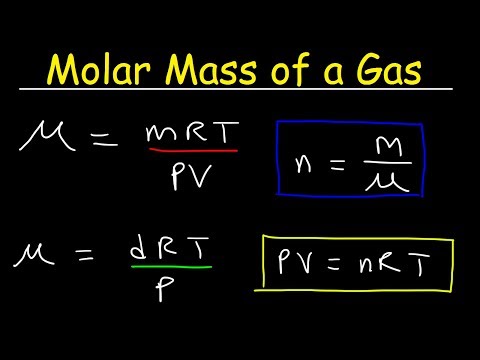
How to Calculate the Molar Mass of a Gas
-
Identify the number of moles of the gas. If this number is unknown, use the Ideal Gas Law. It allows you to calculate the number of moles if you know the volume, pressure, and temperature of the system.
-
Remember, the molar mass has units of grams per mole. So, once you've found the moles of gas, divide the gas's mass by the number of moles.
-
EXTRA STEP: from the molar mass, try to identify what element(s) make up the gas. In some cases you can also determine the molecular fromula and/or determine the empirical formula.

Image source: Caroline Monahan
Example Problem Walk-Through
You have 0.341g of an unknown gas, . It's in a 1.50L beaker under a pressure of 0.678atm, and a temperature of 24°C. What is the molar mass?
1) First identify what information you know, and what you don’t. Also, convert any variables into the proper units if needed.
Variables:
-
Volume: 1.50L
-
Pressure: 0.678atm
-
Temperature: 24°C → 297.15 K (temperature is needed in Kelvin)
-
Mass: 0.341g
-
Number of moles of gas: Unknown
-
Molar mass: Unknown
2) We need the number of moles of gas in order to calculate the molar mass, so first we need to use the ideal gas law to find the number of moles
- Ideal gas law: PV = nRT
- A simple rearrangement of this formula to find the number of moles of gas: n =
Solving for n:
(using R = 0.08206 )
n = = 0.0426 mols
3) Now we can find the molar mass from simply dividing the mass by the number of moles of gas!
Molar mass =
Molar mass = = 7.996g/mol = 8.00g/mol
4) Try to identify the unknown gas!
- We know that the formula for the unknown gas is
- To find the unknown gas, we divide the molar mass by 2. Then we can look at the periodic table to discover which element matches the divided molar mass.
= 4.00g/mol = Helium
Thus the unknown gas is with a molar mass of 8.00g/mol.
As a side note, you might wonder how diatomic helium (called a helium dimer) can exist. Helium is a noble gas. It has a filled valence shell. We know it's one of the exceptions to the octet rule. But, by having a completed valence, it essentially obeys it. So, it shouldn't form any bonds. It turns out it's a unique type of molecule called a Van der Waal's molecule. They aren't held together by covalent bonds! Instead, they are held together by Van der Waal's forces. In the case of helium, they are bonded via dispersion forces. The interaction is much weaker than a covalent bond. For example, the bond length is fifty times larger than the average covalent bond. The bond energy is five-thousand times weaker than diatomic hydrogen. So, we see that the helium-helium bond is unbelievably fragile!
Tips for Tackling These Problems:
- Always be aware of your units and what units you need.
- For molar mass you need mass in grams (g).
- Volume, and pressure have various units. So, make sure that the units match the R-value you use for the ideal gas law.
- Temperature should always be in Kelvin for these types of problems (unless specifically told otherwise).
Now Try a Practice Problem!
A scientist is containing 0.705g of an unknown gas with the formula . The scientist is containing this gas in a container with a pressure of 8.6Pa and at a temperature of 35°C. What is the molar mass of this unknown gas? What is the identity of this gas? (Note: you should check 2 boxes below, one for the molar mass, and one for the identity of the gas)
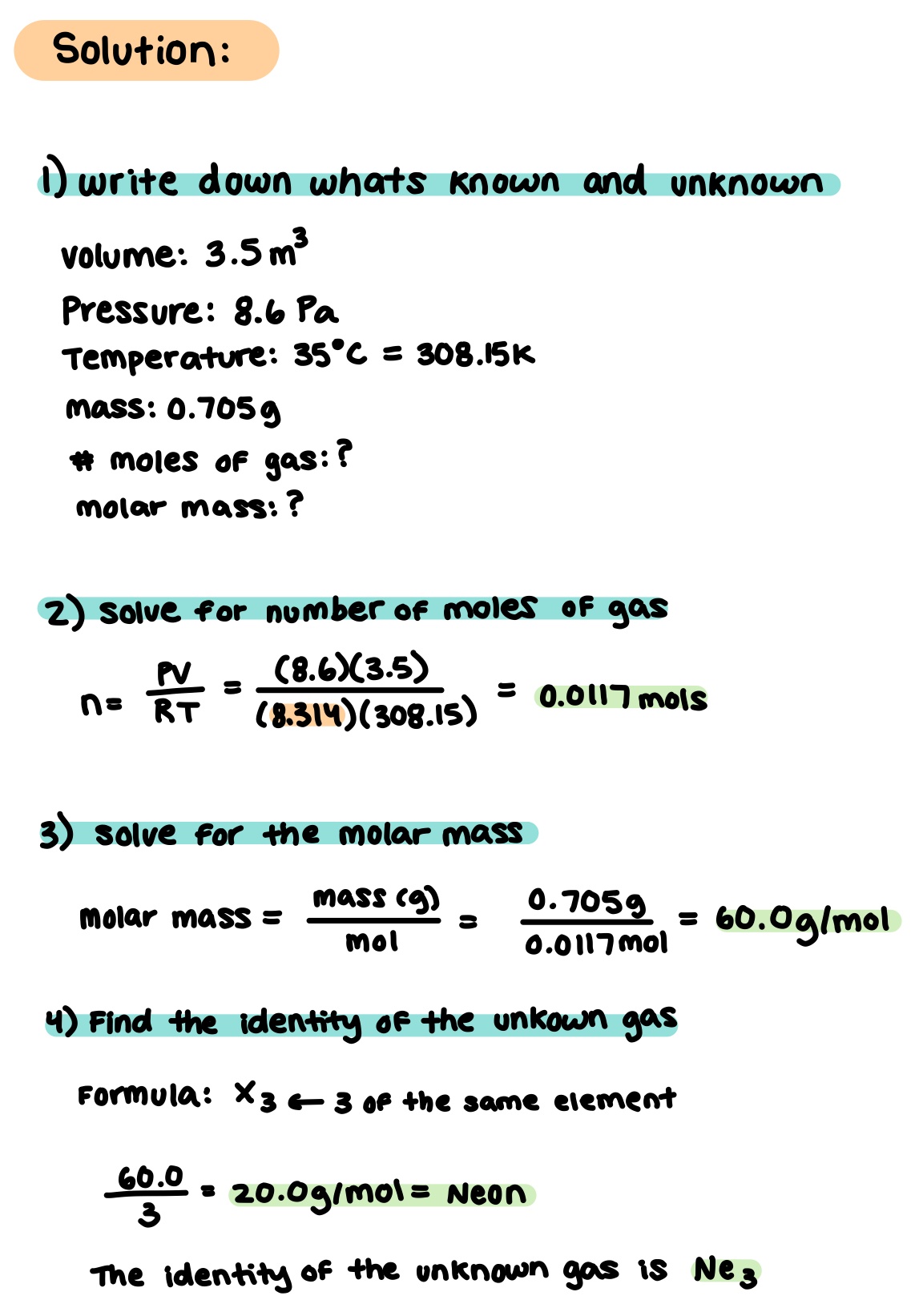
Image source: Caroline Monahan