Interactive · 1 question

We know that if we choose 22 points which are not identical to each other, there will be exactly 11 line that passes through both of the points. Therefore, if we find an equation for this line, we can check if a third point satisfies the equation for the line. If it does, we have that the three points are collinear. If it doesn't, we have that the three points are non collinear. For example, if we want to see if (0,0),(1,2),and(2,4)(0,0), (1,2), \text{and} (2,4) are collinear, we can find the equation of the line that passes through (0,0)and(1,2)(0,0) \text{and} (1,2) and see if (2,4)(2,4) satisfies it. This equation is y=2xy=2x, and sure enough, (2,4)(2,4) satisfies it. Therefore these points are collinear. To check your knowledge of collinearity, try this question:

Check any set of three points that are collinear

Choose all correct answers

Illustrated · 1 min

Collinearity:

Three or more points are said to be collinear if they all lie on a straight line.

(Why not less than three points? Think!)

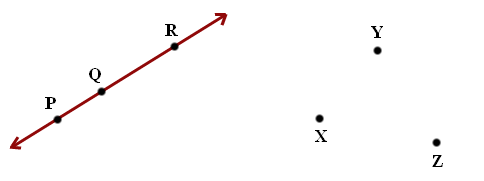
For example points PP , QQ and RR are collinear in contrast to the points XX , YY and ZZ as shown in the figure.

(Source : mathcaptain.com)

For checking the collinearity of three points ( Say PP , QQ and RR ) we can check if the following conditions satisfy:

11. Slope of PQ‾=\overline{PQ} = Slope of QR‾\overline{QR}.

⇒yq−ypxq−xp=yr−yqxr−xq\Rightarrow \dfrac{y_q-y_p}{x_q-x_p} = \dfrac{y_r-y_q}{x_r-x_q}

22. Area of triangle formed by the three points =0= 0

area(Δ)=12⋅∣[xpyp1xqyq1xryr1]∣=0area(\Delta) = \dfrac{1}{2} \cdot \left|\left[\begin{array}{ccc}x_p&y_p&1\\ x_q&y_q&1 \\ x_r&y_r&1\end{array}\right] \right|= 0

i.e. area(Δ)=12⋅∣[xp(yq−yr)+xq(yr−yp)+xr(yp−yq)]∣=0area(\Delta) = \dfrac{1}{2} \cdot \left|[ x_p(y_q-y_r) + x_q(y_r-y_p) + x_r(y_p-y_q)] \right| = 0

NOTE: Notice that we take the modulus of the value obtained by substituting the values of variables as the value of area can never be negative.

Thus, for checking collinearity of three or more points we can use the first property by checking if the slopes between different points is equal or not.

Cheers!

Type a concept, like “slope” or “photosynthesis”.

↑ ↓ to choose · Enter to openSearch explanations and problems