Codominance — Overview & Examples

Illustrated · 1 min

What Is Codominance?

Unlike Mendelian patterns of inheritance, codominance can create three distinct phenotypes using just two alleles.
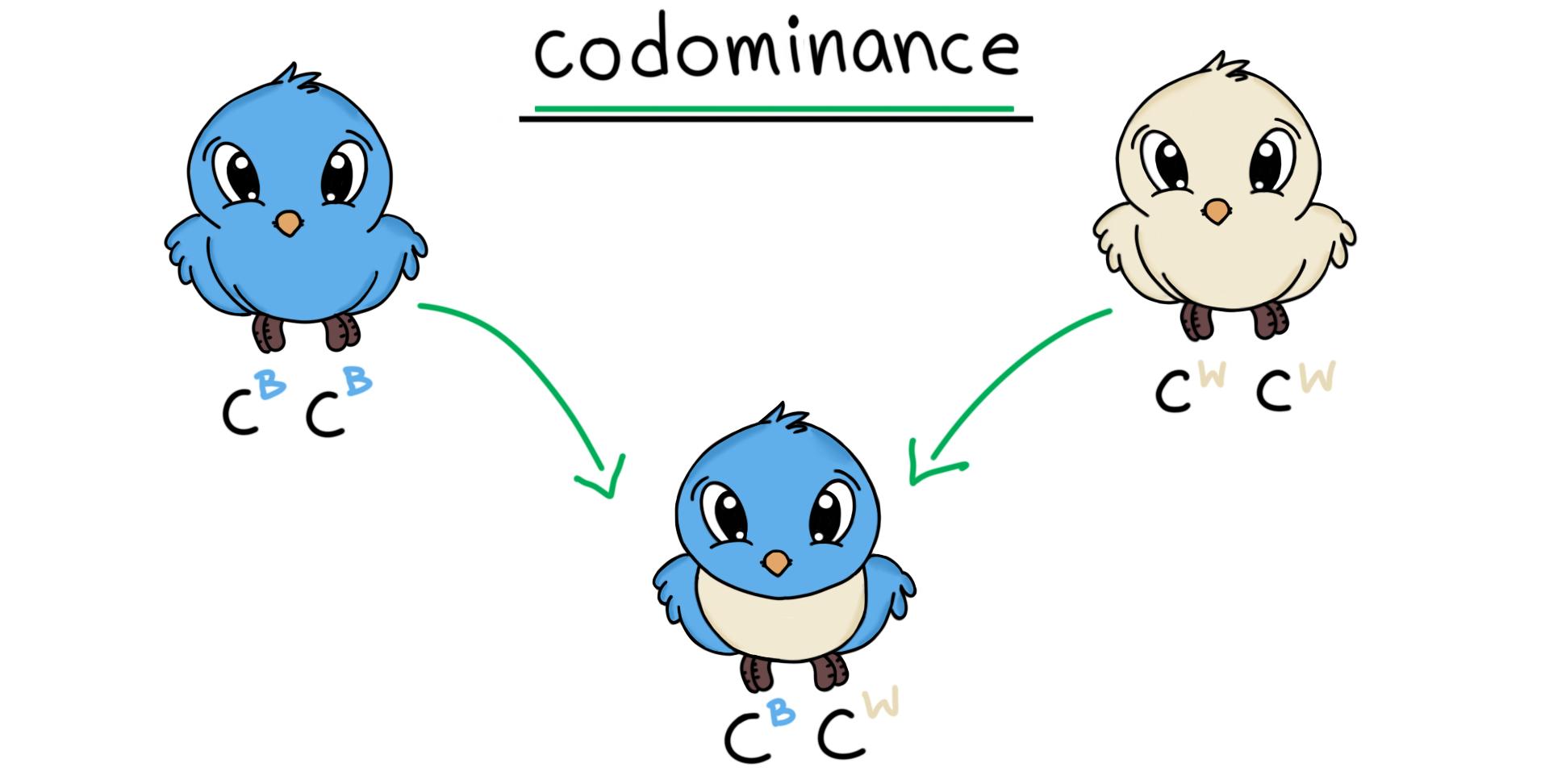
A diagram showing an example of codominance. A homozygous blue bird mates with a homozygous white bird. Their offspring is a bird with patches of blue and white.

Image source: By Gabi Slizewska

For a codominant trait, a heterozygous organism will actually express both alleles. This means that the distinct phenotypes produced by each allele can both be observed.

Take a look at the picture above. We have a homozygous blue bird and a homozygous white bird. The offspring is heterozygous but has blue and white feathers. Neither allele is truly dominant, and the result is an entirely different phenotype.

How Is It Different from Incomplete Dominance?

Remember, codominance is different from incomplete dominance. In the case of incomplete dominance, a heterozygous organism would have a blend of the phenotypes produced by each allele. If this applied to the example above, the heterozygous bird would have uniform lighter blue feathers throughout (a blend of the blue and white phenotypes). With a codominant trait, the original phenotypes do not blend. You can still see patches of blue and patches of white.


Read · 1 min

What Is a Codominant Trait?

Codominance occurs when two heterozygous alleles are fully expressed. Neither allele can dominate, so they both show up, but they do not blend. The prefix co- means "together" so you can use that to remember that "both alleles show up together".

In this pattern of inheritance, the phenotypes of both parents are combined into a third, unique phenotype. As a reminder, a phenotype is a way to use traits to describe genes. It's like saying there is a black fur gene.

What Is an Example?

With a codominant trait, phenotypes like fur color are combined. For example, if a black-feathered chicken breeds with a white-feathered chicken, their offspring will be both black and white. They will not be gray; rather, there will be spots of both colors.

Vocabulary Review:\color{#8925AE}{\text{Vocabulary Review:}}

Independent Assortment\color{#8925AE}{\text{Independent Assortment}} : Alleles of different traits are inherited separately and do not influence each other

Dominant\color{#8925AE}{\text{Dominant}} : The stronger of two expressed genes

Recessive\color{#8925AE}{\text{Recessive}} : The weaker of two expressed genes. Only shown if a gene is homozygous recessive

Heterozygous\color{#8925AE}{\text{Heterozygous}} : Two different kinds of allele, one dominant and one recessive

Homozygous\color{#8925AE}{\text{Homozygous}} : Two of the same type of allele, both dominant or both recessive

Codominance\color{#8925AE}{\text{Codominance}} : Occurs when two heterozygous alleles are fully expressed. Neither allele can dominate, so they both show up, but they do not blend

Incomplete Dominance\color{#8925AE}{\text{Incomplete Dominance}} : Occurs when there is no recessive or dominant allele. The alleles are both expressed and show up as a mixture of the two phenotypes

Sex-Linked Traits\color{#8925AE}{\text{Sex-Linked Traits}} : Traits caused by alleles located on a sex-chromosome

Polygenic\color{#8925AE}{\text{Polygenic}} : Traits that are controlled by two or more genes

Illustrated · 1 min

What Is a Human Example of a Codominant Trait?

The image shows six blood cells: A, B, O, AO, BO, and AB. A and AO have green dots. B and BO have orange dots. O has purple dots. AB has green and orange dots.

Image source: By Sarah Morgan

In codominance, two alleles are equally expressed in the phenotype of an organism. We can easily see this by looking at blood type.

A person's blood type depends on the type of antigen their red blood cells have on their cell membranes. Type A blood has antigen A. Type B blood has antigen B. Type O blood has neither antigen.

Both A and B are dominant, while O is recessive. So, if a person with homozygous genes for type A blood has a child with someone who has type O blood, the child will have type A blood.

However, if someone with homozygous type A blood has a child with someone who has homozygous type B blood, their child will have type AB blood. Both antigen A and antigen B will be present on the cells. This is because A and B are codominant.

Because of this, type O blood can be donated to any person. This is because it does not have A or B antigens. Type AB blood can only be donated to people with AB blood because it has both A and B antigens.

How Is This Different from Incomplete Dominance?

If this were a case of incomplete dominance, then AB type blood would not have A and B antigens. Instead, it would have one antigen that was kind of like antigen A and kind of like antigen B. In incomplete dominance, the phenotype is a mix of two non-dominant genes. In a codominant trait, two dominant genes are equally expressed. This leads to two different phenotypes being visible.

Video

(Video) Non-Mendelian Genetics

by Teacher's Pet

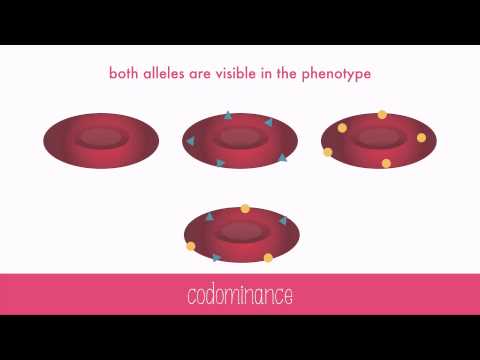
This video will teach you about codominance. In this pattern of inheritance, both alleles are visible in the phenotype. A great example of this is blood type. Type AB blood has both A and B antigens. This video also includes some practice problems using Punnett squares so you can feel confident answering test questions about codominance.

Video

(Video) Incomplete Dominance, Codominance, Polygenic Traits, and Epistasis

by Amoeba Sisters

Have you ever seen a black and white spotted chicken? How does that happen? The answer lies in codominance, which is when two alleles are both expressed. Watch the video above to find out more on how this works.

Type a concept, like “slope” or “photosynthesis”.

↑ ↓ to choose · Enter to openSearch explanations and problems