Illustrated · 1 min

+1 contributors

The Role of mRNA and Codons in Protein Synthesis

Image source: By Gabi Slizewska
mRNA is an important part of protein synthesis. It is assembled during translation from a template DNA sequence.
Just like a DNA strand, a messenger RNA strand, mRNA for short, is made up of a sugar-phosphate backbone and nitrogenous bases that extend out from it. The genetic code is just a little different from that of DNA: the bases are Guanine (G), Cytosine (C), Adenine (A), and Uracil (U).
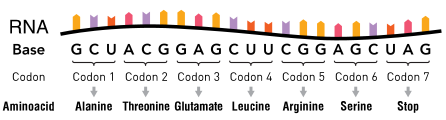
During translation, a ribosome moves down the mRNA strand and assembles a protein according to the nucleotide sequence it sees. The ribosome does not do this base-by-base however. It reads the strand in groups of three bases called codons.

Image source: By Gabi Slizewska
Each triplet corresponds to an amino acid, the building block of proteins.
There are 20 amino acids, and the ribosome has to read through the mRNA codons to decide which one to add to a growing protein. In the picture above, UUC corresponds to the amino acid phenylalanine (Phe).
In addition to coding for amino acids, some triplets also signify where translation needs to start and stop.
There is one start codon: AUG. In addition to signifying the start of translation, it also codes for the amino acid methionine.
There are three stop codons: UAA, UAG, and UGA. These triplets don't code for any amino acids but act as a stop signal for translation.
The codon table below shows the triplet code and the amino acids that each combination codes for. These combinations make up the standard genetic code.

Image source: By Gabi Slizewska