Codons — Definition & Role in Translation

Before this, knowTransfer RNA (tRNA) — Overview & Role in Translation

Illustrated · 1 min

The Role of mRNA and Codons in Protein Synthesis

The structure of mRNA. The bases are adenine, uracil, guanine, and cytosine.

Image source: By Gabi Slizewska

mRNA is an important part of protein synthesis. It is assembled during translation from a template DNA sequence.

Just like a DNA strand, a messenger RNA strand, mRNA for short, is made up of a sugar-phosphate backbone and nitrogenous bases that extend out from it. The genetic code is just a little different from that of DNA: the bases are Guanine (G), Cytosine (C), Adenine (A), and Uracil (U).

During translation, a ribosome moves down the mRNA strand and assembles a protein according to the nucleotide sequence it sees. The ribosome does not do this base-by-base however. It reads the strand in groups of three bases called codons.

A diagram of mRNA. A highlighted section shows the codon UUC which codes for Phenylalanine.

Image source: By Gabi Slizewska

Each triplet corresponds to an amino acid, the building block of proteins.

There are 20 amino acids, and the ribosome has to read through the mRNA codons to decide which one to add to a growing protein. In the picture above, UUC corresponds to the amino acid phenylalanine (Phe).

In addition to coding for amino acids, some triplets also signify where translation needs to start and stop.

There is one start codon: AUG. In addition to signifying the start of translation, it also codes for the amino acid methionine.

There are three stop codons: UAA, UAG, and UGA. These triplets don't code for any amino acids but act as a stop signal for translation.

The codon table below shows the triplet code and the amino acids that each combination codes for. These combinations make up the standard genetic code.

A list of codons and the amino acids they code for. UUU and UUC code for Phe. UUA, UUG, CUU, CUC, CUA, and CUG code for Leu. AUU, AUC, and AUA code for Ile. AUG codes for Met. GUU, GUC, GUA, and GUG code for Val. UCU, UCC, UCA, UCG, AGU, and AGC code for Ser. CCU, CCC, CCA, and CCG code for Pro. ACU, ACC, ACA, and ACG code for Thr. GCU, GCC, GCA, and GCG code for Ala. UAU and UAC code for Tyr. UAA, UAG, and UGA code for Stop. CAU and CAC code for His. CAA and CAG code for Gln. AAU and AAC code for Asn. AAA and AAG code for Lys. GAU and GAC code for Asp. GAA and GAG code for Glu. UGU and UGC code for Cys. UGG codes for Trp. CGU, CGC, CGA, and CGG code for Arg. AGU, AGC, AGA, and AGG code for Arg. GGU, GGC, GGA, and GGG code for Gly.

Image source: By Gabi Slizewska

Illustrated · 1 min

How to Read a Codon Chart

Codons are groups of three nucleotides. During the translation portion of protein synthesis, ribosomes read the mRNA sequence in groups of three. The triplet code is used to add the correct amino acid to a growing protein.

To determine which of the possible 20 amino acids a triplet will code for, we have to use a special chart. You can see one example of this chart shown at the bottom of the page. Radiating out from the center is the order in which the ribosome will read the triplet. The associated amino acid for each combination of bases is shown along the outside of the chart.

Example:

Let's start with the start codon. This triplet needs to be read by a ribosome for translation to begin. The start codon is always AUG. If we look at the chart in the middle we can see the green A. Next, we look at the four available nucleotides that come after A, (GACU). The red U is the next nucleotide and the yellow G is the final nucleotide. We can see that the associated amino acid is Met, which stands for methionine. This amino acid is the first amino acid in every single protein chain in our bodies.

A list of codons and the amino acids they code for. UUU and UUC code for Phe. UUA, UUG, CUU, CUC, CUA, and CUG code for Leu. AUU, AUC, and AUA code for Ile. AUG codes for Met. GUU, GUC, GUA, and GUG code for Val. UCU, UCC, UCA, UCG, AGU, and AGC code for Ser. CCU, CCC, CCA, and CCG code for Pro. ACU, ACC, ACA, and ACG code for Thr. GCU, GCC, GCA, and GCG code for Ala. UAU and UAC code for Tyr. UAA, UAG, and UGA code for Stop. CAU and CAC code for His. CAA and CAG code for Gln. AAU and AAC code for Asn. AAA and AAG code for Lys. GAU and GAC code for Asp. GAA and GAG code for Glu. UGU and UGC code for Cys. UGG codes for Trp. CGU, CGC, CGA, and CGG code for Arg. AGU, AGC, AGA, and AGG code for Arg. GGU, GGC, GGA, and GGG code for Gly.

Image source: By Onie~commonswikivia CC BY-SA 3.0, via Wikimedia Commons

Video · + 1 min read

(Video) Codons

by learnbiologically

An mRNA sequence contains groups of three nucleotides that code for specific amino acids. These triplets are called codons.

There are quite a few base pair combinations that code for each of the 20 amino acids. All of the combinations create a triplet code. During translation, the mRNA sequence is read and corresponding amino acids are linked together to form chains by transfer RNA (tRNA). Those chains can be modified and folded up to create functional proteins.

Mutations can cause the codons to become shifted and mess up the whole amino acid sequence.

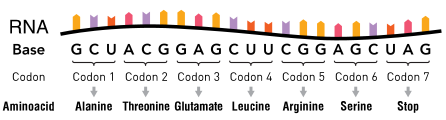
An example of how an RNA sequence forms codons which code for amino acids.

Image source: By Thomas Splettstoesser (www.scistyle.com) CC BY-SA 4.0, via Wikimedia Commons

Vocabulary Review:\color{#8925AE}{\text{Vocabulary Review:}}

Translation\color{#8925AE}{\text{Translation}} : The cell uses the information from RNA to make proteins

Nucleic Acid\color{#8925AE}{\text{Nucleic Acid}} : A nucleic acid is a complex polymer that stores information in a cell in the form of a code. DNA and RNA

mRNA\color{#8925AE}{\text{mRNA}} : Messenger RNA. mRNA nucleobases act as instructions for the cell to build polypeptides

tRNA\color{#8925AE}{\text{tRNA}} : Transfer RNA. Carries a specific amino acid to the ribosomes to help build proteins

Codon\color{#8925AE}{\text{Codon}} : A group of three nucleobases that codes for a specific amino acid

Type a concept, like “slope” or “photosynthesis”.

↑ ↓ to choose · Enter to openSearch explanations and problems