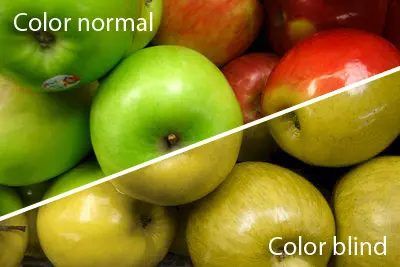
Normally, OPN1LW, OPN1MW, and OPN1SW genes are all not mutated, so the L, M and S cones all work perfectly. When the genes are mutated, the cones function differently or not at all in varying levels. Some forms of color-blindness are more severe since several cones are non-functional, but others are less severe because only one is affected. Luckily, the most common form of color-blindness is also the most mild form, with individuals functioning relatively normally. Changes to the OPN1LW or OPN1MW causes the red-green color blindness defect. These abnormalities lead to absences of the L or M cones. Blue-yellow color blindness comes from mutations to the OPN1SW, so the S cone is defectively produced. Blue chrome monochromacy requires both OPN1LW and OPN1MW genes to not function, meaning both L and M cones do not function.
Genetically inheriting a disease is only one way of getting color blindness. Two other ways of getting color vision deficiency are also possible, one of which comes from hereditary disease, one from physical trauma. Damage to the eyes such as through Shaken Baby Syndrome or from UV rays can also cause color blindness. Another way is through hereditary diseases such as diabetes.
Color-blindness is officially considered a disability, but throughout history, advantages from color-blindness have been discovered. During World War II, it was found that aerial surveillance shots of enemy lands were better analyzed when at least one individual was color-blind. Others have noted that people with color-blindness can see past some camouflages, and female carriers may even have an extra dimension of color awareness. Despite these possible advantages, people with color-blindness may be severely limited in life. Anything from seeing everyday traffic lights to a career in aviation may not be possible for people with forms of color-blindness, and careers in areas of art may be difficult for those with any form of color vision deficiency.
There is no cure for color-blindness, however sometimes contact lenses can be used to adjust for deficiencies. Sometimes, color-vision deficiencies are so mild that they are not diagnosed until eyesight vision tests. The most common type of test to determine color-blindness is the Ishihara test, which often tests for red-green color-blindness and consist of dots that form numbers. 38 different plates are available to test severity, but often only a few are needed.
There are medical names for each individual form of color-blindness. Anomalous Trichromacy is a mild shift in the sensitivity of the cones. Additionally, Protanomaly is a form of color-blindness where shades of red appear weaker in depth and brightness. Deuteranomaly is not as severe, but certain shades of green appear weaker to people with this disorder. Tritanomaly, a rare condition, causes shades of blue to appear weaker. Dichromacy is another condition where severe deficiency or complete absence of one of the types of cones appears. Another form of color-blindness, Protanopia, is when shades of red are greatly reduced in depth and brightness, if they can be seen at all. Similarly, Deuteranopia is when shades of green are greatly reduced in depth and brightness. Finally, Tritanopia is another rare condition in which shades of blue are greatly reduced in depth and brightness when they can actually be seen.