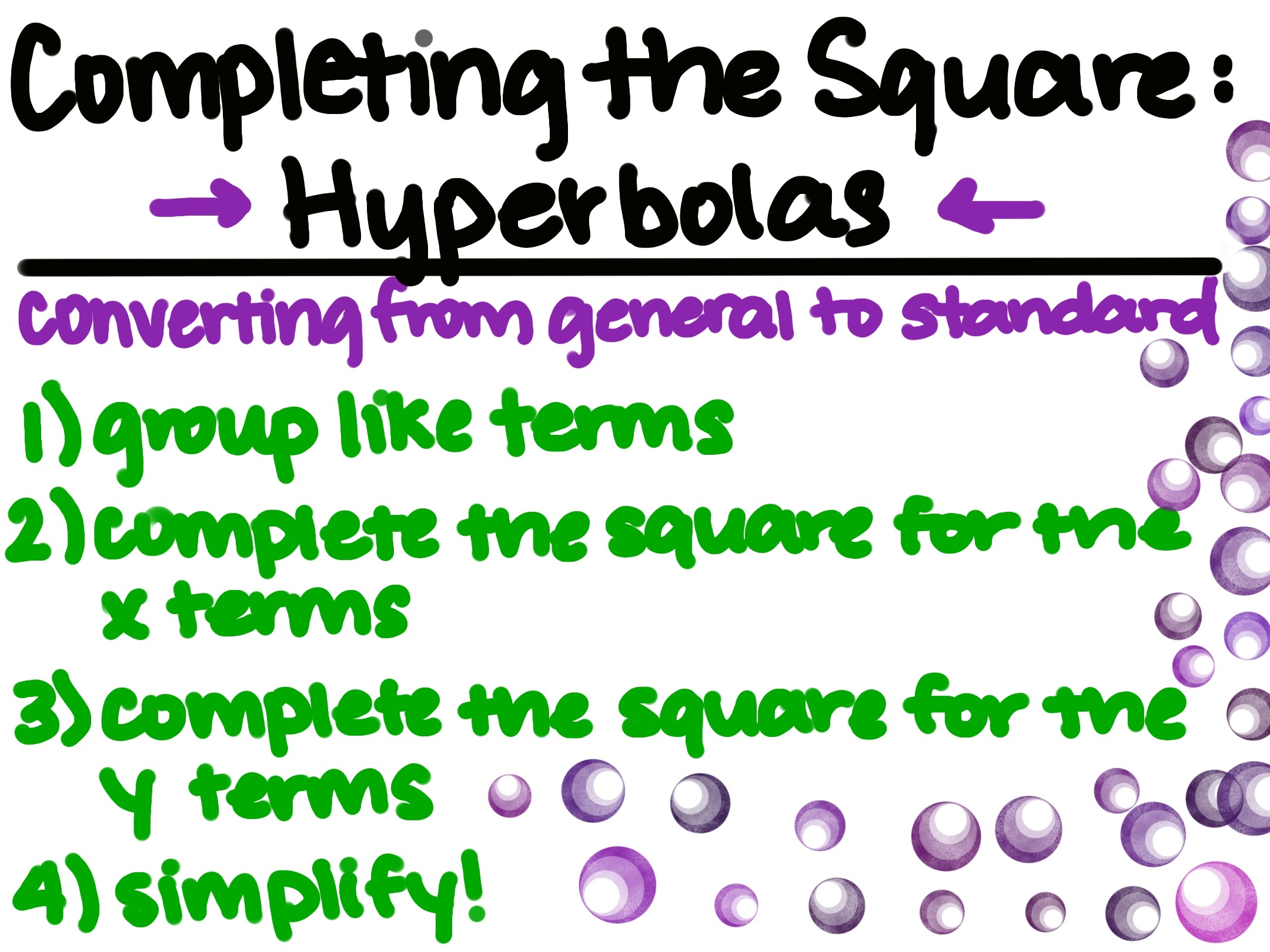
Converting a Hyperbola: General Form to Standard Form
Completing the square is a useful technique for converting the equation of a hyperbola from general form to standard form. The general form of a hyperbola equation looks like:
Ax2+Bxy+Cy2+Dx+Ey+F=0
The standard form of a hyperbola equation looks like:
a2(x−h)2−b2(y−k)2=1
, where (h,k) is the center of the hyperbola, a is the length of the transverse axis, and b is the length of the conjugate axis.
Steps
###1: Isolate the x and y terms.
Ax2+Dx+Cy2+Ey=−Bxy−F
###2: Complete the Square for x
Group the x terms together and complete the square.
Ax2+Dx=A(x2+ADx)
Add and subtract (2AD)2 inside the parentheses.
Ax2+Dx=A(x2+ADx+(2AD)2−(2AD)2
Simplify inside the parenthesis:
Ax2+Dx=A(x+2AD)2−4AD2
###3: Complete the Square for y
Cy2+Ey=C(y2+CEy)
Add and subtract (2CE)2 inside the parentheses.
Cy2+Ey=C(y2+CEy+(2CE)2−(2CE)2
Simplify inside the parenthesis:
Cy2+Ey=C(y+2CE)2−4CE2
###4: Combine the Completed Squares
Substitute back into the original equation.
A(x+2AD)2−4AD2+C(y+2CE)2−4CE2=−Bxy−F
###5: Move constant terms to the other side
A(x+2AD)2+C(y+2CE)2=4AD2+4CE2−Bxy−F
###6: Simplify!
Use your mathematical tricks to simply and rearrange the equation so it looks like the standard form.
a2(x−h)2−b2(y−k)2=1