Read · 2 min
Gases Are Compressible And Expandable
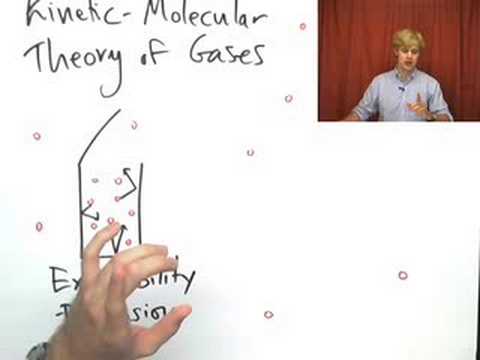
Compounds in the gaseous phase have unique properties different from liquids and solids. These unique properties include the ability of gases to expand or compress.
###Expansion
Gas molecules expand to fill their containers. For example, the air contained in a balloon fills up the entire balloon. It does not remain in one single spot of the balloon more than another. The particles move throughout the entire space. If the balloon popped, the gas molecules would diffuse throughout the space of the room. This also means that the space or volume a gas occupies is inversely related to pressure. The gas in the balloon has a smaller volume and higher pressure. But when let into the room, it has a larger volume and lower pressure.
Now let's consider how liquids and solids differ. If a solid cube is placed in a container, it does not expand to fill the shape. The molecules in a solid are tightly packed and do not conform to their containers. This is true for crystalline and amorphous solids. Liquids do conform to their container's shape. But the liquid molecules do not fill more volume than the mass takes up. When water is placed in a glass to be half-full, it fills the shape of the lower half of the glass. However, the molecules do not fill the entire container unless more water is added.
###Compression
Gas molecules are able to be compressed or pushed closer together. This compressibility occurs when the volume of the system decreases. As the volume decreases, the gas molecules move closer together. There are more collisions with the container. So, this also means the pressure increases.
Solids are nearly incompressible. If we think about a ball of clay being pushed into a table, the clay flattens. This is not compressing the clay. If it was compressed, we could be left with a smaller ball containing the same number of particles, just closer together. Liquids are the same. Their shape can change, but the molecules do not compress. If you have a 100 milliliter bottle, it can only be filled with 100 milliliters of water. More cannot be forced into the bottle while maintaining the original bottle form and integrity.
Compression of Real and Ideal Gases
Do you remember the kinetic molecular theory? For ideal gases, we assume that the particles have negligible volumes. So, the container is mostly empty space. As we compress gases, this assumption begins to break down. Our ideal gas becomes a real gas. At very high pressures, a real gas will begin to experience intermolecular forces. So, often the gas will condense into a liquid. This holds true for all gases because all molecules have dispersion forces. But, it happens more quickly for polar molecules. Why? Because they experience dipole-dipole interactions or hydrogen bonding. So, the stronger the intermolecular attraction the sooner they condense.