Illustrated · 2 min

+1 contributors
Background
In the previous lesson, we learned about polar coordinates. Now, we will learn how to convert them into rectangular coordinates, which may feel more familiar.
Rectangular coordinates are the points we use on the cartesian plane. They are written as .
Polar coordinates are written as . The value tells us how far we move from the center. The value tells us the angle we move from the polar axis.
To plot a polar coordinate, first move degrees (or radians) counterclockwise. Then move outward by units.
To convert between the two systems, we need to remember our trigonometry rules. In particular, we use the rules for sine and cosine to connect , , and .
The Conversion
When we convert to rectangular coordinates, we move from the polar grid to the Cartesian plane.
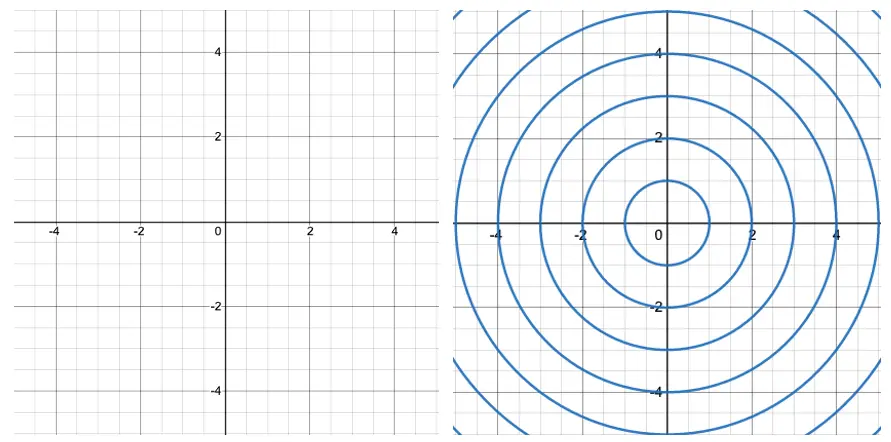
The polar grid is made of circles that share the same center. These are called concentric circles. Points are located using a distance and an angle .
The Cartesian plane is organized in a rectangular grid. Points are located using values that move left, right, up, and down.
Even though the grids look different, they describe the same points in different ways.
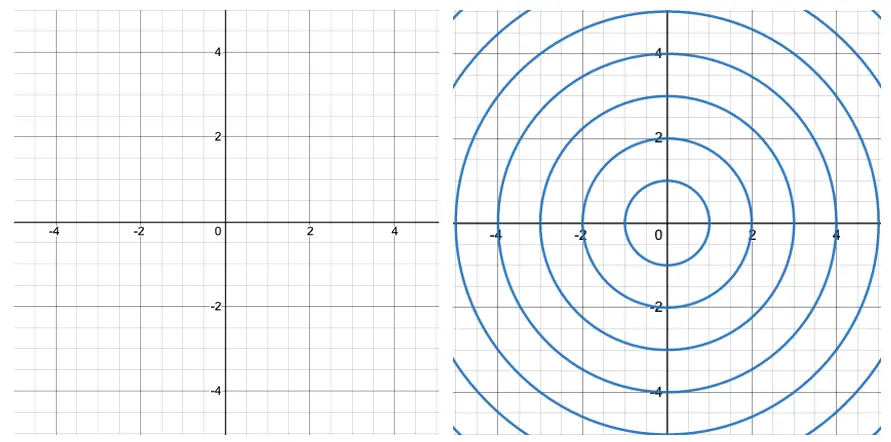
Made using Desmos
When converting from polar coordinates, we need to use the trigonometry rules we learned earlier.
In polar form, the angle plays an important role. We must understand how angles work, whether they are measured in degrees or radians.
Degrees and radians both measure angles, but they use different scales. Knowing how they relate helps us convert correctly.
Understanding this relationship makes it easier to switch from polar coordinates to rectangular coordinates.
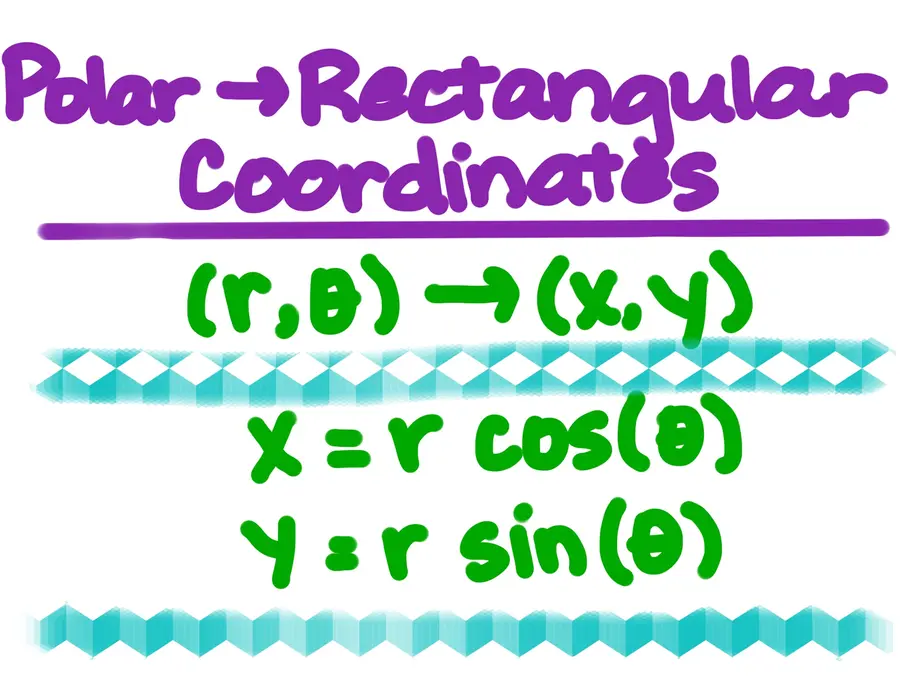
To convert from polar coordinates to rectangular coordinates:
Let's say we are trying to convert to rectangular coordinates. We know that and . If we were to plug these values into our conversions,
That means our rectangular coordinate is: .
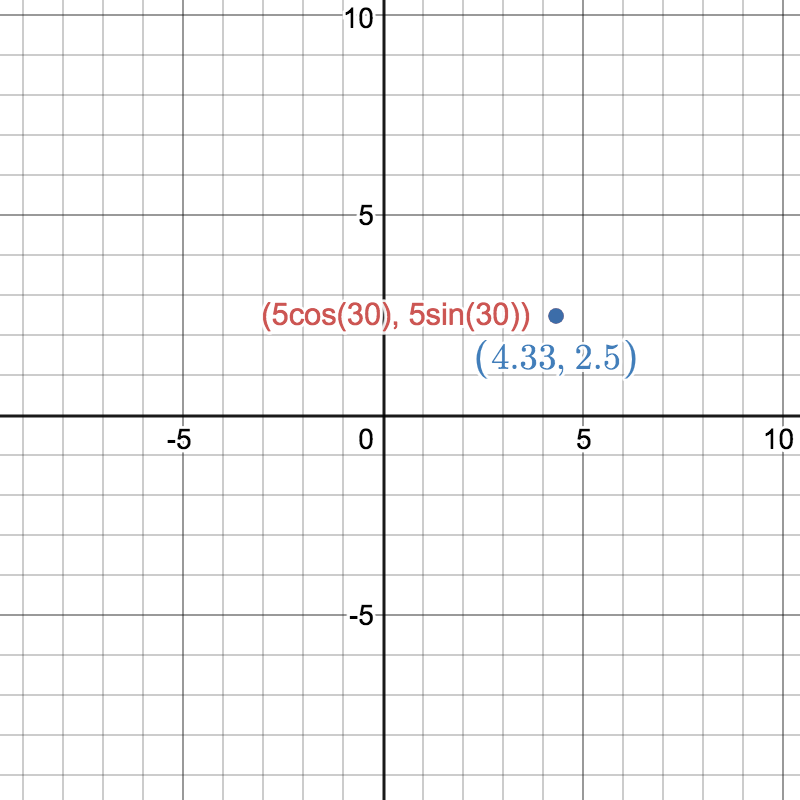
Made using Desmos
are the decimal values for . We can see that the polar and rectangular coordinates are equal.