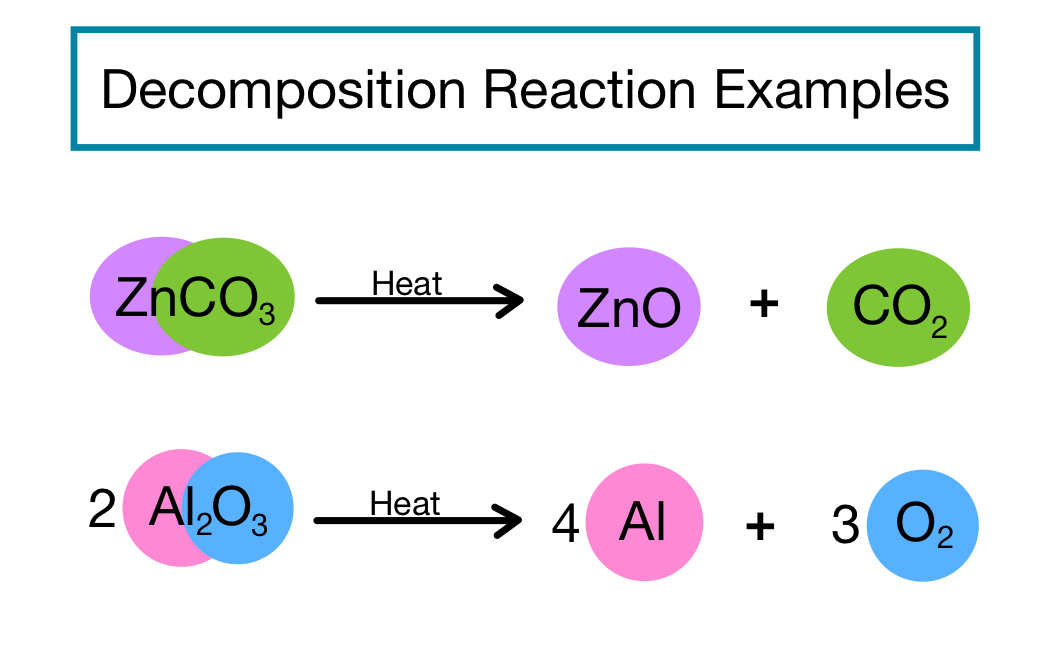
What are Decomposition Reactions?
A decomposition reaction is the breakdown of an individual molecule into multiple parts. If we were to write a generic balanced chemical equation, it would look like AB→A+B. The products can either be smaller molecules or individual atoms. Previously, we studied synthesis reactions. As you can see, decomposition is the reverse of a synthesis reaction.
Why do decomposition reactions occur? We know that forming chemical bonds lowers the overall energy. Atoms are more stable when they bond. So, to break a chemical bond, we have to input energy. The result of decomposition is two products. So, the system should be less stable. And it is! Decomposition reactions almost always require an input of energy. That's why very few decomposition reactions occur spontaneously. Below, we'll explore the most common methods for adding energy.
Thermal Decomposition
The most straightforward method of causing decomposition is adding heat. Remember, the temperature is the average kinetic energy of the molecules. A part of the total kinetic energy is molecular vibrations. Imagine two bonded atoms. As we add heat, they begin to oscillate. As more energy gets added, the oscillation becomes larger. Eventually, the length between atoms expands so much that the bond breaks. We've overcome the electrostatic interactions between the atoms. That's also why bond energy and bond length are directly related.
Photolytic Decomposition
We can also consider a more complicated model. We know that bonds occur between valence electrons. In molecular orbital theory, a bond forms when the electrons fill a bonding orbital. When we add energy, we promote the bonding electron pair to a nonbonding orbital. The nonbonding molecular orbital is unstable. So the molecule undergoes decomposition.
The molecular orbital model is most helpful for photolytic decomposition. What's that? It's a decomposition reaction initiated by electromagnetic radiation. Way back, we studied Bohr's atomic model. He proposed that electrons circle the nucleus in quantized orbits. His model explained the absorption and emission spectra. How? When a photon hits an electron, the electron is promoted to a higher orbit. To return to its original orbit, it has to release a photon. The same concept applies to bonding. What happens when photons with small wavelengths (high energy) hit bonding electrons? The electrons get promoted to nonbonding orbitals. The higher energy state allows for a decomposition reaction to occur.
A great example of photolytic decomposition occurs during the ozone cycle. In the stratosphere, ozone molecules are constantly being synthesized and broken. Why? It's part of a cycle that dissipates ultraviolet radiation. The wavelengths of UV light are between 240 and 310 nanometers (10−9m). Those are unbelievably short wavelengths! So, they have a lot of energy. What would happen if they hit the earth's surface? They would ionize most matter. Life would be impossible. Thankfully, ultraviolet light hits atmospheric ozone. It initiates a process that converts the energy to heat. Let's examine the reactions.
Step one is ozone creation. It's initiated by UV light which splits diatomic oxygen into two singlet oxygen atoms. Then, singlet oxygen reacts with diatomic oxygen to form ozone. As a side note, in a chemical equation, hν indicates a photon.
O2+hν→2O
O+O2→O3
In step two, ozone breaks down into diatomic oxygen and a singlet oxygen atom. Then, the ozone gets reformed. But there's a trick! We need another molecule present. Why? It absorbs some of the kinetic energy. Typically, the other molecule is diatomic oxygen or nitrogen. In the equation below, X is the other molecule. X∗ denotes the excited state because it's absorbed energy. We've converted UV light into heat!
O3+hν→O2+O
O2+O+X→O3+X∗.
All of this is initiated by photolytic decomposition!
Electrolytic Decomposition
Electrolytic decomposition uses electricity to split a molecule. It's also called electrolysis. Electrolysis is most commonly used for industrial chemical production. The typical examples are the electrolysis of water and molten salts. We use water electrolysis to make hydrogen and oxygen gas. We use molten salt electrolysis to split ionic compounds and produce metals. For example, the electrolysis of sodium chloride creates sodium metal and chlorine gas.