Illustrated · 1 min

Dipole Moment — Definition & Overview
Read · 1 min
What is a Dipole Moment?
How Do Dipoles Occur?
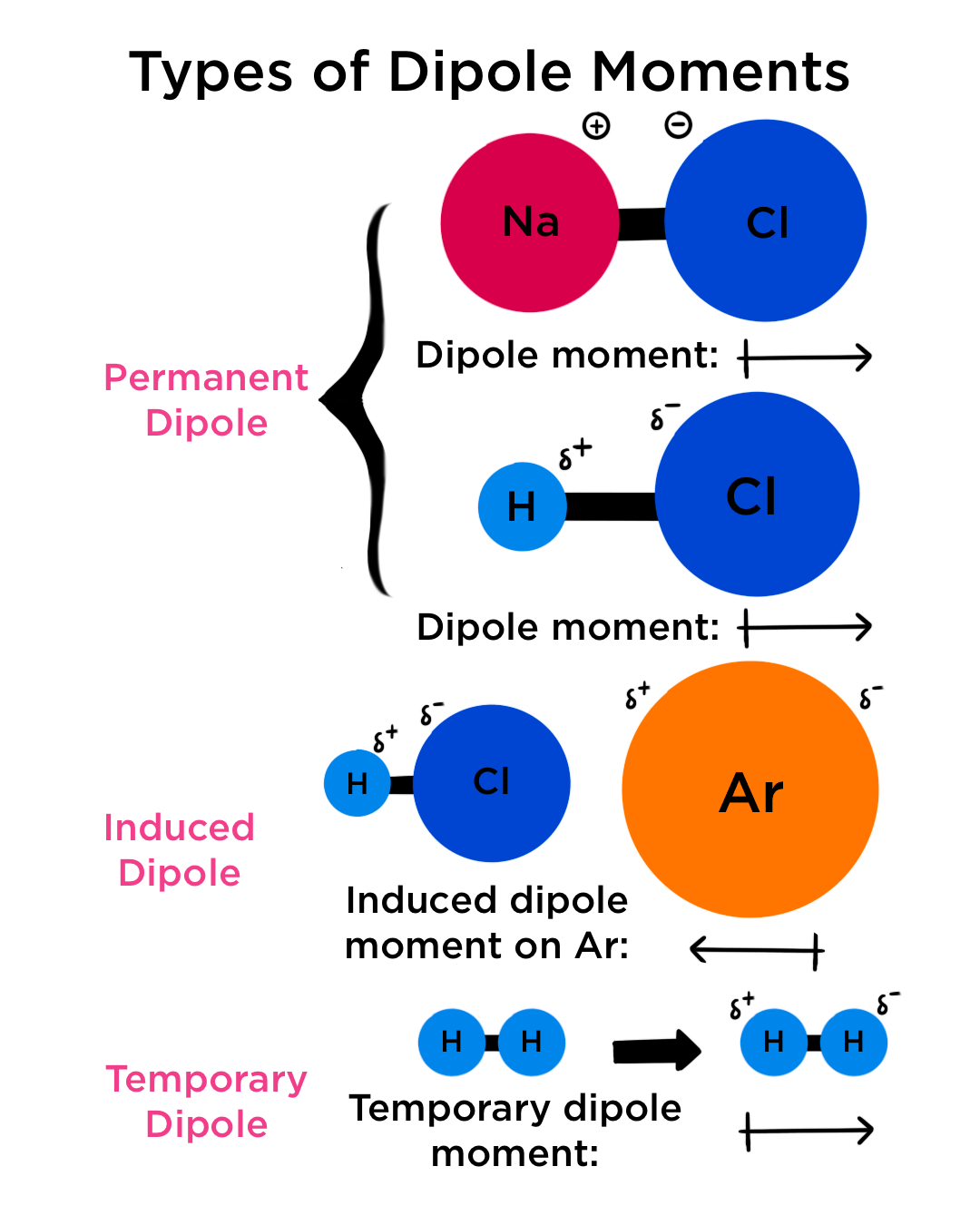
Dipoles can have varying strengths. The strength of a dipole of a chemical compound can vary based on the electronegativity of atoms and combination of dipoles.
Atoms with different electronegativities bonded together can create dipoles. The more electronegative atom will carry the partial negative charge.
Some substances have more than one dipole which can either create a stronger dipole moment or cancel out the net dipole. Dipoles can be thought of as drawing an arrow from the positive end to the negative end of the molecule. A water molecule has a net dipole. In water, there would be two arrows drawn toward oxygen (more electronegative atom). From VSEPR, we know that water molecule is bent and not linear. So, there is a net dipole. If a molecule had more than one dipole and if they cancel each other out, there is no net dipole. This can occur when a linear compound with three atoms. If the two dipoles point toward or away from each other, they cancel out. An example would be carbon dioxide ().
Video
Dipole Moment
(Video) The Dipole Moment of Molecules
By: Knowbee

This video does a great job of explaining dipole moments in depth. It goes over the rules that distinguish a molecule from having a dipole moment or not. It notes key trends on the periodic table that relate to dipole moments. This video also has multiple examples of how to find and show dipole moments on molecules.
Read · 3 min
What is a Dipole?
We've been studying covalent bonding. What happens when two atoms bond covalently? They share an electron pair. One electron is from each of their valence shells. The goal is to complete their octet. But what happens if the atoms have different electronegativities? They won't share the electrons evenly. The electrons will spend more time with the more electronegative element. What's the result? The more electronegative atom will have a partial negative charge. The other will have a partial positive charge. So, there is a distribution of charges. We call it a dipole moment. We would describe the molecule as polar. Why? Because it has two oppositely charged poles or ends.
Dipoles and Intermolecular Forces
Why do we care about dipoles? The charges influence how the molecules interact. Because of their dipoles, polar molecules experience unique intermolecular forces. The most obvious is the dipole-dipole interaction. The positive side of one molecule has an electrostatic attraction to the negative side of another. So, polar molecules are more likely to be in a condensed phase of matter. You'll almost always find them as solids or liquids at room temperature. To vaporize them into gases requires enough heat energy to break the electrostatic attractions.
The most potent form of dipole-dipole interactions is hydrogen bonding. It occurs when hydrogen bonds with fluorine, oxygen, or nitrogen. Why these specific elements? They are incredibly electronegative! So, the dipole is unbelievably powerful. For example, the bond energy for the single bond in diatomic fluorine is 154 kilojoules per mole. The bond energy for the hydrogen bonding in hydrogen fluoride is 164 kilojoules per mole. In most cases, a hydrogen bond is weaker than a covalent bond. But, in this example, it's stronger! So, we see that hydrogen bonding is a significant interaction.
Another type of interaction occurs between ions and polar molecules. We creatively call it the ion-dipole interaction. Remember, ions have a full ionic charge because they have gained or lost electrons. So, a cation is attracted to the negative side of a polar molecule. Anions get drawn to the positive side of a polar molecule. But, polar molecules only have partial charges. So, it often requires many polar molecules to balance an ion.
Chemistry in the World: Water
Water is the quintessential polar molecule. Water's hydrogen bonding is the reason for all its physical and chemical properties. Without it, there would be no life on earth! Let's start with its phases of matter. At standard temperature and pressure, it's a liquid. So, animals can drink it, plants can absorb it through their roots, and fish can swim through it. If it were solid or gas, our food supply would be non-existent. But wait, it does vaporize. Yes! And it condenses again at the pressures and temperatures of the troposphere. So, the earth's wind currents can distribute it from lakes and oceans onto land. But water can also freeze. Because of hydrogen bonding, the water molecules form a crystal lattice. What's the result? Water's density decreases! Ice is less dense than water. So, it creates a protective layer over various bodies of water.
Water's hydrogens bond also makes it an excellent solvent. In fact, we call water the universal solvent. It's advantageous for dissolving other polar molecules and ionic compounds. Its partial charges balance the charges on other particles. What's the result? The particle gets stabilized, and its energy lessens. So, it dissolves into solution. That's also the reason dissolving something is an exothermic process.