Interactive · 10 questions

Can we divide evenly by small numbers?

The three most common divisibility tests are for 22, 33, and 55.

Common Divisibility Tests. Divisibility by 2: even numbers (end in 0, 2, 4, 6, or 8), like 24 or 3570. Divisibility by 5: numbers that end in 0 or 5, like 65 or 3570. Divisible by 3: digits add up to a multiple of 3, like 3570 since 3+5+7+0=15, a multiple of 3.

Image by Caroline Kulczycky

The Number Two\\ A number is divisible by 22 if it is an even number. These numbers are the ones that end in a 00, 22, 44, 66, or 88. This last digit is called the units digit. We only have to look at the units digit this time. The rest of the digits, no matter how many there are, don't matter at all!

Which number in the list is divisible by 22?

Choose one answer

Spot the idea in disguise

In a contest problem, this idea hides inside a situation you have not seen before. Learning to spot it is the real skill. These are real problems from the AMC 8, AMC 10, AMC 12 and AIME, the national math competitions for middle and high school students, each with a worked solution on LIVE by Po-Shen Loh.

Video · + 3 min read

(Video) Common Divisibility Tests

by American Public University

This is a video by American Public University. This one summarizes common divisibility rules you may see.

Summary\large{\text{Summary}}

The video breaks numbers down into groups based on similar divisibility checks.

You check divisibility of 22, 55, and 1010 by checking the last digit of the number. As a result, the video groups these three tests into one category. If the number is even, it is divisible by 22. If the last digit is 55 or 00, it is divisible by 55. If the last digit is 00, it is divisible by 1010. Any positive number might be divisible by more than one of these. As a result I encourage you to try all three tests.

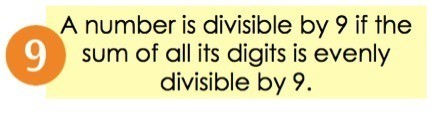
Divisibility of 33 and 99 is found by adding up all the digits in a number. If the sum of the digits is divisible by 33, the number is divisible by 33. If the sum is divisible by 99, the number is divisible by 99. Every number divisible by 99 is also divisible by 33. This is because 99 has 33 as a factor.

For 44 and 88, you have to check multiple digits on the end of a number. If the last two digits of a number are divisible by 44, then the original number is divisible by 44. If the number made by the last three digits of a number are divisible by 88, the number is divisible by 88. If the number doesn't have that many digits, just use all of them. Pretend there are zeros at the front to get the required number of digits. This won't change the value of the number!

Whether a number is divisible by 66 and 1212 depends on other tests. If a number is divisible by both 22 and 33, it is divisible by 66 as well. This is because 66 is a product of different prime numbers. In particular,

6=21×316 = 2^1 \times 3^1

If a number is divisible by both 33 and 44, it is also divisible by 1212. We could also check 22 and 66 instead of 33 and 44. The key is that we check pairs of numbers that multiply to 1212.

Why Do We Care?

These types of tests might seem to serve no real purpose at all. Fortunately, everything in math has a purpose, even if you don't know what it is. In this case we care about factorization of numbers. This is especially true for prime factorizations. Any number's factors are divisible by the factor. Thus we can use the tests to find factors of the number, and eventually the prime factors. In some cases we will have to use the tests more than once. Nonetheless, we have an alternative method to upside-down division.

Example: Let's find all the prime factors of 6666.

Solution: We could start randomly checking for prime factors. That being said, there is a strategy to make things go faster. It is usually easiest to start by checking the smallest prime numbers. The tests for the smaller prime numbers tend to be easier. Since 22 is the smallest prime number, we'll start with 22.

The test for 22 is to check whether our number is even. Certainly 6666 is even, because the units digit is a 66. So, we add 22 to our list of prime factors and divide 6666 by 22:

66÷2=3366 \div 2 = 33

We do this division to make it easier to keep looking for other prime factors. Any prime factor of 3333 will also be a prime factor of 6666, not to mention the 22 we found earlier. The next smallest prime number is 33. As a result we ask if 3333 is divisible by 33. Remember the test for 33. We want to check the sum of the digits of 3333:

3+3=63 + 3 = 6

Of course, 66 is divisible by 33, because 6=3×26 = 3 \times 2. This means 33 is a factor of 3333 (and of 6666). Once again, we divide away the new factor:

33÷3=1133 \div 3 = 11

You might remember that 1111 is a prime number. This means we don't need to run another test. We conclude that the prime factors of 6666 are 2,3,2, 3, and 1111. This completes the problem.

Interactive · 3 questions

Introduction

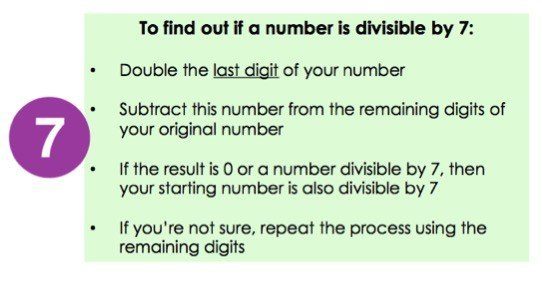
Here we will talk about divisibility tests. These are short tests you can run on a specific number to find out if it's divisible by another number. (If a number aa is divisible by another number bb, then a÷ba\div b is a whole number.) Some numbers have short tests, like 22 and 33, but others have longer, more tedious ones, such as 77. In this article, I'll go over the tests for 2,3,4,5,6,8,9,2,3,4,5,6,8,9, and 1010.

What's wonderful about these tests is they work for large numbers and small numbers. Many of them just depend on one or two digits of the numbers. As a result, there can be any number of digits in a multiple.

By applying a bunch of these tests you can even find the prime factors of a number! The number formed by multiplying all the prime factors will be a multiple of each prime factor.

Without further ado, let's get into the tests.

Checking 2,4,2,4, and 88

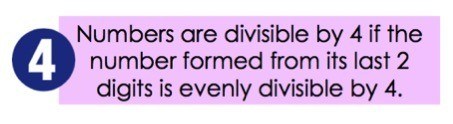
The tests for powers of two are rather simple. In order for a number to be divisible by 22, its last digit must be 22, 44, 66, 88, or 00. In other words, the number must be an even number. The test for 44 is slightly more complicated: If the tens digit is even, the ones digit must be 0,4,or 8.\text{If the tens digit is even, the ones digit must be } 0,4,\text{or }8. If the tens digit is odd, the ones digit must be 2 or 6.\text{If the tens digit is odd, the ones digit must be } 2\text{ or }6. Another way to say this is that the last two digits of the number must be a multiple of 44. Finally, for a number to be divisible by 88, its last three digits have to be a multiple of 88. In any of these cases, the original number is divisible by a power of 22.

Select the numbers that are divisible by 44. If there is more than one correct answer, check all of them.

Choose all correct answers

Interactive · 17 questions

In this example we're going to talk about a handful of tests. These can help find the factors of any whole number we'd want.

Divisibility by 33, 44, 77, and 99

Top hatt and wand

Divisibility tests are math magic—they save TONS of time!

Image source: By 472301 CC0, via pixabay.com

Divisibility by 33

Numbers are divisible by 3 if the sum of all of its digits is evenly divisible by 3.

Example: Consider the number 16021602. We can look to find the sum of all of its digits. This sum is

1+6+0+2=91 + 6 + 0 + 2 = 9

Is the sum of these digits evenly divisible by 33?

Choose one answer

Type a concept, like “slope” or “photosynthesis”.

↑ ↓ to choose · Enter to openSearch explanations and problems