DNA and RNA — Structure & Function

Before this, knowWhat Are Nucleic Acids? — Structure & Function

Illustrated · 1 min

Similarities Between DNA and RNA

Deoxyribonucleic acid (DNA) and ribonucleic acid (RNA) are two types of nucleic acids. You're probably more familiar with DNA and can recognize its famous double helix shape. RNA looks like half of a strand of DNA; it is single stranded.

Both RNA and DNA are made of nucleotides and take similar shapes. Both contain five-carbon sugars, phosphate groups, and nucleobases (nitrogenous bases). They both play important roles in protein synthesis.
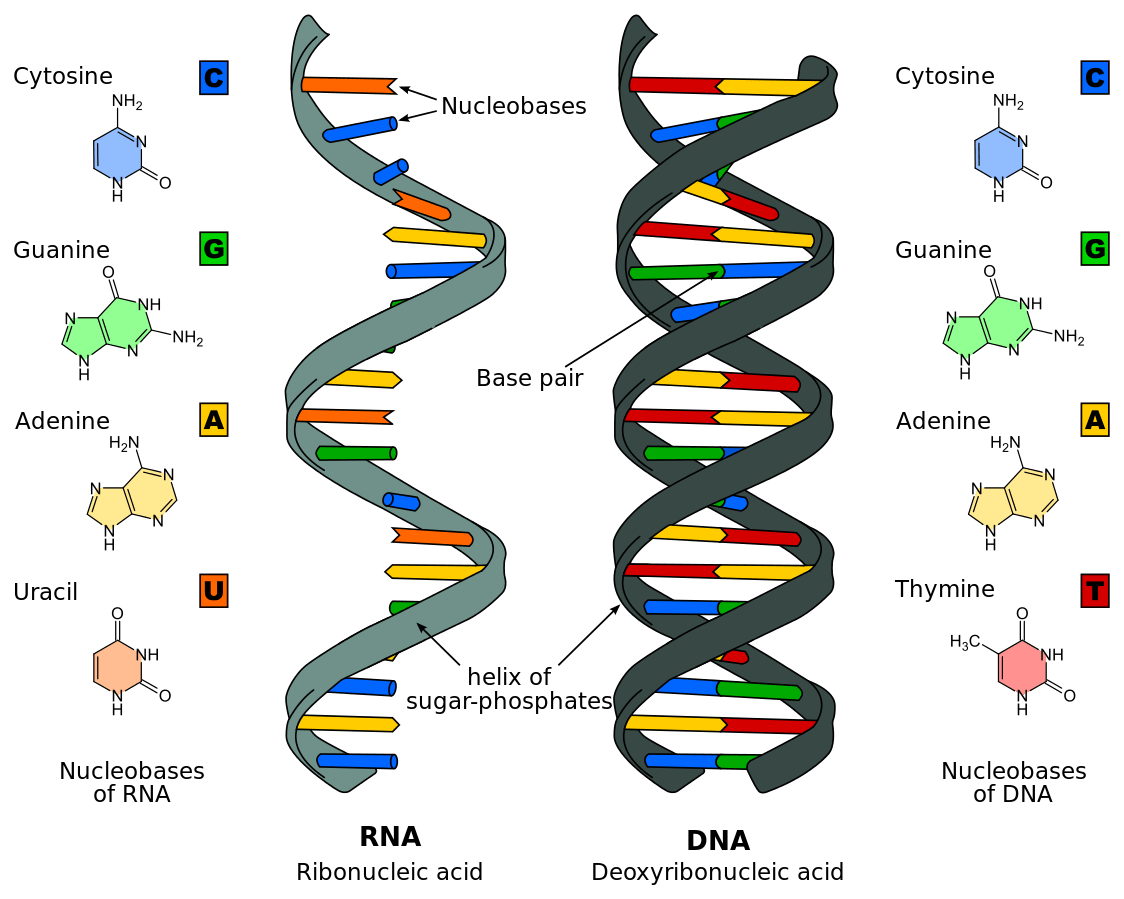
RNA has one strand, while DNA has two strands.

Image source: By Sponk CC BY-SA 3.0, via Wikimedia Commons

DNA has the five-carbon sugar deoxyribose and RNA has the five-carbon sugar ribose, hence their names. Their phosphate groups are identical, but they have different nucleobases. Well, mostly different.

Both nucleic acids have cytosine, guanine, and adenine. However, DNA has the nucleobase thymine while RNA has the nucleobase uracil. The nucleobases in DNA have preferred partners to form hydrogen bonds with: cytosine pairs with guanine, while adenine pairs with thymine in DNA or uracil in RNA.

Vocabulary Review:\color{#8925AE}{\text{Vocabulary Review:}}

Monomer\color{#8925AE}{\text{Monomer}} : Any molecule that can react with other molecules of the same or different makeup to form a chain, or polymer

Polymer\color{#8925AE}{\text{Polymer}} : A chain of monomers made of a specific type of compound

Macromolecule\color{#8925AE}{\text{Macromolecule}} : A polymer that has a large (macro) molecular mass. There are four main types in organisms: carbohydrates, proteins, lipids, and nucleic acids

Nucleotides\color{#8925AE}{\text{Nucleotides}} : The monomers of nucleic acids. Made up of a nitrogen group, a phosphorus group, and a 5-carbon ring

Nucleic Acid\color{#8925AE}{\text{Nucleic Acid}} : Complex polymer that stores information in a cell in the form of a code

Illustrated · 2 min

What's the Difference Between DNA and RNA?

DNA and its relative RNA are two of the most important molecules in our bodies. They store the information necessary for the production of proteins (amino acids) and the transfer of genetic information from parent to offspring.

DNA

DNA stands for deoxyribonucleic acid. It is found in the nucleus of eukaryotic cells, and free-floating in prokaryotic cells. DNA consists of deoxyribonucleotides which are made of a pentose (five-carbon) sugar, a phosphate group, and a nitrogenous base. In DNA the four nitrogenous bases are adenine, cytosine, guanine, and thymine (abbreviated as A, C, G, and T). In DNA the pentose sugar has one less oxygen than the pentose sugar in RNA.

Pentose sugars have five carbons the same way a pentagon has five sides.

Deoxyribonucleotides have one less oxygen and consist of a phosphate, a 5-carbon sugar, and a nitrogenous base. \\ Image source: By NEUROtiker [Public domain], via Wikimedia Commons

The deoxyribonucleotides in DNA are linked together by phosphodiester bonds. These bonds connect nucleotides that are next to each other at the phosphate group and the free 3' hydroxyl group. This creates a single strand of DNA.

DNA is a chain of nucleotides.

Image source: By Sponk [Public domain], via Wikimedia Commons

DNA is a double-stranded molecule. This means that two strands of bonded deoxyribonucleotides interact through hydrogen bonding with another complimentary, anti-parallel strand of DNA. In DNA, the complimentary base pairing rules state that A pairs with T, and G pairs with C.

DNA contains four nucleobases.

Image source: By Sponk CC BY-SA 3.0, via Wikimedia Commons

RNA

RNA stands for ribonucleic acid. RNA consists of ribonucleotides made up of a pentose (5-carbon) sugar, a phosphate group, and a nitrogenous base. In RNA the four nitrogenous bases are adenine, cytosine, guanine, and uracil (abbreviated as A, C, G, and U). Complimentary base pairing rules for RNA states that A pairs with U, and G pairs with C. In RNA, the pentose sugar (called ribose sugar) has one more oxygen than the sugar in DNA.

Each nucleotide has a phosphate group, a pentose sugar, and a nucleobase.

Image source: By Binhtruong CC BY-SA 3.0, via Wikimedia Commons

The ribonucleotides in RNA are linked together by phosphodiester bonds. These bonds connect nucleotides that are next to each other at the phosphate group and the free 3' hydroxyl group. This creates a single strand of RNA.

There are four types of nucleobases in RNA.

Image source: By Sponk CC BY-SA 3.0, via Wikimedia Commons

Unlike DNA, RNA is a single-stranded molecule. There are also a few different types of RNA that have specific functions. Messenger RNA is used in transcription, transfer RNA is used in translation, and ribosomal RNA helps make ribosomes.

RNA has only one strand, so it forms no hydrogen bonds.

Image source: By Sponk CC BY-SA 3.0, via Wikimedia Commons

Video

(Video) DNA vs. RNA

by Amoeba Sisters

You've definitely heard of DNA, but do you know its less-famous cousin RNA? In this video, the Amoeba Sisters go through the differences between the two molecules as well as how they work together and how their structures are similar.

Illustrated · 2 min

How Is DNA Different from RNA?

DNA and RNA are the two most important macromolecules on Earth. These two nucleic acids are responsible for storing all of the information that is used to build an organism (including the human genome).

  • DNA is also known as deoxyribonucleic acid. It is made up of two polynucleotide strands that are twisted together into a double helix shape.
  • RNA is ribonucleic acid. It is one polynucleotide consisting of a single strand of nucleotides.
RNA has one strand while DNA has two.

Image source: By Sponk CC BY-SA 3.0, via Wikimedia Commons

Both are made up of monomers called nucleotides. There are two classes of nucleotides used in nucleic acids: purines and pyrimidines.

RNA and DNA have two purines and two pyrimidines each. The difference between the five nucleotides is dependent on their attached base. A nucleotide plus a unique base is called a nucleobase.

The bases that form DNA and RNA's pyrimidines are adenine and cytosine. DNA's two purine nucleobases are thymine and guanine. RNA has one different purine nucleobase called uracil, but RNA still uses guanine.

In DNA the nucleobases of the two separate strands will point towards the middle of the double helix and bond with each other. Adenine always bonds with thymine, and cytosine always bonds with guanine.

Each purine and pyrimidine has a similar structure consisting of a 5-carbon sugar with an attached phosphate.

Image source: By Lhunter2099 CC BY-SA 4.0, via Wikimedia Commons

Each purine and pyrimidine has a similar structure consisting of a 5-carbon sugar with an attached phosphate. DNA's sugar is deoxyribose, while RNA's sugar is ribose.

The phosphate emerges from this sugar ring off of the fifth carbon. This is called the "five prime end". When nucleotides are joined together to form a DNA or RNA molecule, the phosphate that comes off of the 5' (pronounced "five prime") carbon on the sugar molecule is bonded to the third carbon on the ring of another sugar molecule. This is called five prime to three prime (5' to 3').

The purines and pyrimidines all point towards the middle of the helix and bond together.

Image source: By Calibuon at English Wikibooks [Public domain], via Wikimedia Commons

When DNA twists into its double helix shape, it orients itself so that its two strands of nucleotides run in opposite directions. The purines and pyrimidines all point towards the middle of the helix and bond together.

Illustrated · 1 min

What Are DNA and RNA?

Nucleic acids come in two major forms: DNA (deoxyribonucleic acid) and RNA (ribonucleic acid). These two molecules contain the genetic code. Here's a chart that can help us tell these two apart:

DNA has a double helix shape that looks like a twisted ladder, while RNA is single-stranded. DNA has the nitrogenous bases adenine, guanine, cytosine, and thymine. In RNA, thymine is replaced with uracil. DNA contains the sugar deoxyribose, while RNA has ribose. That's where they get their names.

Image source: By Clker-Free-Vector-Images CC0, via pixabay.com

Notice in particular how DNA uses adenine (A), guanine (G), cytosine (C), and thymine (T) for its nitrogenous bases. The only difference for RNA is that thymine (T) is replaced by uracil (U).

Each side of DNA's double helix is a row of nucleotides.

The nitrogenous bases are the rungs on the twisted ladder. The sugars and phosphate group form the outside of the ladder.

I boxed one nucleotide for you here. So, we have four nucleotides on the left paired up with four nucleotides on the right. This means that this picture shows us an eight-nucleotide chunk of DNA. Your DNA is significantly longer than that, but this is a good little snapshot.

Image source: Boumphreyfr (modified by expii) CC BY-SA 3.0, via Wikimedia Commons

Notice how the nitrogen bases are matched up in the middle of DNA. The pairs are specific (not random) and are called base pairs. They join together with hydrogen bonds, shown in the image above as the dotted lines.

It is these hydrogen bonds that literally hold the two sides of DNA's double helix together.

Let's take a look at the base pair rules:

Cytosine always pairs with guanine. Always. In DNA, adenine pairs with thymine. In RNA, adenine pairs with uracil.

Image source: By Hannah Bonville

When we write out part of the code in a nucleic acid, we just write the letters of the nitrogenous bases instead of drawing out individual nucleotides with phosphate groups and sugars.

Here's an example of a DNA sequence. Pay close attention to the base pairing between the top and bottom strand of the DNA molecule. The pairing follows the rules from the chart above: A-T and C-G.

Two base pair sequences for DNA are shown. The top strand reads "GGATCTAGTTAC". The bottom strand reads "CCTAGATCAATG". They are complements of each other.

Image source: By Hannah Bonville

Key Vocabulary:

  1. Nucleic acid
  2. Nucleotide
  3. DNA
  4. RNA
  5. Hereditary
  6. Hydrogen bond
  7. Phosphodiester bond

Type a concept, like “slope” or “photosynthesis”.

↑ ↓ to choose · Enter to openSearch explanations and problems


