DNA Proofreading — Definition & Role in Replication

Before this, knowDNA Replication — Steps & Diagram

Illustrated · 1 min

Proofreading During DNA Replication

As you probably know, DNA is pretty important. So when a cell needs to make a copy of its DNA, it needs to be sure that there are no mistakes.

DNA polymerase is the enzyme that does most of the work during DNA replication. It builds a new strand that is complementary to one of the existing DNA strands. Sometimes mistakes happen though, and DNA polymerase adds the wrong base to the new strand.

Issues like this need to be fixed as soon as possible or else the DNA might be damaged and the cell will make proteins that don't work right. Just like how you (hopefully) proofread your essays before turning them in, our cells proofread DNA before it can be used to make proteins.

Proofreading checks DNA for errors. In the picture is an essay draft containing several red marks. Next to it is a DNA strand with a mismatched base.

Image source: By Gabi Slizewska

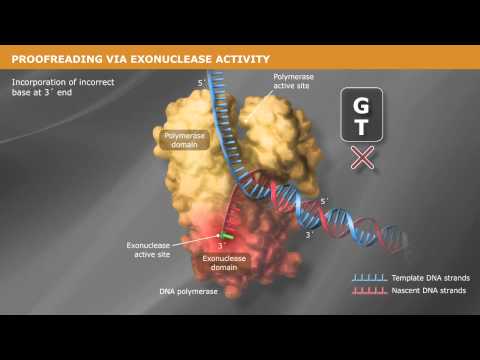
This process happens as the new DNA strand is being made. DNA polymerase checks every base it adds, and when it finds a mistake it moves backwards along the strand to fix it. This is also called exonuclease activity. Once the problem is solved, the DNA polymerase moves forward again and keeps replicating the rest of the DNA strand.

Proofreading is an efficient way to immediately fix a problem, but it doesn't always catch every mistake. After replication, there are several other mechanisms to screen new DNA for errors.

Why proofread? Well, when a mismatched base isn't fixed, we call that a mutation. Mutations can be harmless, or they can cause some serious health issues like cancer. All of the mechanisms that our cells use to fix DNA errors are super important because they protect us from a lot of diseases.

Read · 1 min

Role of DNA Polymerase

During DNA replication, DNA polymerase is responsible for placing the new complementary nucleotides. If it accidentally places the wrong nucleotide, then it will correct itself using exonuclease activity. This just means that the polymerase moves the DNA strand to a section of itself where it can remove the incorrect nucleotide.

Proteins are big and can have multiple active sites. A DNA polymerase has an active site for placing new nucleotides and for removing them.

Ribosomes are also capable of proofreading. During translation, as the tRNAs come into the ribosome's active site the ribosome can tell if the incorrect tRNA is present. If so, it will remove the tRNA before the incorrect amino acid has been added to the chain.

Read · 1 min

How Is DNA Proofread?

DNA polymerase is a handy little enzyme that helps with DNA replication and proofreads after it's done. During DNA replication, the DNA is "unzipped" so that the two strands are separated. DNA polymerase is responsible for matching the correct nucleotides on a newly made strand by using base-pairing.

At the same time, it is proofreading the new strand of DNA to ensure that it is complementary to the original strand. It is able to tell the difference between each of the nitrogenous bases and can fix any errors.

Vocabulary Review:\color{#8925AE}{\text{Vocabulary Review:}}

Monomer\color{#8925AE}{\text{Monomer}} : Any molecule that can react with other molecules of the same or different makeup to form a chain, or polymer

Polymer\color{#8925AE}{\text{Polymer}} : A chain of monomers made of a specific type of compound

Macromolecule\color{#8925AE}{\text{Macromolecule}} : A polymer that has a large (macro) molecular mass. There are four main types in organisms: carbohydrates, proteins, lipids, and nucleic acids

Nucleotides\color{#8925AE}{\text{Nucleotides}} : The monomers of nucleic acids. Made up of a nitrogen group, a phosphorus group, and a 5-carbon ring

Nucleic Acid\color{#8925AE}{\text{Nucleic Acid}} : Complex polymer that stores information in a cell in the form of a code. DNA and RNA

Video

(Video) DNA Replication with a Proofreading Polymerase

by New England Biolabs

Watch this video to see how DNA polymerase checks the DNA strand for incorrect nucleotides, and what happens if a mistake is found.

Illustrated · 1 min

Proofreading DNA's rough draft

Image source: By Valeri Natole

Type a concept, like “slope” or “photosynthesis”.

↑ ↓ to choose · Enter to openSearch explanations and problems