
Illustrated · 3 min
+2 contributors

Electromagnetic Radiation
What Is Electromagnetic Radiation?
- Electromagnetic Radiation (also referred at ER or EMR) is defined as a type of radiation that has both a magnetic and an electric field.
- These magnetic and electric fields cause electromagnetic radiation to travel in the form of waves. This is because the electric field and the magnetic field cause a vibration of an electrical charge, which causes a wave-like formation.
- Electromagnetic waves, can also be described as a stream of photons/particles. This is because of the wave-particle duality. Because they are photons and travel through space, they have an energy and momentum. But, there's a catch! They don't have any mass.
- As a side note, Albert Einstien was the first person to consider light a particle. He developed the concept while working on the photoelectric effect.
- Electromagnetic waves are also referred to as light. Most of the electromagnetic spectrum is not visible to the human eye. The exception is visible light.
That was a lot of information, but here is an overview of the basics of Electromagnetic Radiation:
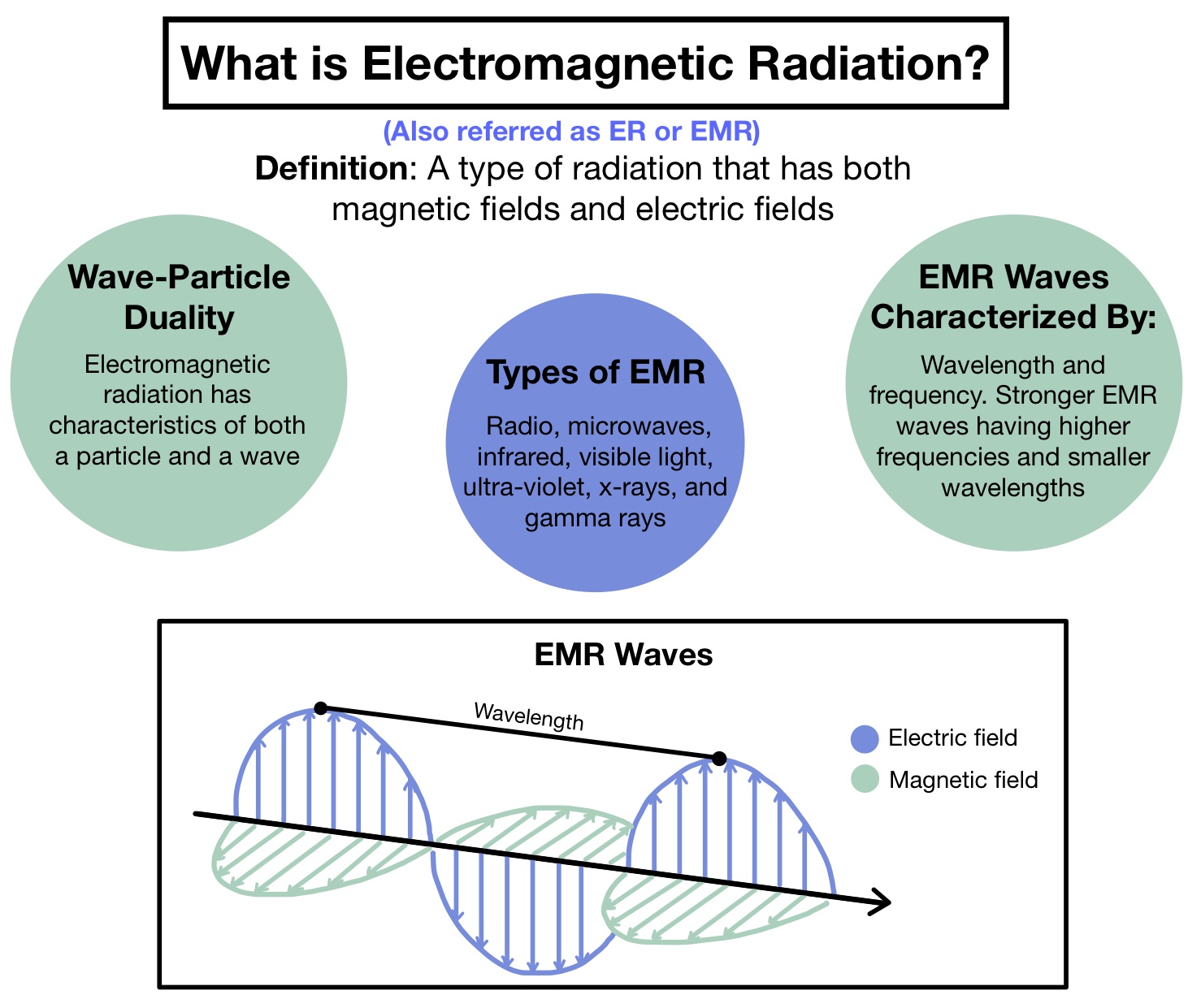
Image source: Caroline Monahan
Electromagnetic Waves
- Electromagnetic waves can be characterized by wavelength and frequency
- Wavelength (λ): Is described as the distance between identical points on a wave. It is typically measured using the distance between the crests/peaks of two waves. Wavelength is measured in nanometers (nm). In scientific notation, that meters!
- Frequency (𝜈): Is described as the number of waves that pass a given point for a given amount of time. Frequency has the units, Hertz (Hz).
- Wavelength and Frequency are inversely related. This means that when the frequency of a wave is big, the wavelength will be small (and vice versa). This relationship is described via the equation: c=λ𝜈, where c is the speed of light (3.00x10 m/s).
- Smaller wavelengths and higher frequencies result in stronger electromagnetic waves, and bigger wavelengths and smaller frequencies result in weaker electromagnetic waves.

Image source: Caroline Monahan
The Electromagnetic Spectrum
Here are the different types of electromagnetic radiation (from weakest to strongest):
-
Radio Waves: Radio waves are the lowest/weakest electromagnetic waves. They have frequencies between 3kHz and 300GHz, with 1mm to 100km wavelengths. We use radio waves broadcast to radios, televisions, and cell phones.
-
Microwaves: Microwaves have frequencies between 1GHz and 300GHz, with wavelengths between 1mm and 30cm. So, they are a subclass of radiowaves. You probably know about microwaves from your kitchen appliance. A microwave uses electromagnetic radiation to increase the rotation of the water molecules in your food. Rotation is a form of kinetic energy. So, as the molecules rotate faster, your food's temperature increases.
-
Infrared: Infrared waves have frequencies between 300GHz and 400THz, with wavelengths between 780nm and 1mm. Infrared waves are used to transmit heat. Infrared waves are produced by any object that produces heat. That's how night vision goggles work! In chemistry, infrared radiation causes covalent bonds to bend and stretch. Organic chemists can tell which bonds are in a sample molecule by the absorbed frequencies. For example, a carbon-oxygen-hydrogen (an alcohol) group absorbs between and .
-
Visible Light: Visible light waves have frequencies between 4x10Hz and 8x10Hz, with wavelengths between 380nm and 740nm. Visible light waves make up everything that we can see.
-
Ultra-Violet: UV-light has frequencies between 8x10Hz and 3x10Hz, with wavelengths between 10nm and 380nm. Ultraviolet waves can be absorbed by the skin. They are also commonly used to kill bacteria. In chemistry, ultraviolet and visible light are used to determine a solution's concentration. The molarity is proportional to the absorbance.
-
X-Rays: X-rays have frequencies between 3x10Hz and 3x10Hz, with wavelengths between 0.01nm and 10nm. They are used to image objects and bodies. In chemistry, we use them to discover the 3D structure of crystals. In a crystal lattice, the X-rays interact with the atom's electron cloud. The diffraction pattern allows the chemist to determine the atom's location.
-
Gamma Rays: Gamma waves have frequencies greater than 10 Hz, with wavelengths less than 100pm. Gamma rays are the strongest electromagnetic waves on the spectrum and are used to help kill cancer as well as in sterilization. We'll talk more about gamma decay when we study radioactivity.

Image source: Caroline Monahan
