Electron Affinity of Different Periodic Groups
What is Electron Affinity?
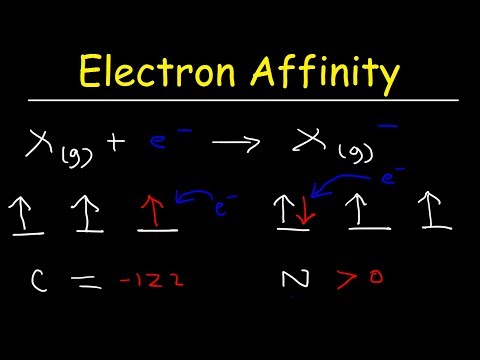
The electron affinity measures the energy required to add an electron to a gaseous atom. We can write the generic chemical equation as X(g)+e−→X(g)−. What do we find? It's the opposite of ionization energy!
The electron affinity is a measure of stability. In chemistry, something is more stable when it has less energy. For example, do you remember absorption and emission? When an electron moves from a higher to lower energy orbital, it emits a photon. It released energy to become more stable! So, let's say we add an electron to an atom. If we produce a stable electron configuration, it will release energy. The fancy chemistry word for released energy is exothermic. It will have a negative sign in front of the number. What if we had to add energy? We call it endothermic. It's a positive value.
General Electron Affinity Trends
First, we should be aware of the broad trends. You should know that both of these trends have a lot of exceptions. But, let's say your teacher asks you about the electron affinity trends. These are the most basic correct answer.
-
The electron affinity increases across a period. For example, lithium has a lower electron affinity than fluorine.
-
It also decreases down a group. So, fluorine has a greater electron affinity than iodine.
Why does electron affinity increase across the periodic table? It corresponds to the electronegativity trend. Consider lithium and fluorine. Lithium wants to give up its valence electron. It's far easier to give up its electron to reach a full octet. But fluorine is very electronegative. It wants an electron! So, we'd expect fluorine to have a greater electron affinity. And it does.
Why does electron affinity decrease down a group? It very roughly corresponds to the atomic radius. Why? Electrons that are further from the nucleus feel less electrostatic attraction. There is also more repulsion from the other electrons. So, overall it's harder to add an electron.
Electron Affinity Rules
The electron affinity is always a balance between competing factors. When you add an electron to an atom, there is more electrostatic repulsion. It is always endothermic. You have to add energy to overcome it. But, there is always attraction between the electron and the nucleus' protons. It is always exothermic. It increases stability and releases energy. But, we also have to consider the atomic orbitals. Higher sub-levels have more energy. So, it takes energy to add an electron to a new orbital sub-level. Let's turn these into a few rules. Then, we explore electron affinity in more detail.
-
Adding an electron always increases electrostatic repulsion.
-
Adding an electron to a higher energy level requires energy.
-
Spin pairing of two electrons cancels the electromagnetic fields. So, it's favorable.
-
Adding an electron to an empty sub-level releases energy.
-
Completing a subshell or octet is favorable. Having complete spin pairing helps to minimize the energy.
Electron Affinity by Periodic Group
Group 1
The alkali metals follow the rules perfectly. They all have negative electron affinities. But wait! Don't they want to lose electrons? In a chemical reaction, they do. But remember, the definition of electron affinity is adding an electron. But, do notice that they have tiny electron affinities compared to other elements. For example, lithium's electron affinity is about −60kJ/mol. Fluorine's is about −330KJ/mol. For the alkali metals, we added an electron to the s-orbital. We completed the subshell. So, the anion is stable.
Group 2
Let's move to the [alkaline earth metals}(https://www.expii.com/t/alkaline-earth-metals-overview-properties-8344). The electron affinity becomes positive! Why? We have to add an electron to the p-orbital. The p subshell has higher energy. So, it's an endothermic process.
Groups 3A and 4A
Groups 3A and 4A start the metalloids and nonmetals while finishing the metals. We are adding electrons to p-orbitals. In each case, there is an empty subshell. So, adding an electron is exothermic.
Group 5
Group 5 is one of the exceptions. Nitrogen has a positive electron affinity. So, we had to add energy for the atom to take an electron. Why? We are now pairing electrons in the p-orbital. So, we increased the electrostatic repulsion.
Group 6
We might predict group 6 to be positive. We added an extra electron without completing the octet. So we expect more electrostatic repulsion. But, remember we're balancing attraction and repulsion. So, the nucleus' attraction and the two spin pairings overwhelm the electrostatic repulsion. So, group 6 has negative electron affinities.
Group 7
Adding an electron to a halogen gives it a full octet. That's the most stable electron configuration. So, the halogens have significant electron affinities.
Group 8
The noble gases all have complete octets. Adding an electron begins filling the next energy level. So, the noble gases all have positive electron affinities.
Moving Down the Groups
In many of the groups, you'll notice something strange. As you move down, the second element has a higher electron affinity. But, the third element lessens. For example, in the halogens, F=−328,Cl=−349,Br=−325. Why does chlorine have a larger electron affinity? In smaller atoms, the electrons are closer to the nucleus. So, there is more electron repulsion. Compared to fluorine, chlorine better balances nuclear attraction and electron repulsion. But what about bromine? It has d-orbital electrons. So, there's lots of shielding from the electrons in lower orbitals. The added electron isn't as attracted to the nucleus. You'll notice this trend in groups 3, 4, 6, and 7.
Why Don't We See These Anions?
Did it surprise you that we made an anion for every element? For example, we never see a sodium anion. It's always a cation. In general chemistry, it will always be positive. Why? Because we mostly bond it to a halogen. The halogens have way higher electron affinities. So, they'll snatch sodium's electron. But, the sodium anion does exist. Inorganic chemists have made it and studied it. It's just not a general chemistry topic.
But, there's another answer. Many of the elements form covalent bonds. They don't give up electrons. Instead, they share them. For example, carbon almost exclusively covalently bonds. But, again the carbon anion does exist. And again, it's just not a general chemistry topic.