Factoring Quadratic Equations - Examples & Practice

Before this, knowZero Product Property - Definition & Examples

Video

(Video) Solving Quadratic Equations by Factoring

by PatrickJMT

This video by PatrickJMT covers quadratic equations.

Summary\large{\text{Summary}}

We combine factoring and the zero product property to solve quadratic equations. The general steps to solving a quadratic equation are as follows:

  1. Manipulate the equation so you have a quadratic set equal to 00.
    1. If possible, remove common factors to make a=1a=1.
  2. Factor the quadratic.
  3. Solve for xx by setting each factor equal to 00.

Let's work through the first example from the video.

x2−9x+14=0x^2-9x+14=0

Steps 1 and 1.1 are already done for us! The equation is set equal to 00 and a=1a=1. Let's move on to factoring the equadratic.

x2−9x+14=0(x−2)(x−7)=0\begin{align} x^2-9x+14&=0\\ (x-2)(x-7)&=0\end{align}

The last step is to set each factor equal to 00 and solve for xx.

(x−2)(x−7)=0x−2=0x=2x−7=0x=7\begin{align}(x-2)(x-7)&=0\\ \\ x-2&=0\\ x&=2\\ \\ x-7&=0\\ x&=7\end{align}

The solutions are x=2,7x=2,7.

Stretch your creativity

Contest problems rarely look like the examples you studied. Solving one means finding your own way in. These are real problems from the AMC 8, AMC 10, AMC 12 and AIME, the national math competitions for middle and high school students, each with a worked solution on LIVE by Po-Shen Loh.

Illustrated · 1 min

The Fraction Method for Factoring

We can use the Fraction Method, based on Vieta's Theorem, to factor more efficiently than using guess-and-check.

  1. Move everything to one side and identify your coefficients ===

For example, if you were given: x2+2x=−1x^{2}+2x=-1 You would want to add 11 to both sides in order to make the equation look like this: x2+2x+1=0x^{2}+2x+1=0 And then identify your coefficients: a=1b=2c=1\begin{align}a&=1\\ b&=2\\ c&=1\end{align} Your next step is:

  1. Multiply the aa value and the cc value together ===

So, for the equation we used in the last step, we would do this: a×c=(1)×(1)=1a \times c=(1) \times (1)=1

We'll call this mm. You want to to find two values that multiply to equal mm and add to equal bb. So your third step is:

  1. Find two values that multiply to get mm and add them to equal bb ===

We need to find two values that multiply to get 11 and add to get 22, so:

j+k=2andj×k=1\begin{align} j+k&=2\\ &\text{and}\\ j \times k&=1\end{align}

With this, we can see that jj an d kk both must be 11 since 1+1=21+1=2 and 1×1=11 \times 1=1. Now that we have these two values, we will "divide" both of them by aa.

  1. Divide jj and kk by aa ===
jaka\frac{j}{a} \quad \quad \quad \frac{k}{a} ⇓⇓\Downarrow \quad \quad \quad \Downarrow 1111\frac{1}{1} \quad \quad \quad \frac{1}{1}

The next step is very important to correctly factoring this equation.

  1. Let the denominator of each fraction be the coefficient of the xx value. Let the numerator be what you add to that xx value ===

For the first fraction, the denominator=1=1 and the numerator=1=1 so, 11⟹(1x+1)\frac{1}{1} \Longrightarrow (1x+1) For the second fraction, the denominator=1=1 and the numerator=1=1 so, 11⟹(1x+1)\frac{1}{1} \Longrightarrow (1x+1) You have both components of the equation in factored form. Next,

  1. Multiply the two components together and set it equal to 00 ===
(1x+1)×(1x+1)=0(1x+1) \times (1x+1)=0

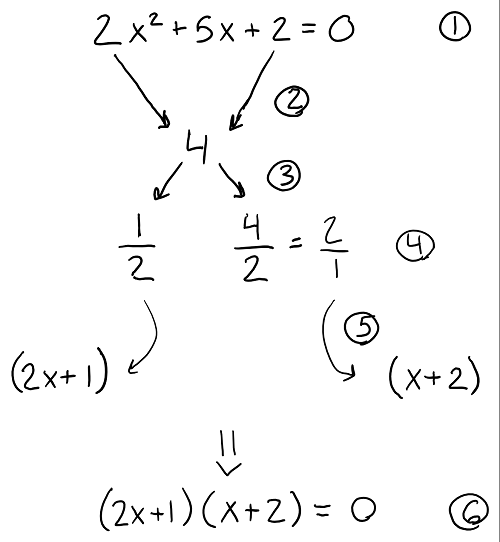
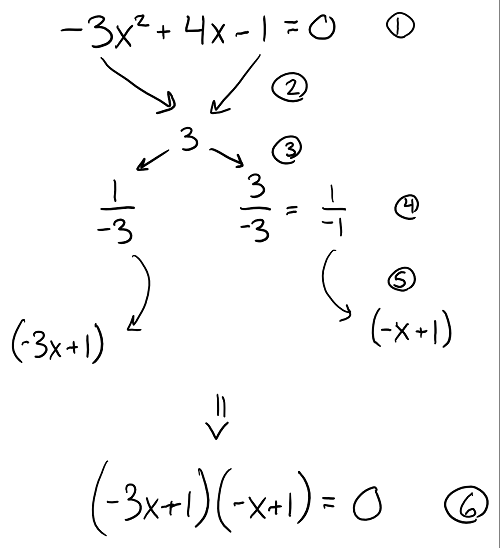
Below are examples of different problems to help you understand them more.

Example 1

Above is an example of using the Lizzie Method.

Image source: by Brandon Love

Example 2

Above is an example of the Lizzie Method.

Image source: by Brandon Love

Example 3

Above is an example of the Lizzie Method.

Image source: by Brandon Love

Read · 1 min

Solving Quadratic Equations by Factoring

There are many ways to solve a quadratic equation, including graphing, using the quadratic formula, and factoring. Factoring is the easiest and quickest way to solve a quadratic function, but it doesn't work for everything. Let's look at a very simple example of factoring a quadratic in standard form y=ax2+bx+cy=ax^2+bx+c. The steps boil down to:

  1. Make sure one side of the solution is equal to zero. You may have to manipulate the equation into standard form.

  2. If possible, factor out constants to get a=1a=1. These next steps are only for if the leading coefficient, aa, a=1a=1. aa can't equal a negative number.

  3. Find two numbers that add up to bb and multiply to cc (cc is the constant). These then go into the form: 0=(x+    )(x+    )0=(x+\;\;)(x+\;\;). We do this any time we factor a polynomial.

  4. Last, we set each of the two terms in parentheses equal to 00 and solve for xx. The Zero Product Property allows to solve for xx with both factors.

Let's take a look at an example.

Solve 4x2−15x=−164x^2-15x=-16

We can start by factoring out the common factor, 44.

4x2−15x4=−164x2−5x=−4\begin{align}\frac{4x^2-15x}{4}&=\frac{-16}{4}\\ x^2-5x&=-4\end{align}

Now we're going to make sure one side is 00.

x2−5x=−4x2−5x+4=0\begin{align} x^2-5x&=-4\\ x^2-5x+4&=0\end{align}

Let's factor the left side.

x2−5x+4=0(x−4)(x−1)=0\begin{align}x^2-5x+4&=0\\ (x-4)(x-1)&=0\end{align}

We're going to use the zero product property to solve each factor for xx.

(x−4)(x−1)=0x−4=0x=4x−1=0x=1\begin{align}(x-4)(x-1)&=0\\ \\ x-4&=0\\ x&=4\\ \\ x-1&=0\\ x&=1\end{align}

Our solutions are x=4,1x=4,1.

Type a concept, like “slope” or “photosynthesis”.

↑ ↓ to choose · Enter to openSearch explanations and problems