Factoring the Greatest Common Factor (GCF) of Polynomials

Interactive · 2 questions

One approach we can take when factoring a polynomial is to factor out a GCF before factoring the rest of the expression.

For example, consider the polynomial 4x2+8x+44x^2+8x+4. Since this polynomial has a GCF of 44, we can factor that 44 out of the polynomial before factoring the rest of it:

4x2+8x+44x^2+8x+4 =4(x2+2x+1)=4(x^2+2x+1) =4(x2+x+x+1)=4(x^2+x+x+1) =4(x(x+1)+1(x+1))=4(x(x+1)+1(x+1)) =4(x+1)(x+1)=4(x+1)(x+1) =4(x+1)2=4(x+1)^2

Factor 2x2+6x+42x^2+6x+4

Choose one answer

Video · + 3 min read

(Videos) Find the GCF with Different Techniques

by PatrickJMT and eHow

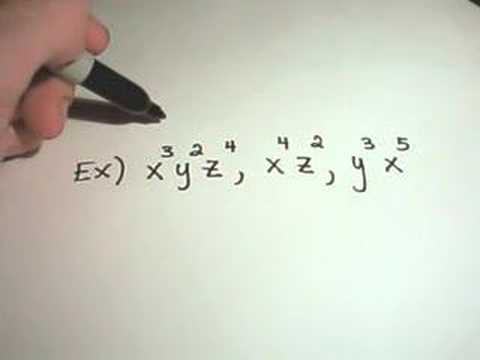
Here's a video by PatrickJMT that demonstrates how to find the greatest common factor of several terms.

A polynomial's greatest common factor is exactly what it sounds like: it's the largest term that divides evenly into all of a polynomial's terms. For instance, a polynomial that consists of the terms 12x12x and 3030 would have a greatest common factor of 66, as that is the largest term that divides evenly into both 12x12x and 3030.

In order to find a polynomial's GCF, you must first find the numerical portion of that polynomial's GCF. You can do this by following these three steps:

  1. Break down the coefficient of each of your polynomial's terms into its prime factorization.
  2. Select all the numbers that appear in each coefficient's prime factorization.
  3. Multiply those selected numbers together; this is the numerical portion of your polynomial's GCF.

What's more, if all of your polynomial's terms have any variables in common (e.g. all of your polynomial's terms contain xx variables, all of your polynomial's terms contain an xx variable and a yy variable, et cetera), then your polynomial's GCF will also contain those variables.

If this is not the case, then the numerical portion of your polynomial's GCF is your polynomial's GCF. However, if all of your polynomial's terms do have at least one variable in common, you can use the following method to find the variable portion of your polynomial's GCF:

  1. List all of the variables that your polynomial's terms have in common.
  2. Take one of the variables that you just listed and look at the exponent that is attached to each of that variable's instances in your polynomial. Then, take the lowest of those exponents and attach it to your listed variable.
  3. Repeat the previous step for all other variables that you listed in step 1.
  4. Multiply all of your listed variables (complete with their newly attached exponents) together; this is the variable portion of your polynomial's GCF (note: you must multiply this result by the numerical portion of your polynomial's GCF in order to determine the complete version of your polynomial's GCF).

Here's a video by eHowEducation that introduces you to a different method for finding the greatest common factor of several numbers. It's called the ladder method, and it consists of the following steps:

  1. Take all of the numbers that you would like to find the GCF of and write them down in a horizontal line; then, make an "L" shape to contain those numbers, as is demonstrated in the video above.
  2. Find the smallest prime number that divides evenly into all of the numbers that you just wrote down; then, write that prime number outside of your "L" shape (on the left-hand side of your original group of numbers).
  3. Divide all of the numbers inside of your "L" shape by the prime number that you wrote down in the previous step; then, write each of those results outside of your "L" shape (below your original group of numbers).
  4. Now, make a new "L" shape to contain the new numbers that you just wrote down.
  5. Repeat steps 2, 3 and 4 until you are left with a group of numbers that do not possess a common prime factor.
  6. To find your original numbers' GCF (greatest common factor), multiply all of the prime numbers going down the left side of the ladder you've created.
  7. To find your original numbers' LCM (least common multiple), multiply the GCF that you found in the previous step by all of the numbers along the bottom of the ladder you've created.

Test Yourself: What is the GCF of 7272 and 126126?

Video · + 2 min read

(Videos) Factorize Simple Expressions

by HEGARTYMATHS

Here are a couple of videos by HEGARTYMATHS that show you how to factor polynomials by pulling out greatest common factors. Over the course of both videos, our instructor walks us through plenty of examples, ensuring that you get a good amount of practice with this particular method of factoring.

A polynomial's greatest common factor is exactly what it sounds like: it's the largest term that divides evenly into all of a polynomial's terms. For instance, a polynomial that consists of the terms 12x12x and 3030 would have a greatest common factor of 66, as that is the largest term that divides evenly into both 12x12x and 3030.

In order to find a polynomial's GCF, you must first find the numerical portion of that polynomial's GCF. You can do this by following these three steps:

  1. Break down the coefficient of each of your polynomial's terms into its prime factorization.
  2. Select all the numbers that appear in each coefficient's prime factorization.
  3. Multiply those selected numbers together; this is the numerical portion of your polynomial's GCF.

What's more, if all of your polynomial's terms have any variables in common (e.g. all of your polynomial's terms contain xx variables, all of your polynomial's terms contain an xx variable and a yy variable, et cetera), then your polynomial's GCF will also contain those variables.

If this is not the case, then the numerical portion of your polynomial's GCF is your polynomial's GCF. However, if all of your polynomial's terms do have at least one variable in common, you can use the following method to find the variable portion of your polynomial's GCF:

  1. List all of the variables that your polynomial's terms have in common.
  2. Take one of the variables that you just listed and look at the exponent that is attached to each of that variable's instances in your polynomial. Then, take the lowest of those exponents and attach it to your listed variable.
  3. Repeat the previous step for all other variables that you listed in step 1.
  4. Multiply all of your listed variables (complete with their newly attached exponents) together; this is the variable portion of your polynomial's GCF (note: you must multiply this result by the numerical portion of your polynomial's GCF in order to determine the complete version of your polynomial's GCF).

Test Yourself: What is the GCF of 5656 and 2828?

Video · + 1 min read

(Videos) Factoring

by mathman1024

Here's a video by mathman1024 that covers some of the basics of factoring. To factor a polynomial means to express that polynomial as a product, and one key property that you should keep in mind when factoring polynomials is the distributive property, which states the following:

a∗(b+c)=a∗b+a∗ca*(b+c)=a*b+a*c

In the video above, the first polynomial that our instructor shows us how to factor is 5x+155x+15. Right off the bat, you might notice that this polynomial contains a greatest common factor of 55:

5x+15=5∗x+5∗35x+15 = \textcolor{red}{5}*x+\textcolor{red}{5}*3

This means that, according to the distributive property, we can rewrite the polynomial 5x+155x+15 like so:

5(x+3)5(x+3)

Our instructor then goes over some more factoring examples. Try factoring a GCF out of each of the following polynomials, making sure to check your answers by looking to the video above.

  1. 24x−32y24x-32y
  2. 7x5+4x37x^5+4x^3
  3. 25x9−35x525x^9-35x^5
  4. 12x4y3+8x2y2−4xy212x^4y^3+8x^2y^2-4xy^2

In this next video, our instructor goes over another batch of factoring examples. Again, try factoring a GCF out of each of the following polynomials, making sure to check your answers by looking to the video directly above.

  1. 5x11y3−28x9y5−42x6y105x^{11}y^3-28x^9y^5-42x^6y^{10}
  2. −2x2+5x−12-2x^2+5x-12
  3. x25y51+x42y38x^{25}y^{51}+x^{42}y^{38}
  4. xy+5yxy+5y
  5. x(x+7)+5(x+7)x(x+7)+5(x+7)

Test Yourself: What is the GCF of 4x6y2+6x8y24x^6y^2+6x^8y^2?

Choose one answer

Video · + 1 min read

(Video) Factoring out the GCF

by Friendly Math 101

Here's a video by Friendly Math 101 that shows you how to factor a GCF out of an expression.

The acronym GCF stands for greatest common factor. When we say that we want to find an expression's greatest common factor, we mean that we want to find the largest term that will divide evenly into all of that expression's terms.

In the video above, our instructor walks us through the process of factoring a GCF out of the expression 4x2−8x+164x^2-8x+16.

First, he sets out to find the GCF of 4x2−8x+164x^2-8x+16 by taking note of all the terms that can divide into each of his expression's three terms without resulting in decimals or fractions. Our instructor discovers that all of his expression's terms have a factor of 22 and a factor of 44; since the latter of those is the largest of his expression's two common factors, our instructor is able to determine that 44 is his expression's greatest common factor.

Our instructor then factors that GCF out of his expression by first dividing all of its terms by the GCF:

4x24−8x4+164=x2−2x+4\frac{4x^2}{\color{red}{4}}-\frac{8x}{\color{red}{4}}+\frac{16}{\color{red}{4}} = x^2-2x+4

Finally, he writes down the result of that division inside a pair of parentheses, making sure to place the GCF that he divided out on the outside of those parentheses like so:

4(x2−2x+4)4(x^2-2x+4)

Try it yourself!

What is the GCF of −12b2+6b−15-12b^2+6b-15?

Choose one answer

Type a concept, like “slope” or “photosynthesis”.

↑ ↓ to choose · Enter to openSearch explanations and problems