Finding Roots of Numbers

Illustrated · 1 min

Finding Roots

Most roots of larger numbers can be broken into smaller roots. It is a good idea to memorize the smaller squares.

xx2243941652563674986498110100xx32832746451256216734385129729101000\begin{array}{|c|c|} \hline x&x^2\\ \hline 2&4\\ 3&9\\ 4&16\\ 5&25\\ 6&36\\ 7&49\\ 8&64\\ 9&81\\ 10&100\\ \hline \end{array} \quad\quad\quad \begin{array}{|c|c|} \hline x&x^3\\ \hline 2&8\\ 3&27\\ 4&64\\ 5&125\\ 6&216\\ 7&343\\ 8&512\\ 9&729\\ 10&1000\\ \hline \end{array}

Let's look at an example.

196\sqrt{196}

That is a big number, but we can factor it into more digestible pieces.

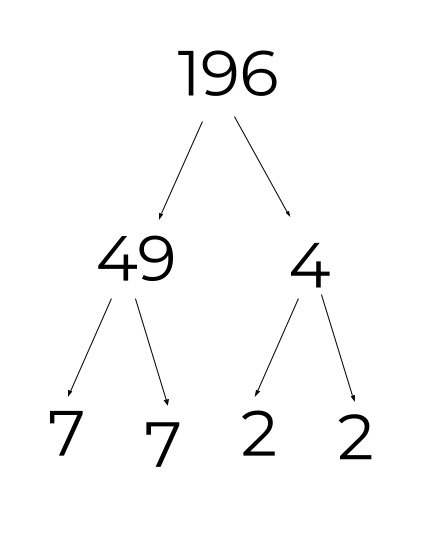
Prime factorization of 196

196196 is factorable into 44 and 4949. 196=4⋅49=4⋅49=2⋅7=14\sqrt{196}=\sqrt{4\cdot 49}=\sqrt{4} \cdot \sqrt{49} = 2 \cdot 7 = 14

Read · 1 min

Example Walk-through \\

We have established that we can convert between rational exponents and radicals. When finding the root, we cannot always find a nice whole number.

Recall learning about perfect square: 4=2\sqrt{4} = 2 5=5\sqrt{5} = \sqrt {5} 8=22\sqrt{8} =2\sqrt{2} 9=3\sqrt{9} = 3

We always try to find the simplest form of an answer!

Now, let's go into the example:

(22)23(2\sqrt {2})^{\frac{2}{3}}
(22)23=(22)23=83=2\begin{align} (2\sqrt {2})^{\frac{2}{3}} &= \sqrt[3]{(2\sqrt{2})^2}\\ &= \sqrt[3]{8}\\ &=2\\ \end{align}

Now, let's try an example with variable:

x2=(3)25x^{2}=(3)^{\frac{2}{5}}

There are two approaches and they are essentially the same.

Approach 1: Raise both sides to a power of 12\frac{1}{2}

x2=(3)25(x2)12=((3)25)12x=312x=35\begin{align} x^{2} &= (3)^{\frac{2}{5}} \\ (x^{2})^{\frac{1}{2}} &= \left((3)^{\frac{2}{5}}\right)^{\frac{1}{2}}\\ x &= 3^{\frac{1}{2}} \\ x &= \sqrt[5]{3}\\ \end{align}

Approach 2: Take the square root of both sides, because we have a x2x^2.

x2=(3)25x2=325x=(325)12x=315\begin{align} x^{2} &= (3)^{\frac{2}{5}} \\ \sqrt{x^{2}} &= \sqrt {3^{\frac{2}{5}}} \\ x &= (3^{\frac{2}{5}})^{\frac{1}{2}}\\ x&= 3^{\frac{1}{5}} \end{align}

Interactive · 1 question

Strategy to Finding Roots and Simplifying \\

Finding the root of perfect squares and cubes rely on some familiarity with numbers. For example, we immediately know the square root of 9 is 3. However, it might take a second to realize the square root of 121 is 11.

What if a number is not a perfect square or cube?

We can simplify! For example: 125=5×25=5×25=55\sqrt{125} = \sqrt{5\times 25}= \sqrt{5}\times \sqrt{25} = 5\sqrt{5}

However, what if we are not sure whether we can break down the number?

One strategy is to find the prime factorization of the number, then see if there is any perfect square or cube. Breaking the number allow us to observe it more easily.

For example: 198\sqrt{198}

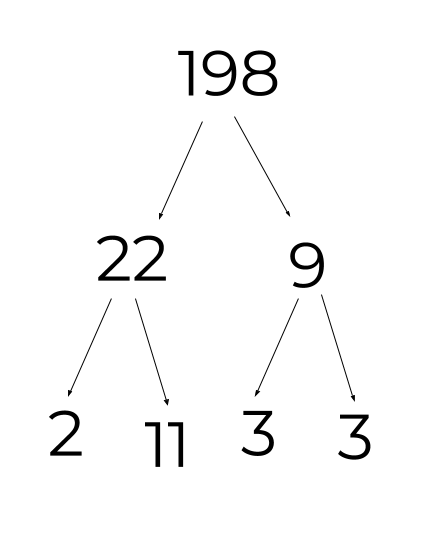
Let's write 198198 in terms of its prime factorization.

Prime factorization of 198
198=2×3×3×11198 = 2\times 3\times 3 \times 11

Immediately, we have two 3's. 198=9×22=322\sqrt{198} = \sqrt{9 \times 22} = 3\sqrt{22}

Do the following problem to test your understanding.

Simplify 240\sqrt{240}

Choose one answer

Video

(Video) Finding real number roots

by T Demott

In this video, we take a look at finding real roots.

Summary\large{\text{Summary}}

We see the prime factorization of −83\sqrt[3]{-8}. We know that −2×−2×−2=−8-2 \times -2 \times -2 =-8.

Now, similarly 814=3\sqrt[4]{81}=3 because 3×3×3×3=9×9=813\times3\times3\times3=9\times9=81

How about −100\sqrt{-100}? There are no real roots for this!

Lastly, we know 49=7\sqrt{49}=7 because it is a perfect square! 7×7=497\times7=49.

Keep going

Type a concept, like “slope” or “photosynthesis”.

↑ ↓ to choose · Enter to openSearch explanations and problems