
Read · 1 min

As we know, a hyperbola is a type of conic section, which is a curved formed by the intersection of a plane and a double cone.

The foci of a hyperbola (the plural of focus) are two fixed points inside the hyperbola curve that play an important role in defining its shape. They are denoted as F1F_1 and F2F_2, and the distance between these foci is constant, 2c2c.

####Calculating Foci

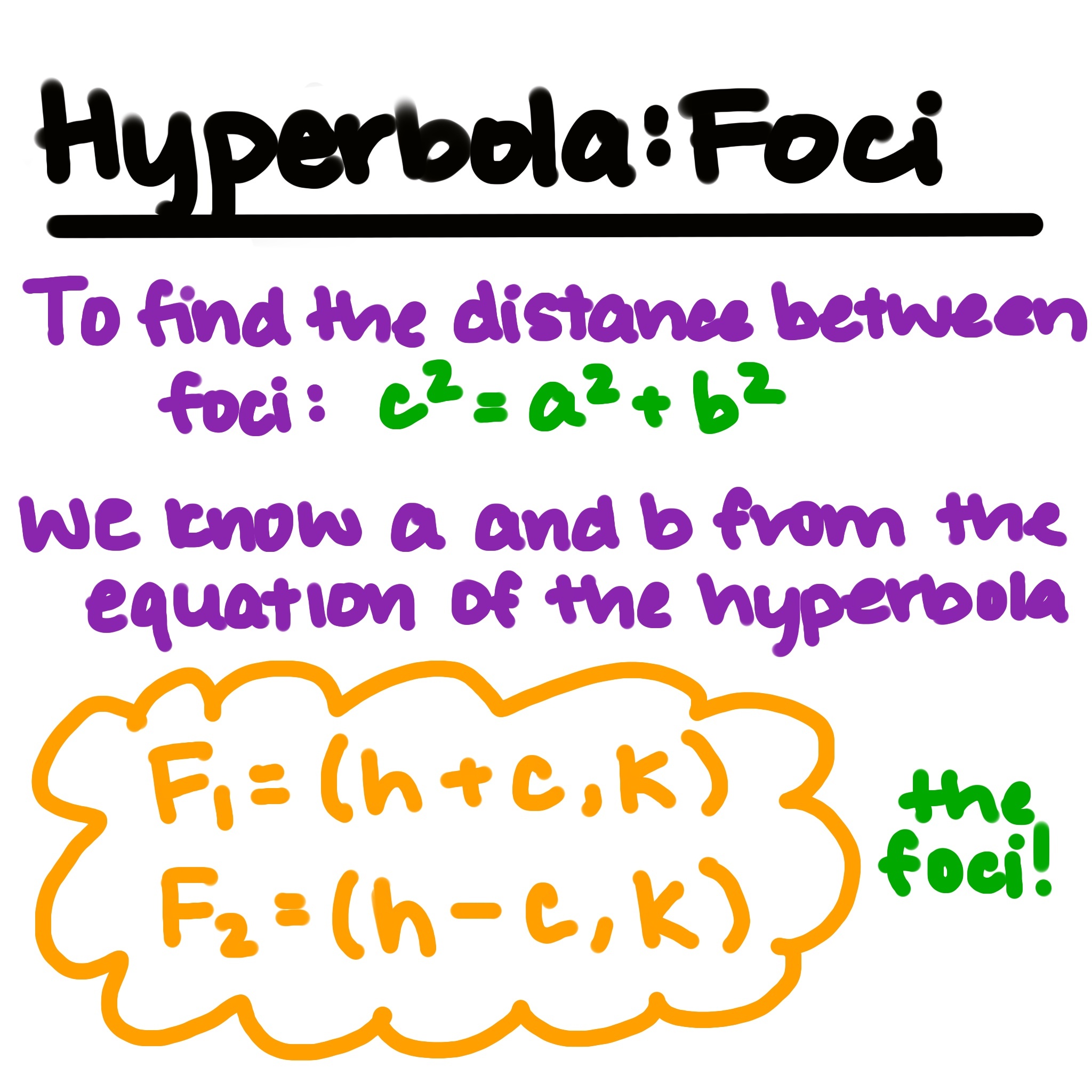
The good news is that there is a formula to calculate the distance between foci.

c2=a2+b2c^2 = a^2 + b^2

Remember that aa is the distance from the center to a vertex along the transverse axis. bb is the distance from the center to a vertex along the conjugate axis.

####Coordinates of the Foci

Now that we know the distance between foci, we can find the coordinates of the foci. We can calculate the foci relative to the center of the hyperbola. If the center is (h,k)(h,k), then the coordinates of the foci are:

F1=(h+c,k)F_1 = (h + c, k) F2=(h−c,k)F_2 = (h - c, k)

Unlike an ellipse, in a hyperbola, the difference of distances from each point on the curve to the foci is constant. In an ellipse, the sum of the distances from each point on the curve to the foci is constant.

A big point to note: the center, foci, and vertices will all lie on the same axis.

Once you've practiced finding the foci of a hyperbola, try your hand at solving some word problems with hyperbola or learn how you can graph hyperbola using foci.

Preparing for a math contest?

Working through past problems on one idea at a time is one of the most effective ways to prepare. These are real problems from the AMC 12 and AIME, the national math competitions for middle and high school students, each with a worked solution on LIVE by Po-Shen Loh.

Video

(Video) Determine the Foci and Vertices of a Hyperbola

by Brian McLogan

In this video by Brian McLogan, you will walk through an example of finding the foci and vertices of a hyperbola.

Summary

Because the example is a horizontal hyperbola, the foci, vertices, and center will lie on the horizontal axis, also known as the transverse axis.

If the center is (h,k)(h,k), then we know that the vertices are aa units to the left and aa units to the right from the center on the transverse axis. Algebraically, it looks like: (h±a,k)(h \pm a, k)

The distance of the foci is cc units from the center. We know aa and bb from the equation, and we can use the pythagorean theorem to find cc. Algebraically, for a horizontal hyperbola, it looks like: (h±c,k)(h \pm c, k)

Illustrated · 1 min

The Foci of a Hyperbola

A hyperbola is a curve made from two separate parts called branches. A hyperbola is the set of all points where the difference of the distances to two fixed points, called the foci, is always the same. This rule is what makes the hyperbola different from other conic sections.

Handwritten notes: the distance between foci uses c^2 = a^2 + b^2, with a and b read from the hyperbola's equation. The foci are F1 = (h + c, k) and F2 = (h - c, k).

These fixed points (the foci) lie on the transverse axis, which is the line segment that passes through the center and the vertices of the hyperbola. For any point on the hyperbola, the distance to one focus minus the distance to the other focus equals a constant.

We know that the standard form of the hyperbola is:

(x−h)2a2−(y−k)2b2=1 OR (y−k)2b2−(x−h)2a2=1\frac{(x - h)^2}{a^2} - \frac{(y - k)^2}{b^2} = 1 \text { OR } \frac{(y - k)^2}{b^2} - \frac{(x - h)^2}{a^2} = 1

The first equation is for the horizontal hyperbola, and the second equation is for the vertical hyperbola. These equations give us a2a^2 and b2b^2, which describe the shape and size of the hyperbola. We can then use the pythagorean theorem to find the distance from the center to each focus.

a2+b2=c2a^2 + b^2 = c^2

Once you find cc, the foci are located cc units from the center along the transverse axis, for both horizontal and vertical hyperbolas. In the next lesson, you'll learn more about graphing hyperbolas using foci.

Type a concept, like “slope” or “photosynthesis”.

↑ ↓ to choose · Enter to openSearch explanations and problems