We've been studying radioactivity. So far, we've discovered that some elements have unstable nuclei. Do you remember the cut-off? It's atomic number 82 on the periodic table. Above lead-208, the electrostatic repulsion is more prominent than the strong nuclear force. The protons want to repel! So, atomic nuclei have various methods to increase their nuclear stability.
The first method we studied was alpha decay. An atom will eject two protons and neutrons (helium) from its nucleus. Why? Because it can quickly lose mass. Next, we studied beta decay. Remember, there are two types. Beta-minus converts a proton to a neutron and shoots out an electron. Beta-plus converts a neutron to a proton by releasing a positron. Remember, they're the electron's anti-particle. So, they have the same mass but opposite charge. But, if an atom can release an electron, it can also absorb one. That's electron capture! It converts a proton to a neutron. Remember, for beta decay and electron capture, the atom's goal is to balance the strong nuclear force and repulsion.
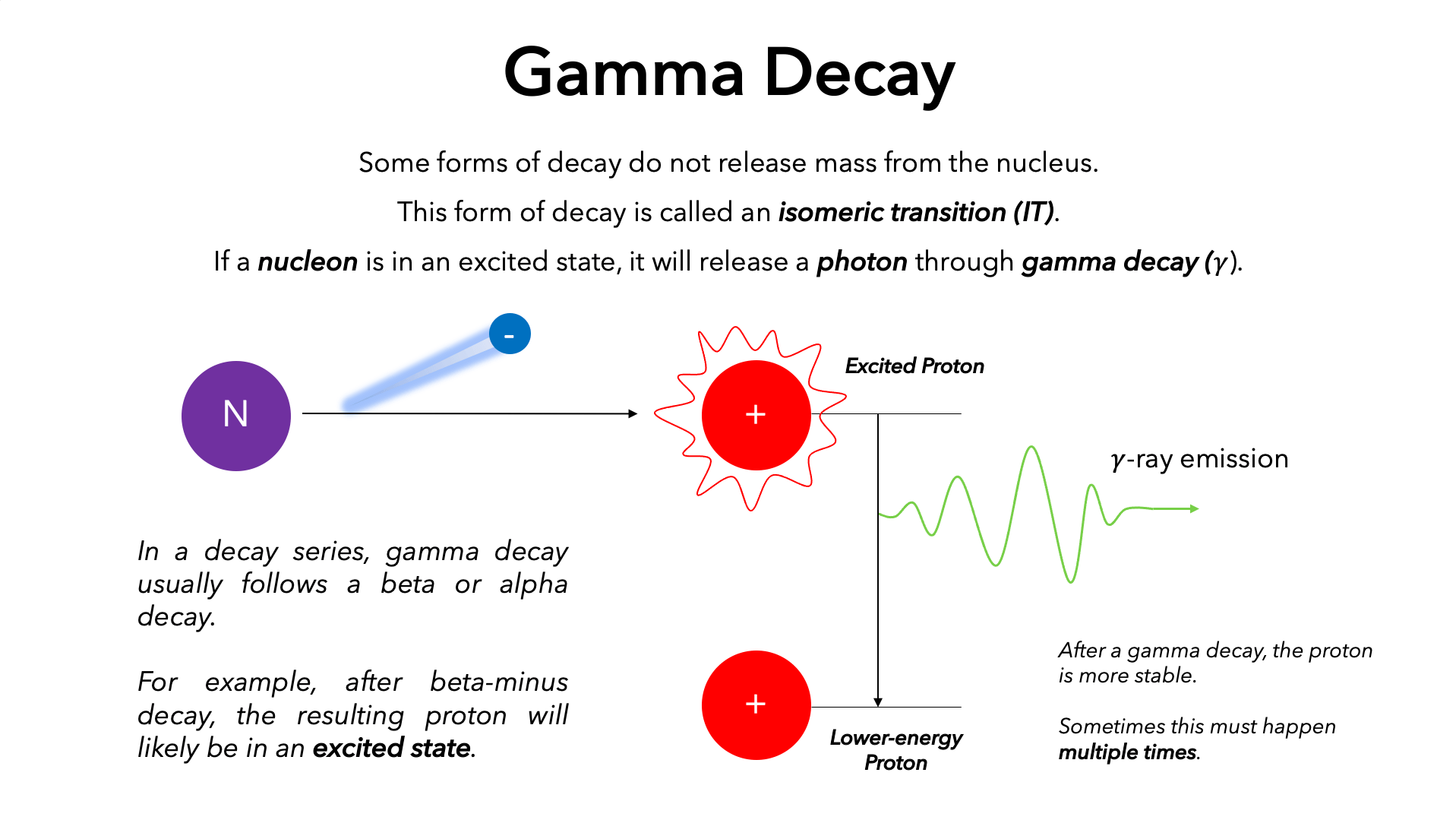
So, we've studied the different decay methods. But there's a catch! Sometimes, atoms have to decay multiple times. We call it a decay series. What happens once they become stable? Typically, they are still excited. It's like excited electrons. To relax, they need to release energy. How? Via photons. But, excited nuclei have unbelievably high energies! So, they produce gamma radiation.
What is Gamma Radiation?
Gamma radiation has the smallest wavelength. So, it has a lot of energy. But remember, the units are mega-electronvolts (MeV). That's about thirteen orders of magnitude smaller than the joule. That seems small. But remember, chemists, use per mole. So, we have a lot of atoms or molecules. But here, we have a single atom. So, it's actually a lot of energy. Again, it's helpful to think about electrons. Way back, we studied atomic spectra. We saw that hydrogen produced an emissions spectra between 400 and 650 nanometers. That's the visible region! But, a gamma photon has wavelengths less than one-hundred picometers. They are so small they can pass between atoms!
Photoelectric Effect
Way back, we studied the photoelectric effect. Albert Einstien developed it to explain a photon's particle behavior. What happens when light collides with an electron? It depends. He surmised that electrons need specific energy quanta to escape. If the light doesn't have enough energy, nothing happens. But, if it does, the electron is ejected.
What does this have to do with gamma decay? Great question! What happens when the gamma-ray hits an electron? Gamma rays have a lot of energy. So, it easily overcomes the binding energy. The electron breaks free of the nucleus. At first glance, this seems like beta decay. But it's not! Why? The electron came from an atomic orbital, not the nucleus. So, it's ionization!
Compton Scattering
Sometimes, the gamma-ray has too much energy for the electron to absorb. In this case, the electron still gets ejected. But, a new gamma photon forms. This secondary photon has less energy. So, we know it has a longer wavelength. The shift in wavelength depends on the amount of energy the electron took. It also gets deflected at an angle, away from the electron. So, we say the particle was scattered. We call the whole process Compton scattering.
Internal Conversion
So, we've seen that gamma rays can strike an electron. But, there is another way for the electron to gain energy. Quantum mechanics tells us there is a non-zero probability of finding an s-orbital electron in the nucleus. Just look at the electron cloud diagram. What happens if the atom is in an excited state? An electron that gets too close can absorb the energy directly. Again, it easily overcomes the binding energy. So, the electron discharges. Yet, in this case, there was no gamma particle intermediate. The electron absorbed the energy directly! We call this internal conversion.
Pair Production
Let's return to Einstien. What's his most famous equation? E=mc2! We explored this equation when we studied mass defects. We learned that mass and energy are interchangeable. A gamma-ray near an atomic nucleus gets influenced by the electric field. Sometimes, the photon's energy gets converted into two particles. The two particles are always in particle and anti-particle pairs. The most common is an electron and positron pair. The particles obey the conservation of energy. So, the two particles' energies equal the original photon's.
We're observing an example of pair production. Pair production is the creation of a subatomic particle and its corresponding anti-particle. In this case, it's from a photon. But, in particle physics, it can come from any boson without a charge. For the most part, nuclear chemists only work with photons.
Properties and Effects of Gamma Radiation
I already mentioned that gamma particles pass between atoms. They have incredibly tiny wavelengths! But that's an enormous problem. How do we block gamma radiation? Alpha particles are so large we can blockade them with paper. A beta particle is quite a bit smaller. But, a sheet of aluminum metal works well. To impede gamma particles, we need a material with a large density and a high atomic number. The most common material is lead. One centimeter reduces the number of gamma rays by half. In contrast, you need six centimeters of concrete.
But why do we care? Gamma rays are exceptionally hazardous. We've seen that they can ionize atoms. Furthermore, they can penetrate most materials. That's a bad combination for people! Gamma radiation readily enters our cells. What happens? It ionizes our DNA! So, high exposure to gamma rays is carcinogenic. So, there is an increased risk of cancer. Thankfully, the amount of natural exposure is minuscule. But, there is a sizable increase near nuclear power plants.