Gay-Lussac's Law — Overview & Formula

Interactive · 1 question

Gay-Lussac's Law

What is Gay-Lussac's Law?

  • Gay-Lussac’s Law states that a gas's pressure is directly proportional to temperature. We assume a constant volume and a constant number of moles.

  • In Gay-Lussac’s Law, as pressure increases or decreases, the temperature also increases or decreases.

  • There are a few mathematical representations of Gay-Lussac's Law.

  • Gay-Lussac’s Law: P1T1=P2T2\frac{P_1}{T_1}=\frac{P_2}{T_2}.
  • Gay-Lussac’s Law also states that PT=k\frac{P}{T}=k, where k is the proportionality constant.
  • We can write also write Gay-Lussac's Law as a proportionality: P∝TP \propto T.

Note:\color{#50BF14}{Note:} Gay-Lussac's Law uses kelvin for temperature units, while the pressure units can be any pressure unit (mm Hg, atm, etc.).

Gay-Lussac's Law Formula Cheat Sheet

Image showing the formula's covered by Gay-Lussac's Law: P1/T1 = P2/T2, Pressure is directly proportional to temperature, and P/T = k

Image source: Caroline Monahan

Gay-Lussac's Law Visualization

Image showing an example of Gay-Lussac's Law. Showing that as the pressure increases, so does the temperature
Image showing the math for the situation above. 
100/200 = 300/600

Image source: Caroline Monahan

Gay-Lussac's Law Practice Problem Walkthrough

A 150mL chamber with a fixed amount of oxygen gas has a pressure of 140 atm and a temperature of 60°C. If the temperature is raised 40°C, what is the new pressure of the chamber?

1) Ensure that the units are correct. For Gay-Lussac's Law, we need to have kelvin for temperature. But we are given celsius. So we must convert those numbers to kelvin!

  • 60°C + 273.15 = 333.15 K

Because the problem states that the temperature was raised 40°C, we add 40°C to our original temperature.

  • 60°C + 40°C + 273.15 = 373.15 K

2) Identify your variables!

  • P1P_{1} = 140 atm

  • T1T_{1} = 333.15 K

  • P2P_{2} = ?

  • T2T_{2} = 373.15 K

3) Plug the variables into the equation and solve for P2P_{2}.

140333.15=P2373.15\frac{140}{333.15}=\frac{P_2}{373.15}

P2=140333.15(373.15)P_2=\frac{140}{333.15}\left(373.15\right)

P2P_{2} = 156.81 atm

Now try out a problem!

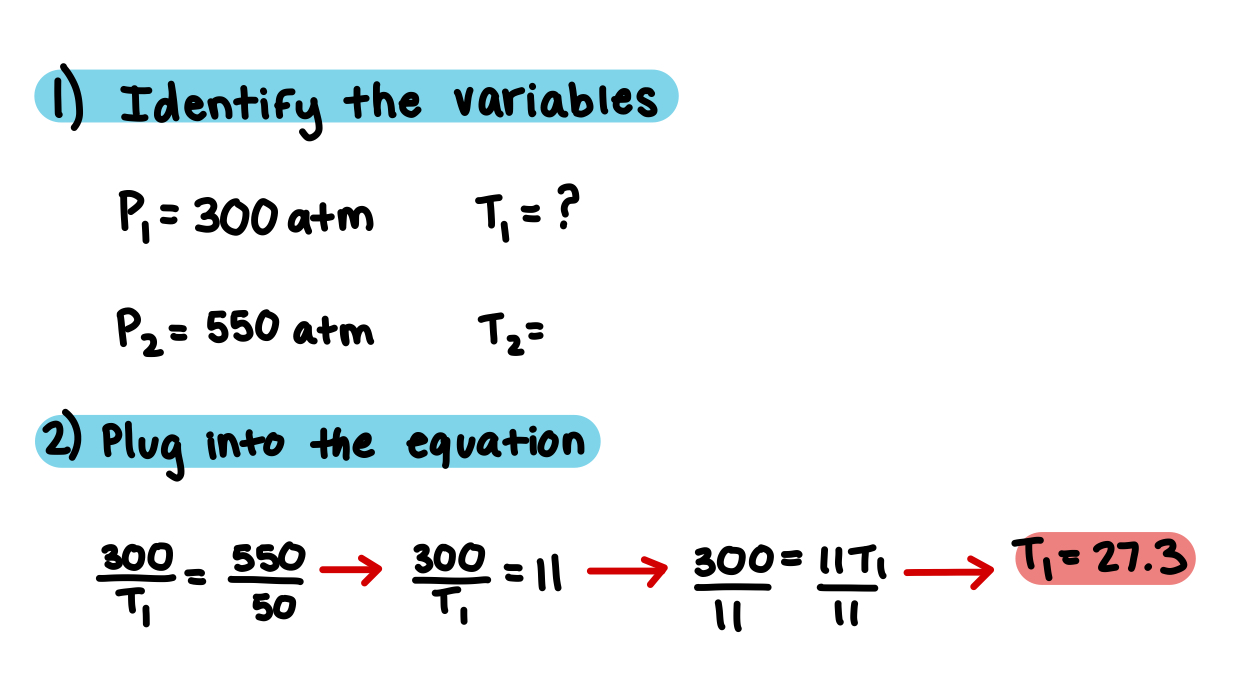
A scientist has a 140mL chamber with a fixed amount of carbon dioxide gas. The scientist noted the pressure to be 300 atm but forgot to write down the temperature in the chamber. If the new pressure is 550 atm, and the new temperature is 50K, what was the original temperature in the chamber?

Choose one answer

Read · 3 min

What is Gay-Lussac's Law?

It is a law describing the properties of gases. It is also sometimes referred to as Amonton's law or the pressure-temperature law. The law states that:

An amount of gas in a closed container (at a constant volume) has a pressure that will vary proportionally to the absolute temperature.

The mathematical representation for this law is:

PT = k\frac{P}{T}\ =\ k or P∝TP \propto T

Where, PP= pressure, TT=temperature, and kk= constant.

Importance of Gay-Lussac's Law

Let's think about the gas molecules in a closed system. If the temperature increases, the molecules of gas will have more energy. They will move around more and expand. This causes an increase in pressure. If the temperature decreases, the molecules lose energy and are closer together. So, the pressure decrease.

A great example of Gay-Lussac's law is the tires on your vehicle. If the tire has no punctures and a good seal, it is a closed container. There is a specific amount of gas or mass of gas in that container. In the winter, the pressure in tires often drops due to cold temperatures. The amount of gas did not change, but as the temperature drops so does the pressure.

History of Gay-Lussac's Law

The Gay-Lussac law has an intriguing history. It is named after the french physical chemist Joseph-Louis Gay-Lussac. But he was actually the first person to publish Charles' Law. So, why did we call Charles' Law after Jacques Charles? It turns out Charles discovered his law but never published his work. Gay-Lussac found the unpublished work and credited Charles. Interestingly, at the same time, John Dalton had determined Charles Law on his own.

So, what about the Gay-Lussac law? It had already been discovered over 100 years earlier by Guillaume Amontons. But, because of the technology at the time, Amontons could only work with air. Gay-Lussac had the opportunity to confirm Amontons' work with pure elements. He used hydrogen, oxygen, and nitrogen gases. Each of these is an ideal gas at STP. So, he confirmed the relationship between temperature and pressure. Sadly, Amontons seems to be a forgotten figure in the origins of chemistry. His law is often named after Gay-Lussac. Some modern textbooks and papers are trying to correct the mistake. So, you'll sometimes see it called Amontons' law.

Most of Gay-Lussac's work was dedicated to the relationship between gases and volume. He actually developed the law of combined volumes. It states, "gases react and produce products in simple whole number ratios." He discovered this by observing that two liters of hydrogen reacted with one liter of oxygen. What was the result? They formed one liter of water. He had essentially created the mole ratio. But, at the time, we didn't know about the mole. In fact, Amedeo Avagadro created Avagardo's Law based on Gay-Lussac's work. Unfortunately, it would take another 50 years for Avagardo's work to be accepted. We honor him today with Avagadro's number.

So, where do we end up? At this point in history, we had three gas laws. The first was Boyle's law which connected volume and pressure. Next, Amontons developed the relationship between temperature and volume. Finally, we get Charles' law. It explained the relationship between pressure and temperature. The three laws were integrated into the combined gas law. At the time, Avagadro's law wasn't accepted. But, once it was, we had four gas laws. The combination of the four produced the ideal gas law.

Video

(Video) Chemistry: Gay-Lussac's Law (Gas Laws) with 2 examples | Homework Tutor

by Socratica

This video will teach you about Gay-Lussac's law. This gas law looks at the relationship between temperature and pressure. You can calculate it using the formula P1T1=P2T2\frac{P_1}{T_1} = \frac{P_2}{T_2}.

Type a concept, like “slope” or “photosynthesis”.

↑ ↓ to choose · Enter to openSearch explanations and problems