Video · + 3 min read
Gravity
Let's watch some physics in action:
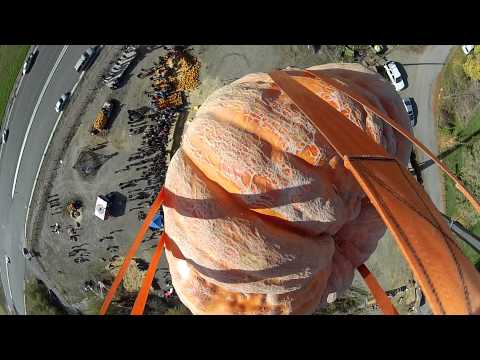
When the giant pumpkin hits the ground, it definitely feels the force of the ground stopping it.
But are there any forces acting on it as it falls, before it makes contact with the edge of the pool?
Ok, so what forces act on the pumpkin while it's in the air?
It may seem a bit strange that gravity can act without touching an object. The force of gravity acts at a distance. Near the surface of a planet, it is ubiquitous, felt by every single object.
Gravity is one of the fundamental forces in the universe. We'll talk more about its nature when we learn about these fundamental forces. But for now, let's focus on gravity as we experience it every day, near a planet's surface. We'll start with one of the most famous observations in the development of physics, made by Galileo way back in the 16th century. Galileo postulated that all objects, regardless of how heavy they are, fall at the same rate. In fact, he supposedly dropped two balls of different masses off the Leaning Tower of Pisa to prove it.
Now, pretend for a moment you haven't heard this idea before, and consider whether it makes sense. Actually, from our everyday experience such a premise seems completely counter-intuitive. Imagine dropping a feather and a hammer together, right where you are.
Which one will hit the ground first?
Of course we expect the hammer to hit first, but the reason has little to do with gravity, and everything to do with air resistance, a form of drag force which we'll also discuss later. This same experiment when carried out in a vacuum will uphold Galileo's postulate. Here's a beautiful demonstration:

By dropping objects off different heights, you can show that a freely falling object has constant acceleration over time (near the surface of a planet).
How do we figure out this acceleration. Well, we can get a rough estimate easily enough from this handy recreation of Galileo's Leaning Tower of Pisa experiment.

What did you get as the average fall time from the two experiments?
The Leaning Tower of Pisa is 56m tall.
Use this fact, and the assumption of constant acceleration to approximate the acceleration due to gravity. Confused? You'll find the relevant formula in the kinematics section. What did you get (rounded to the nearest m/s^2)?
The more precise value for the acceleration due to gravity near the earth's surface is .
Now, given that all objects accelerate at the same rate under gravity, what does that tell us about the force of gravity on different objects.
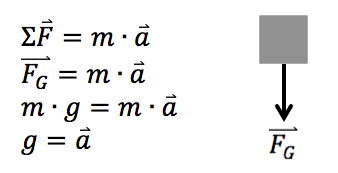
So saying that all objects accelerate at the same rate regardless of mass is equivalent to saying that the force of gravity is proportional to the mass of the object. Specifically, \begin{equation} F=mg \end{equation} where is the acceleration we found above.
The force of gravity on an object is also called its weight. And now we see why weight and mass are so often confused in casual conversation. So long as we stay on earth, they're directly related to each other with the proportionality constant .
And now for one final question. The force of gravity on the surface of the moon is about that of earth.
If a man of average height (180cm) were to drop something on the moon, how long would it take to hit the ground?
Check your answer against this demonstration courtesy of the Apollo 15 mission:

How many seconds would the drop have taken if it happened anywhere on earth? (Round to the nearest tenth.)
So now you know where to direct any remaining conspiracy theorists that think the moon landing was faked...